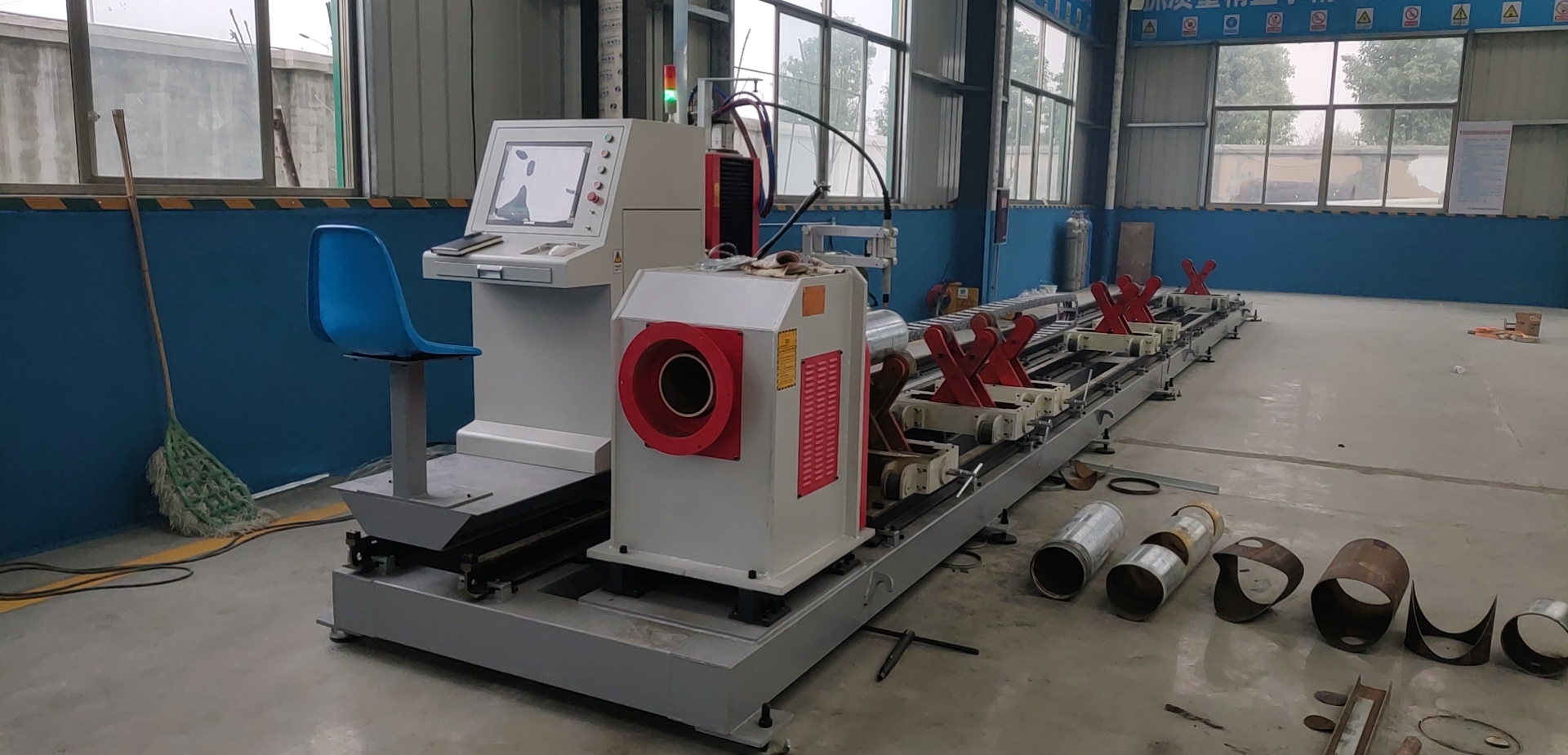
Shop-Floor Realities: Beveled Tube Fabrication for Rolling Stock Interiors
Railway passenger seat frames are not a cosmetic product. They are structural weldments that must survive EN 12663-1 static and fatigue load cases, repeated 1.5g emergency braking events, and 25-year service cycles with minimal maintenance intervention. The dominant geometry is thin-to-medium wall tube: 6061-T6 and 6082-T6 aluminum for weight-critical high-speed applications, SUS304 and SUS316L for fire-rated and corrosion-exposed zones, and S355JR or Q345B for lower-cost commuter rolling stock. Every one of these frames terminates in a mitered or beveled joint that must close within 0.5 mm gap tolerance before robotic MIG or TIG welding. That is where the process chain historically breaks down, and that is the exact problem a CNC tube beveling laser cutter for railway passenger seat frames is engineered to solve.
The Failure Modes of Legacy Beveling on Seat Frame Tube
Conventional plasma cutting on 2.0 mm SUS304 tube produces a heat-affected zone of 0.8 to 1.4 mm with dross adhesion on the lower kerf edge. The operator then spends 40 to 90 seconds per joint grinding the bevel face flat. That grinding introduces two problems: dimensional drift (the bevel angle wanders ±2.5° from nominal) and cold-work hardening at the weld prep surface. Mechanical sawing with carbide blades avoids thermal damage but cannot produce compound bevels (variable-angle saddle cuts) without secondary fixturing, and blade wander on 1.5 mm wall aluminum tube routinely exceeds 0.3 mm eccentricity.
The downstream cost is measurable. A 32-seat commuter car contains roughly 96 to 128 welded tube joints. At a 12 percent rework rate driven by bevel mismatch, a single car shell loses 6 to 9 hours of welding bay time. Multiply that across a 200-car order and the schedule slip becomes a contractual liability.
Comparative Technical Data: Legacy vs. Fiber Laser Beveling
| Parameter | Plasma + Grinding | Mechanical Saw + Deburr | CNC Fiber Laser Beveling |
|---|---|---|---|
| Bevel angle accuracy | ±2.5° | ±1.0° | ±0.15° |
| Cut edge roughness (Ra) | 25–40 µm | 12–20 µm | 3.2–6.3 µm |
| HAZ width (SUS304, 2 mm) | 0.8–1.4 mm | None (cold work instead) | 0.05–0.12 mm |
| Cycle time per joint | 95–140 s | 70–110 s | 18–32 s |
| Consumable cost / 1000 joints | USD 210 (tips, electrodes, discs) | USD 340 (blades, coolant) | USD 45 (protective lens, nozzle) |
| Compound saddle cut capability | Manual only | Not feasible | Full 5-axis interpolation |
| Post-process deburring | Mandatory | Mandatory | Optional (edge quality W) |
Workshop Condition Adaptation: The Real Engineering Problem
Railcar fabrication halls are hostile to precision optics. Ambient temperature swings of 12 to 18 °C between winter morning and summer afternoon are normal in unclimatized bays. Airborne conductive dust from adjacent grinding stations, plus humidity cycling between 35 and 85 percent RH, will destroy an unprotected laser head within weeks. The machine architecture must address this at the design stage, not through aftermarket filtration.
Practical countermeasures deployed on production-grade tube beveling cells include:
- Positive-pressure optical cavity at 0.02 to 0.04 MPa above ambient, fed by a dedicated 0.01 µm particulate filter and desiccant dryer holding dew point below −40 °C.
- Sealed linear guideways with bellows and automatic lubrication at 8-hour intervals, rated IP65 on the X and Y axes.
- Chuck jaw assemblies machined from hardened 20CrMnTi with hard chrome plating, maintaining grip repeatability under 0.03 mm after 50,000 clamping cycles.
- Pneumatic chuck clamping pressure regulated at 0.6 to 0.8 MPa for aluminum tube and 0.9 to 1.1 MPa for stainless, with pressure-loss interlocks that halt the cutting program if the regulator drops below setpoint.
Thermal Expansion Mitigation and Stress-Relieved Bed Stability
A 6-meter tube beveling machine experiences linear thermal growth of roughly 70 µm per meter per 10 °C rise when the bed is mild steel. Over a 6 m working length, that is 0.42 mm of positional drift — enough to push a bevel out of weld tolerance on a compound saddle joint. The standard fix is not to heat the whole hall. It is to decouple the metrology frame from the structural frame.
Production machines for this application typically use a granite or polymer-concrete (reaction-bonded) bed with a coefficient of thermal expansion of 6 to 8 × 10⁻⁶ /K, roughly one-third that of steel. The linear encoders are mounted on Invar 36 tape (CTE 1.2 × 10⁻⁶ /K) bonded directly to the bed, so the feedback loop measures actual tool position rather than motor rotation. Combined with a 30-minute warm-up cycle that runs the servo axes through their full stroke before production, positional repeatability holds at ±0.05 mm across a 15 °C ambient swing.
Stress relief of the bed itself is non-negotiable. Castings are vibratory stress-relieved for 45 to 60 minutes at 30 to 50 Hz, then machined, then re-stressed. Weld-fabricated frames are thermally stress-relieved at 580 to 620 °C with controlled cooling at 50 °C/hour. Skipping this step produces a bed that moves 0.1 to 0.2 mm in the first six months of service as residual stresses redistribute.
Cutting Parameters That Actually Hold Tolerance
For 2.0 mm SUS304 seat frame tube, a 2 kW single-mode fiber source running 1,200 W average at 1,500 Hz pulse frequency, 0.8 ms pulse width, and 100 percent duty cycle through a 1.2 mm nozzle at 1.4 MPa nitrogen produces a clean bevel with Ra under 5 µm. Cutting speed sits at 4.2 m/min on straight sections and drops to 2.1 m/min on the bevel interpolation pass.
For 3.0 mm 6061-T6 aluminum, oxygen assist at 1.2 MPa is used only when a slight oxide edge is acceptable; otherwise nitrogen at 1.5 MPa with a 2.5 kW source at 1,800 W continuous and 6.5 m/min feed. The higher reflectivity of aluminum demands a protective lens with anti-reflective coating rated for 1,070 nm, and the pierce routine must ramp power over 180 ms to avoid back-reflection damage to the QBH connector.
For S355JR structural tube at 4.0 mm wall, oxygen assist at 1.3 MPa with 2,200 W continuous delivers a 0.15 mm kerf with minimal dross, suitable for direct robotic MIG welding without secondary cleaning.
Integration With Downstream Welding Cells
The beveled tube exits the laser cell and enters a robotic welding fixture within 90 seconds. Any dimensional drift between the two stations propagates directly into weld gap variation. The practical solution is to mount the laser cell and the welding fixture on a common stress-relieved base plate, or to use a shared laser tracker reference network updated every 4 hours. Seat frame fabricators running this configuration report weld rework rates dropping from 11 to 14 percent down to 1.5 to 2.8 percent, with corresponding reductions in post-weld straightening labor.
FAQ: Procurement and Specification Questions
What wall thickness range can a CNC tube beveling laser cutter handle for railway seat frame tube?
Production machines in this class typically cover 0.8 mm to 6.0 mm wall thickness on round, square, and rectangular tube up to 220 mm diagonal. For SUS304 and S355JR, 4.0 mm is the practical upper limit at full bevel angle without speed penalties. Aluminum 6061-T6 cuts cleanly to 5.0 mm with nitrogen assist.
How is thermal drift controlled in an unclimatized railcar fabrication hall?
Three mechanisms work together: a low-CTE bed material (granite or polymer concrete), linear encoders mounted on Invar tape rather than the drive motor, and a mandatory 30-minute axis warm-up cycle before production. This combination holds ±0.05 mm positional repeatability across a 15 °C ambient swing.
What gas delivery pressure and purity is required for stainless and aluminum seat frame tube?
Nitrogen assist at 1.2 to 1.5 MPa with 99.999 percent purity for both SUS304 and 6061-T6. Oxygen assist at 1.2 to 1.3 MPa with 99.95 percent purity is acceptable for S355JR when a slight oxide edge does not interfere with downstream MIG welding.













