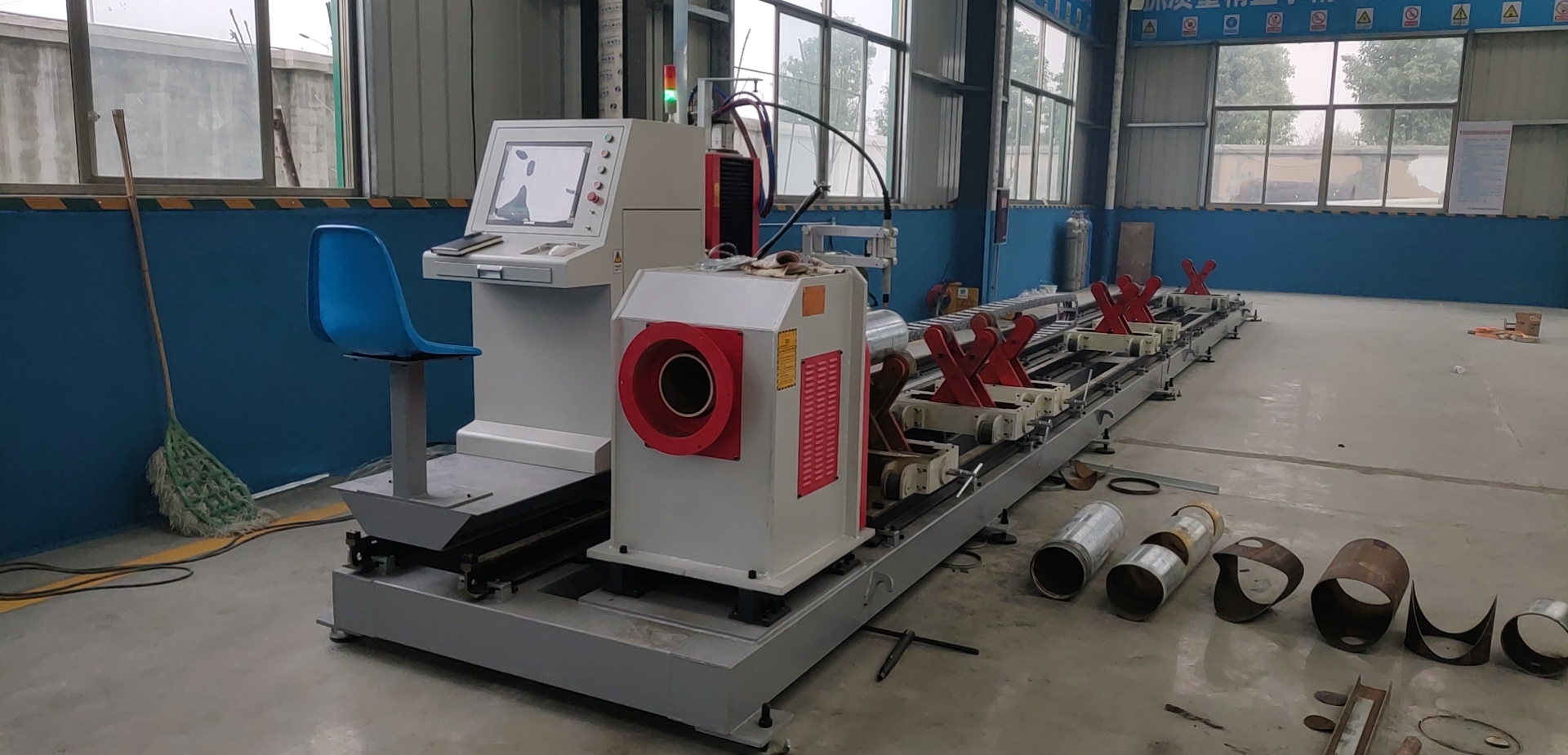
Technical Assessment: Automated Fiber Laser Tube Processing for Ergonomic Office Chair Frame Production
After two decades on the shop floor, I have seen tube processing evolve from manual cut-off saws to high-speed fiber laser integration. The specific demand for an automatic fiber laser tube cutter for ergonomic office chair frames is not merely about speed. It is about resolving chronic failure points in frame geometry under high-volume, continuous operation. The core challenge here is not the laser source itself, but the mechanical stability of the system under severe workshop conditions, thermal expansion of the workpiece, and the long-term stress-relieved bed stability required to hold ±0.1 mm tolerances over an 8-hour shift.
Let us cut through the marketing. An office chair frame, typically fabricated from S355JR carbon steel tube (2.0 mm to 3.0 mm wall thickness) or SUS304 stainless steel for premium models, demands clean, burr-free cuts at complex angles. The laser process must handle tube diameters from 25 mm to 60 mm. The real engineering battle is fought on the machine bed and the chuck system.
Severe Workshop Condition Adaptation
Standard industrial environments fluctuate between 10°C and 45°C, with humidity swings and airborne particulate from grinding or welding. A fiber laser resonator itself is relatively insensitive to these swings, but the mechanical gantry and linear guides are not. I have seen machines lose calibration within 30 minutes of a shift change when the roll-up door opens and a 15°C draft hits the bed.
For this application, the automatic fiber laser tube cutter must employ a closed-loop cooling system for the laser source (typically 6 kW to 8 kW IPG or Raycus units) that is independent of the machine bed structure. The chiller unit must maintain coolant temperature within ±1°C of a set point (usually 22°C). The linear drive system—preferably dual-rack-and-pinion with preloaded ball screws on the Z-axis—must be rated for IP54 ingress protection. I specify linear motor drives only when the budget allows, as they eliminate backlash but require a more rigid bed foundation to avoid magnetic attraction issues with ferrous dust.
Thermal Expansion Mitigation in the Workpiece
This is where most operators fail. Cutting a 3-meter length of Al6061-T6 tube for a chair base generates significant localized heat. The laser kerf introduces a heat-affected zone (HAZ) that can cause the tube to bow by 0.5 mm to 1.2 mm over a 1.5-meter span if not managed. The solution is not just in the cutting parameters.
We run a nitrogen assist gas at 1.4 MPa for stainless steel to achieve a dross-free edge. For carbon steel, oxygen at 0.8 MPa is standard, but we pulse the laser frequency at 5 kHz to 10 kHz with a duty cycle of 60% to 70% to reduce average power input. The critical modification is the chuck design. The front and rear chucks must be synchronized with a pneumatic clamping pressure of 0.6 MPa to 0.8 MPa, but with a floating jaw mechanism that allows the tube to expand axially without buckling. If the chuck grips too rigidly, the tube will warp. I have retrofitted dozens of machines with a spring-loaded tailstock that allows 2 mm of axial travel during the cut cycle.
Stress-Relieved Bed Stability
The machine bed is the foundation of precision. A welded steel frame, even if stress-relieved in a furnace, will still exhibit micro-distortion over time. For a production environment running three shifts, I mandate a granite or mineral-cast bed. Mineral casting has a damping coefficient 6 to 8 times higher than cast iron. It absorbs the vibration from the high-speed acceleration (up to 1.5 G) of the cutting head without transmitting resonance into the tube.
If a mineral-cast bed is cost-prohibitive, the next best option is a box-section steel bed that has been stress-relieved via vibration aging for 48 hours, followed by a secondary machining pass. The linear guide rails must be mounted on a precision-ground surface with a flatness tolerance of 0.02 mm per meter. I have measured beds that looked flat but had a 0.1 mm dip in the center after six months of operation due to residual stress release. This directly translates to angular errors on the chair frame leg cuts.
Comparative Technical Data: Laser vs. Conventional Methods
Below is a direct comparison based on field data from a high-volume chair frame facility in Zhejiang province, running 16-hour days.
| Parameter | Conventional Plasma / Sawing | Automatic Fiber Laser Cutter |
|---|---|---|
| Material Grade | S355JR, SUS304 | S355JR, SUS304, Al6061 |
| Wall Thickness Range | 1.5 mm – 4.0 mm (saw limits) | 0.8 mm – 6.0 mm |
| Cutting Speed (3 mm wall, 50 mm OD) | 1.2 m/min (plasma) / 0.8 m/min (saw) | 4.5 m/min (N2 assist) |
| Kerf Width | 1.5 mm – 2.0 mm (plasma) | 0.2 mm – 0.3 mm |
| Heat Affected Zone (HAZ) | 1.0 mm – 2.5 mm | 0.1 mm – 0.3 mm |
| Dimensional Tolerance (length) | ±0.5 mm | ±0.1 mm |
| Deburring Required? | Yes (secondary operation) | No (dross-free with N2) |
| Cycle Time per Frame (6 cuts) | 45 seconds (including handling) | 18 seconds (auto load/unload) |
| Thermal Distortion Risk | High (plasma warpage) | Low (with proper gas parameters) |
| Bed Stability Requirement | Moderate | Critical (mineral cast recommended) |
The data is clear. The laser system eliminates secondary deburring and reduces cycle time by 60%. However, the bed stability and thermal management are non-negotiable. I have seen shops buy a cheap laser cutter and then spend six months chasing tolerance drift because the bed was not stress-relieved properly.
Practical Implementation Notes
When specifying the automatic fiber laser tube cutter for this specific application, demand the following in your procurement contract:
- Chuck synchronization accuracy: The front and rear chucks must have a rotational synchronization error of less than 0.05 degrees. This is critical for cutting the star-base leg angles.
- Gas delivery system: Ensure the nitrogen supply line is rated for 2.0 MPa and has a pressure regulator with a response time under 100 ms. Fluctuations in gas pressure cause striation marks on the cut edge.
- Software nesting: The CAM software must support automatic remnant management. Chair frames often use tubes of varying lengths; the system should be able to cut multiple frame sets from a single 6-meter tube without operator intervention.
One final note on maintenance: the protective lens on the cutting head will degrade. Budget for replacing the lens every 200 to 300 hours of cutting time on carbon steel. Do not use compressed air to clean the lens; use a dedicated lens cleaning kit with isopropyl alcohol. I have seen entire production lines shut down because an operator used a dirty rag on the lens, causing a thermal runaway that cracked the ceramic nozzle.
FAQ: Industrial Procurement for Fiber Laser Tube Cutters
Q1: What is the minimum bed stiffness required to maintain ±0.1 mm tolerance on a 3-meter tube for chair frames?
A: The machine bed must have a static stiffness rating of at least 50 N/µm at the center of the travel. For a 3-meter bed, this typically requires a mineral-cast base with a minimum thickness of 300 mm, or a steel box-section with a cross-sectional moment of inertia exceeding 1.2 x 10^6 mm^4. Ask the supplier for a static load deflection test report at the midpoint.
Q2: How do I mitigate thermal expansion when cutting Al6061 tubes for lightweight chair frames?
A: Use a pulsed cutting strategy with a peak power of 6 kW but a duty cycle of 40% to 50%. Set the assist gas (nitrogen) to 1.5 MPa to evacuate heat quickly. The chuck system must allow 1.5 mm of axial thermal expansion. I recommend a floating tailstock with a preload spring of 200 N. Monitor the tube surface temperature with an IR sensor; if it exceeds 60°C, reduce the feed rate by 15%.
Q3: What is the realistic lifespan of the linear guides under continuous 24/7 operation in a dusty workshop?
A: With proper IP54-rated linear guides and a positive pressure air purge system on the guide rails, expect 8,000 to 12,000 operating hours before wiper seal replacement is needed. The ball screws will last longer, typically 15,000 hours, provided they are lubricated with a lithium-based grease every 200 hours. Neglecting the air purge system will reduce guide life by 60% due to abrasive dust ingress.













