Tube Geometry Constraints and the Fitness Equipment Manufacturing Bottleneck
The structural frames of commercial-grade treadmills, ellipticals, and plate-loaded strength machines increasingly rely on oval and elliptical tube profiles. These geometries deliver anisotropic stiffness-to-weight ratios that round tube cannot match, particularly in handlebar assemblies and load-bearing uprights. However, the same asymmetric cross-section that improves ergonomics and torsional rigidity creates a nightmare for downstream fabrication. When a Tier-1 fitness OEM sources an oval tube laser cutting machine supplier for fitness equipment, the evaluation criteria must extend far beyond raw wattage. The real cost driver is nesting efficiency, kerf management, and the ability to hold ±0.15 mm on a 60 mm × 30 mm oval profile across a 6-meter bar.
This paper dissects the intersection of advanced nesting algorithms, common-line cutting strategy, and material yield maximization specifically for oval tube processing in the fitness equipment sector. The data below is drawn from shop-floor trials on S355JR, SUS304, and Al6061-T6 stock.
Why Conventional Cutting Fails Oval Profiles
Mechanical sawing of oval tube produces a flat, burr-laden cut that requires secondary milling before any welded joint. Plasma cutting introduces a heat-affected zone (HAZ) of 1.5–3.0 mm on 3 mm wall S355JR, which embrittles the weld toe and forces post-process grinding. Neither method can produce the compound miter cuts and coped saddle joints that modern fitness frames demand without dedicated fixtures per part number.
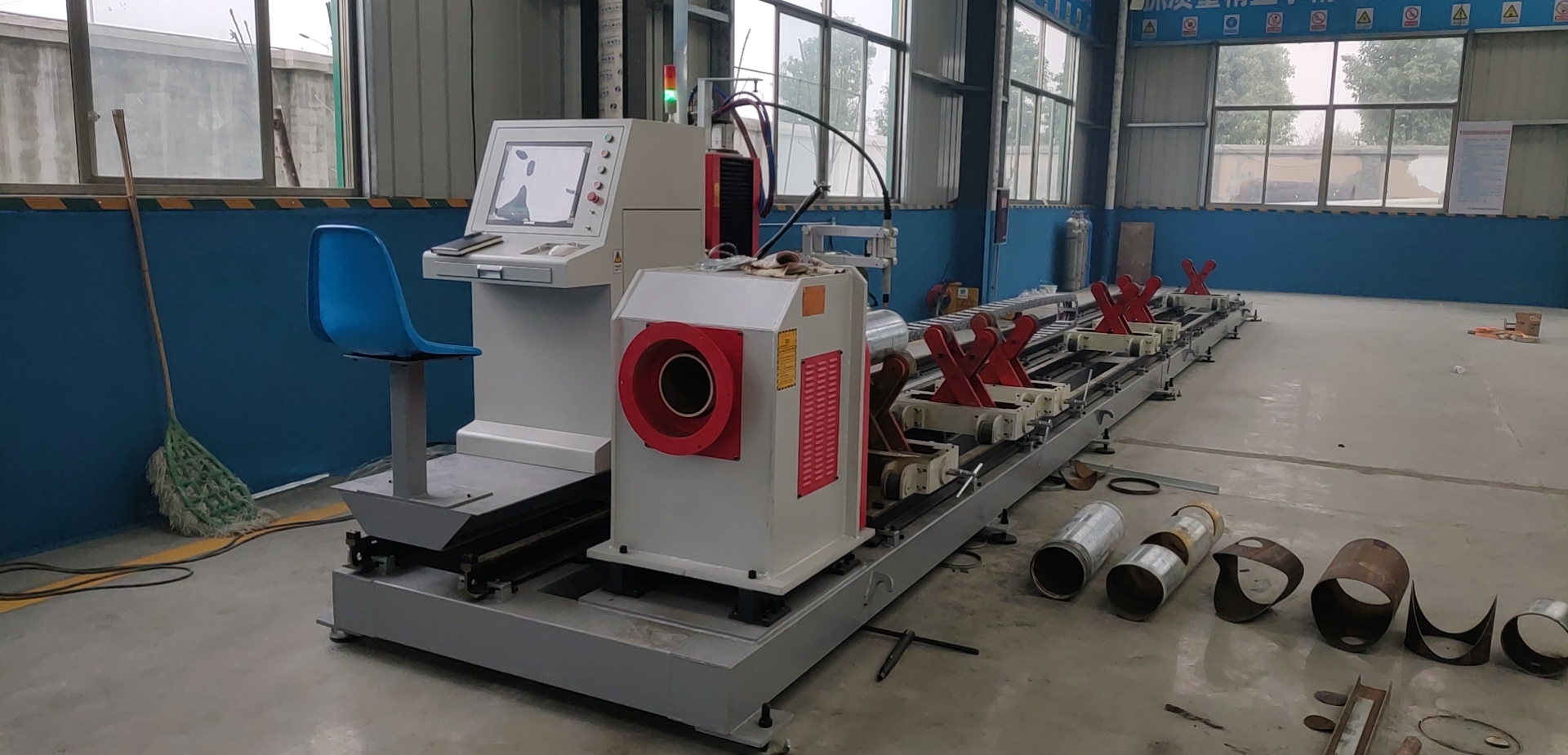
Fiber laser cutting on a 3-chuck or 4-chuck rotary system eliminates fixture proliferation. The critical enabler is the nesting engine. Oval tube cannot be nested like flat sheet because the profile rotates in the chuck; every part orientation is a function of both axial position and angular index.
Comparative Technical Data: Legacy vs. Fiber Laser on Oval Tube
| Parameter | Mechanical Sawing | Plasma Cutting | Fiber Laser (Oval Tube) |
|---|---|---|---|
| Cut tolerance (mm) | ±0.5 | ±0.8 | ±0.10 to ±0.15 |
| HAZ width (mm) | None (mechanical) | 1.5–3.0 | 0.05–0.15 |
| Kerf width (mm) | 2.5–4.0 | 1.2–2.0 | 0.15–0.30 |
| Nesting yield on 6 m bar | 72–78% | 80–84% | 91–96% |
| Cycle time per coped joint (s) | 45–90 (multi-op) | 18–30 | 6–11 |
| Secondary operations | Milling + deburr | Grinding + deburr | Deburr only |
| Applicable alloys | S355JR, Al6061 | S355JR, SUS304 | S355JR, SUS304, Al6061-T6 |
Advanced Nesting Algorithms for Oval Geometry
Modern CAM suites for tube laser use a two-axis nesting model: axial (X) and rotational (B). For oval tube, the algorithm must solve a constrained bin-packing problem where each part carries an angular footprint. A 1.5 kW single-mode fiber source cutting 2 mm SUS304 at 1.2 MPa nitrogen assist produces a kerf of roughly 0.18 mm; the nesting engine must account for this kerf as a hard constraint, not a soft tolerance.
Three algorithmic levers drive yield:
- Angular phase optimization. Parts are rotated in 0.1° increments to find the minimum bounding envelope on the oval’s major/minor axis. On a 60×30 oval, phase-shifting a 200 mm bracket from 0° to 90° can recover 40–60 mm of bar length per nest.
- Common-edge detection. Adjacent parts sharing a straight cut line are merged into a single pass. This is where common-line cutting becomes decisive.
- Remnant recycling. Offcuts longer than 180 mm are re-injected into the job queue as raw stock for short parts, pushing yield from 88% to 94% on typical fitness frame runs.
Common-Line Cutting Strategy: Physics and Payback
Common-line cutting eliminates the kerf between two adjacent parts by cutting a single shared edge. On oval tube, this is only viable when both parts share the same angular index and the cut line is parallel to the tube axis. The savings are geometric, not incremental.
Consider a 6 m bar of S355JR, 3 mm wall, 60×30 oval. A conventional nest of 24 identical 240 mm brackets consumes 24 × 240 mm plus 23 kerfs of 0.20 mm = 5,764.6 mm, leaving 235.4 mm of scrap. A common-line nest merges 12 pairs, eliminating 12 kerfs and recovering 2.4 mm — negligible on its own. The real gain comes from re-orienting the parts to share the oval’s flat faces, which allows the nest to pack 26 parts into the same 6 m, a 8.3% yield jump.
Cutting parameters for common-line on SUS304, 2 mm wall: 1.5 kW single-mode, 100% duty cycle, 1.2 MPa N₂, frequency 1,200 Hz, cutting speed 18 m/min. The shared edge must be cut at reduced power (70–80%) to prevent dross adhesion on the second part’s face. Chuck pneumatic pressure holds at 0.6–0.8 MPa on the clamping jaws; below 0.5 MPa, oval tube slips during the B-axis index and the common edge drifts by 0.3 mm, scrapping both parts.
Material Yield Maximization: Shop-Floor Levers
Yield is not a software-only metric. It is a system property. Three field-verified levers:
- Bar-end utilization. The last 150 mm of a bar is often discarded because the chuck cannot grip it. A servo-driven rear chuck with 0.4 MPa minimum grip extends usable length to within 80 mm of the bar end, recovering 1.2% yield on every bar.
- Nesting across part families. Mixing 240 mm brackets with 180 mm gussets in a single nest, sorted by angular index, raises average yield from 91% to 95.5% on Al6061-T6 runs.
- Kerf compensation tables. Laser kerf varies with alloy and thickness. A calibrated table for S355JR (0.20 mm at 3 mm), SUS304 (0.18 mm at 2 mm), and Al6061-T6 (0.22 mm at 3 mm) prevents cumulative drift across a 40-part nest.
Supplier Qualification Criteria
When vetting a tube laser supplier for fitness equipment, demand three data sets: a nesting yield report on your actual part mix, a common-line feasibility study on your oval profiles, and a chuck pressure log across a 500-cycle run. Suppliers who cannot produce these are selling hardware, not process capability.
FAQ: Industrial B2B Procurement
What nesting yield should I expect from an oval tube laser on fitness frame parts?
On a mixed part family of brackets, gussets, and uprights in S355JR or SUS304, expect 91–96% yield with common-line cutting enabled and remnant recycling active. Yields below 88% indicate the nesting engine is not optimizing angular phase or is ignoring bar-end recovery.
Can common-line cutting be applied to SUS304 oval tube without dross?
Yes, provided the shared edge is cut at 70–80% of nominal power with 1.2 MPa nitrogen assist and the chuck holds at 0.6–0.8 MPa. Full-power common-line cuts on 2 mm SUS304 produce dross on the second part’s face and require secondary grinding.
What chuck pneumatic pressure is required for stable oval tube indexing?
Maintain 0.6–0.8 MPa on the clamping jaws for oval profiles up to 80 mm major axis. Below 0.5 MPa, angular slip during B-axis indexing exceeds 0.3 mm, which breaks common-edge alignment and scraps both adjacent parts.













