Heavy Profile Laser Processing for Agricultural Machinery Frames: Compliance-Driven Engineering Under EN 1090
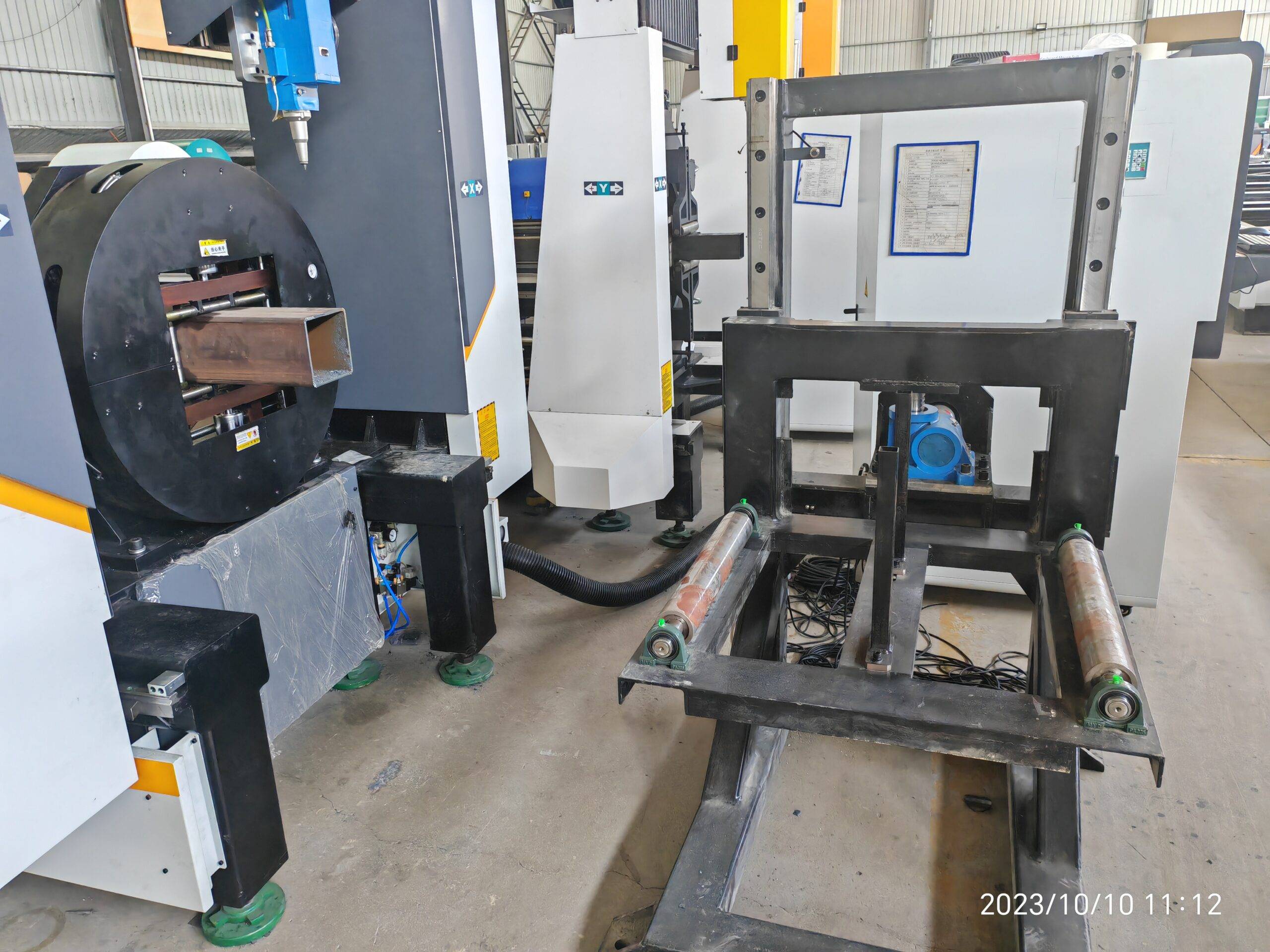
Agricultural machinery frames live in a brutal mechanical environment. A 12-meter seed drill boom, a combine harvester chassis rail, or a telehandler main frame absorbs torsional loads, cyclic fatigue from field vibration, and impact shock from rock strikes. When these structures are fabricated from heavy-wall square tube, rectangular hollow section, or I-beam profiles in S355JR, S420MC, or SUS304 stainless, the cut quality of the tube end directly determines weld integrity, dimensional stack-up, and ultimately the certification status of the finished machine. This is where heavy profile laser processing for agricultural machinery frames has shifted from a productivity upgrade to a compliance necessity, particularly for OEMs exporting into EU and UK markets where EN 1090-2 execution class EXC2 and EXC3 govern structural steel fabrication.
The Physics of Cutting Thick-Wall Tube: Why Process Window Matters
Heavy profile tube for ag frames typically runs 6 mm to 16 mm wall thickness in carbon steel, with occasional 20 mm flanges on hitch assemblies. A fiber laser at 6 kW to 12 kW output does not simply “burn through” this material. The controlling variables are focal spot diameter, Rayleigh length, assist gas dynamics, and duty cycle stability under thermal load.
For S355JR at 12 mm wall, a typical production window uses a 1.2 mm nozzle orifice, nitrogen assist at 1.2 to 1.5 MPa, focal position set 1.5 mm below the top surface, and a cutting speed of 1.8 to 2.2 m/min. Switch to oxygen assist for thicker sections above 16 mm and the chemistry changes: oxygen at 0.05 to 0.08 MPa with a slower 0.9 to 1.2 m/min feed produces an exothermic reaction that improves edge squareness but introduces a heat-affected zone of 0.15 to 0.30 mm. That HAZ matters under EN 1090 because it alters the local microstructure and can affect Charpy impact values at -20°C for EXC3 applications.
For SUS304 stainless frames used in fertilizer spreaders and slurry tankers, nitrogen purity must sit at 99.999% with delivery pressure held at 1.4 to 1.6 MPa. Any oxygen contamination above 15 ppm in the assist stream produces dross adhesion on the bottom edge and discoloration that fails downstream weld inspection.
Chuck Dynamics and Profile Handling
Heavy tube is not light gauge. A 250 x 250 x 12 mm square section in S355JR weighs approximately 89 kg per meter. A 9-meter stick weighs over 800 kg. The pneumatic chuck clamping pressure on a tube laser must be tuned to prevent wall deformation while maintaining rotational grip. Typical values run 0.6 to 0.9 MPa on the clamping jaws, with independent pressure regulation on the front and rear chucks to accommodate wall thickness variation in mill-certified stock.
Rolling-axis acceleration must be limited to prevent inertial slip. On a 400 mm diameter chuck handling a 900 kg tube, angular acceleration above 1.2 rad/s² causes jaw marking and micro-slippage that destroys cut perpendicularity. Field engineers typically dial this back to 0.8 rad/s² for heavy profiles, accepting a 15% cycle time penalty in exchange for edge quality that holds ±0.1 mm perpendicularity across the wall.
Comparative Process Analysis: Legacy Methods vs. Heavy Profile Laser
The following table reflects production data collected across agricultural frame fabrication cells running mixed batch sizes from 5 to 200 pieces.
| Parameter | Plasma Cutting (Manual/CNC) | Mechanical Sawing + Drilling | Fiber Laser Heavy Profile |
|—|—|—|—|
| Achievable edge tolerance | ±0.8 to ±1.5 mm | ±0.3 mm (saw), ±0.5 mm (drill) | ±0.1 mm |
| HAZ depth on S355JR 12 mm | 0.8 to 1.5 mm | None | 0.15 to 0.30 mm (O₂), negligible (N₂) |
| Perpendicularity deviation | 1.5 to 3.0 mm over 250 mm | 0.2 mm | 0.1 mm |
| Setup time per profile change | 15 to 45 min | 20 to 60 min | 3 to 8 min |
| Consumable cost per meter | $0.40 to $0.90 (electrodes, tips) | $0.25 to $0.60 (blades) | $0.15 to $0.35 (nozzles, gas) |
| Weld prep capability | Requires grinding | Requires separate bevel operation | In-process bevel and land cutting |
| EN 1090 traceability | Manual records | Manual records | Digital log, per-part serialization |
| Typical cycle time, 250 mm square tube, 12 mm wall, one end | 90 to 150 sec | 180 to 300 sec | 35 to 55 sec |
The data shows why plasma and sawing lines are being displaced in frame shops pursuing EXC2 certification. The laser’s ability to cut a weld-prep bevel, a fish-mouth saddle, and a bolt hole pattern in a single pass eliminates three separate operations and removes the dimensional drift that accumulates across them.
EN 1090 Compliance: What the Laser Actually Delivers
EN 1090-2 does not regulate the cutting machine. It regulates the fabricated component. But the cutting process feeds directly into three compliance checkpoints:
- Dimensional tolerance (EN 1090-2, Annex D): Essential tolerances for welded assemblies require fit-up gaps under 2 mm for partial penetration and under 1 mm for full penetration. Laser-cut edges at ±0.1 mm make this achievable without shimming or rework.
- Weldability and HAZ control: The narrow HAZ from nitrogen-assisted laser cutting on S355JR keeps the base metal outside the 0.30 mm zone in the unaffected parent material, preserving the mill certificate’s mechanical properties. Plasma cutting at 1.5 mm HAZ can push the local hardness above 350 HV, creating a hard zone that promotes hydrogen cracking in thick sections.
- Traceability (EN 10204 3.1): Modern tube lasers log every cut with timestamp, program ID, material heat number, and operator ID. This digital record integrates with MES systems and satisfies the documentation requirements for EXC2 and EXC3 factory production control.
Certification Readiness Beyond EN 1090
Agricultural machinery exported to North America falls under ANSI/ASABE S354 and OSHA 1928. The structural welding code AWS D1.1 governs the frame welds. Laser-cut edges with minimal HAZ reduce preheat requirements and lower the risk of lamellar tearing in thick flanges. For ISO 3834-2 welding quality management, the dimensional consistency of laser-cut joints simplifies the welder qualification and procedure qualification record (PQR) process because the joint geometry is repeatable within tight tolerances.
Shops pursuing ISO 9001 and IATF 16949 for ag equipment supply chains also benefit from the statistical process control data that a tube laser generates. CpK values on hole position and cut length typically exceed 1.67 on a properly maintained machine, which is well above the 1.33 threshold most OEMs require.
Machine Configuration for Heavy Ag Frames
Not every tube laser is built for this work. Key specification points for agricultural frame production:
- Chuck bore diameter: minimum 350 mm to handle 300 mm square and 350 mm round profiles
- Wall thickness capacity: 20 mm carbon steel, 12 mm stainless, 10 mm aluminum (Al6061-T6 requires nitrogen at 1.5 MPa and reduced duty cycle to prevent thermal distortion)
- Loading system: automatic bundle loader rated for 1,500 kg per stick, with profile recognition to prevent misloads
- Duty cycle: 80% at full power to sustain production across 8-hour shifts without thermal drift in the resonator
- Control: 3D CAD/CAM with collision simulation for complex saddle cuts on round-to-square transitions
The duty cycle point deserves emphasis. A machine rated at 6 kW peak but only 40% duty cycle will thermal-throttle during a run of 200 frame rails. The resonator output drops, cutting speed falls, and the operator compensates by increasing gas pressure, which degrades edge quality. Specifying 80% duty cycle at rated power is non-negotiable for heavy agricultural work.
Procurement FAQ
What wall thickness can a fiber laser reliably cut in S355JR for agricultural frames?
Production-grade cutting with acceptable edge quality and minimal dross runs to 20 mm in carbon steel using oxygen assist at 0.05 to 0.08 MPa. Above 20 mm, cutting speed drops below 0.8 m/min and the HAZ widens, which complicates EN 1090 EXC3 compliance. For 16 mm and below, nitrogen assist at 1.2 to 1.5 MPa delivers the cleanest edge and narrowest HAZ.
Does laser cutting affect the material certification of the steel tube?
The mill certificate for S355JR or SUS304 remains valid because the laser does not change the chemical composition of the base metal. The narrow HAZ, typically 0.15 to 0.30 mm with nitrogen assist, stays within the tolerance of EN 1090-2 for weldability. However, the fabricator must document the cutting parameters and demonstrate that the HAZ does not exceed the limits specified in the welding procedure qualification.
What pneumatic chuck pressure is required for heavy square tube without deformation?
For 250 x 250 x 12 mm S355JR tube, clamping pressure typically runs 0.6 to 0.9 MPa. The exact value depends on wall thickness and tube size. Thinner walls require lower pressure to avoid crushing, while thicker walls need higher pressure to prevent slip during high-torque rotation. Most machines allow independent front and rear chuck pressure regulation, which is essential when cutting profiles with varying wall thickness.













