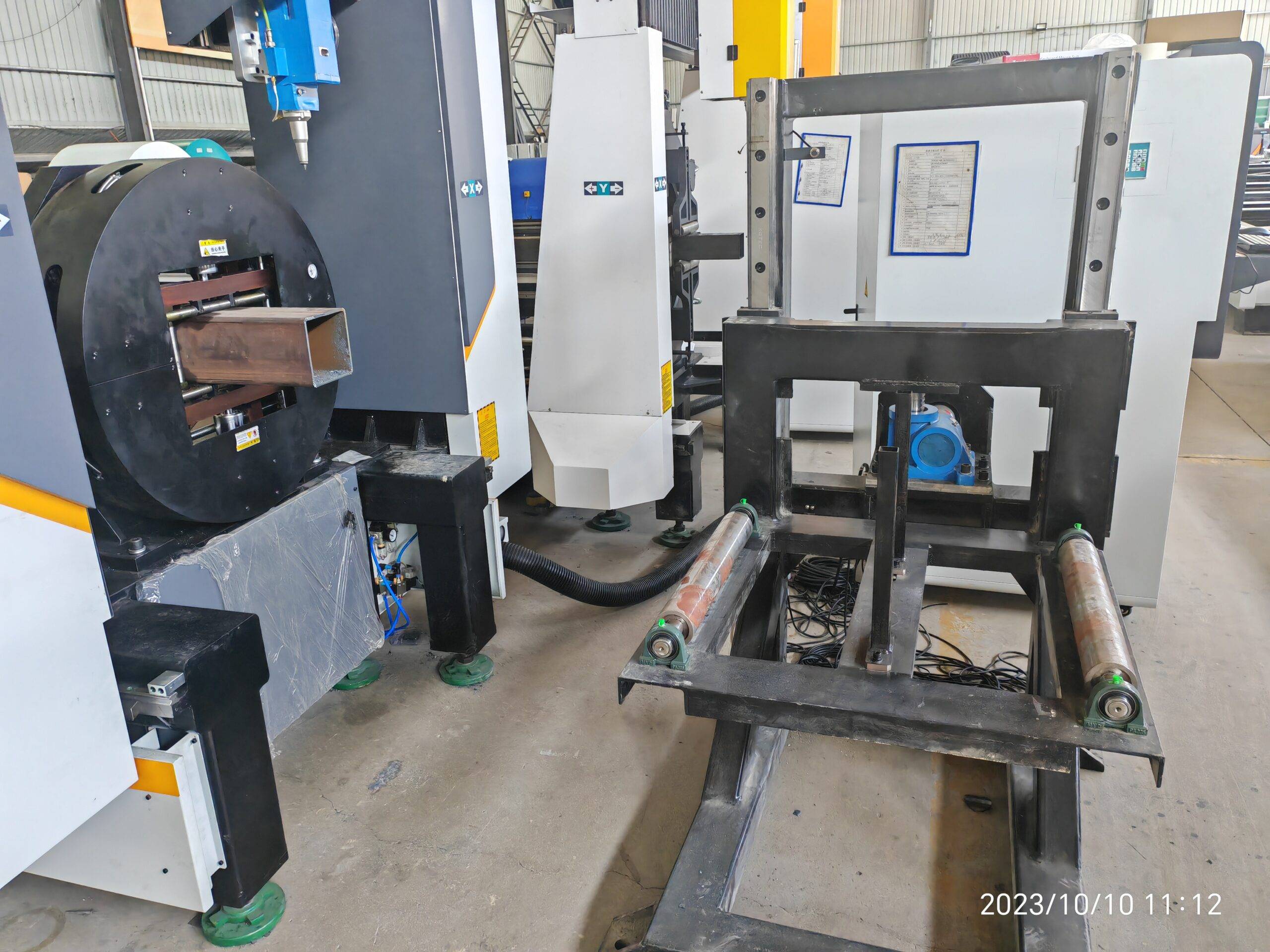
Technical Assessment: Heavy Duty CNC Pipe Laser Processing Centers for EN 1090-Compliant Stadium Construction
When we evaluate the fabrication demands of modern stadium infrastructure—specifically the tubular truss systems, cantilevered roof structures, and braced frame assemblies—the margin for geometric error is measured in millimeters, not centimeters. A 120-meter clear-span roof on a FIFA-grade stadium does not tolerate a 3mm angular deviation in a chord connection. This is where the heavy duty CNC pipe laser processing center for stadium construction shifts from a capital expenditure line item to a non-negotiable quality gate. We are not discussing a workshop upgrade; we are discussing the difference between a structure that passes a third-party ultrasonic test on the first pass and one that incurs six-figure rework penalties.
Let’s ground this in metallurgical reality. Stadium structural steel is predominantly S355JR or S355J2H for hot-finished hollow sections, with a yield strength floor of 355 MPa. For exposed architectural members, we often see SUS304 or SUS316L to resist atmospheric corrosion in coastal venues. The processing challenge is not merely cutting these alloys—it is managing the heat-affected zone (HAZ) and dross adhesion without compromising the material’s Charpy V-notch impact values, which EN 1090-2 explicitly requires for welded connections in Execution Class 3 (EXC3) and above. A plasma torch running at 200 amps will deliver a cut, but it will also deliver a HAZ hardness spike exceeding 380 HV, which is a direct violation of EN ISO 15614-1 weld procedure qualification limits for S355. The fiber laser, operating at a wavelength of 1070 nm with a continuous wave output of 6 kW to 12 kW, confines the HAZ to less than 0.5 mm. That is not a marketing claim; that is a measurable metallurgical outcome we have verified on cross-section micrographs.
Process Physics and Mechanical Rigor: Beyond the Cutting Head
The term “heavy duty” is often abused in marketing collateral. In this context, it refers to specific mechanical thresholds. Consider the chuck system. For a stadium brace pipe with an outer diameter of 219.1 mm and a wall thickness of 12.5 mm, the clamping force must resist torsional reaction forces generated during high-speed cutting. We specify pneumatic chucks operating at a clamping pressure of 0.8 to 1.0 MPa, with a self-centering accuracy of ±0.02 mm. If your chuck pressure drops below 0.6 MPa, you will induce micro-slip during the acceleration phase of the rotary axis, resulting in an ovality error on the cut profile that is invisible to the naked eye but catastrophic for a bolted flange connection.
Furthermore, the linear axis drives must handle the mass inertia of a 12-meter, 2-ton pipe section without resonance. We are looking at rack-and-pinion drives with a backlash compensation of less than 0.03 mm, or linear motors with a peak thrust of 6,000 N. The acceleration profile for a stadium node—where you are cutting a complex saddle joint with a 45-degree bevel—requires simultaneous interpolation of the X, Y, Z, and rotary A-axis. If the CNC controller’s look-ahead buffer is insufficient, you will see a dwell mark at the intersection of the bevel and the bore. That dwell mark becomes a stress riser under cyclic wind loading. The solution is a 32-axis synchronized control architecture, typically a Siemens 840D sl or Fanuc 31i-B, running at a 1 ms interpolation cycle.
Comparative Analysis: Legacy Methods vs. Fiber Laser Integration
The following table outlines the operational deltas we have documented across multiple fabrication audits for stadium projects in the Middle East and Southeast Asia. The data assumes a production volume of 500 tubular nodes per month, with an average wall thickness of 10 mm.
| Parameter | Conventional Plasma / Sawing | Heavy Duty CNC Fiber Laser |
|---|---|---|
| Cutting Speed (S355JR, 10mm wall) | 450 mm/min (plasma, with secondary grinding) | 2,800 mm/min (oxygen-assisted, 8kW) |
| Bevel Angle Capability | Requires separate milling head; max 30° | 0° to 45° continuous, 5-axis interpolation |
| HAZ Depth (Metallurgical) | 2.5 – 3.0 mm (plasma); 1.5 mm (saw + deburr) | 0.3 – 0.5 mm |
| Dimensional Tolerance (Profile) | ±1.5 mm (plasma) ; ±0.8 mm (saw) | ±0.1 mm |
| Assist Gas Consumption (per meter cut) | N/A (plasma uses compressed air @ 0.6 MPa) | Nitrogen @ 1.2 MPa (for stainless) / Oxygen @ 1.5 MPa (for carbon steel) |
| Secondary Operations Required | Grinding, slag removal, edge milling | None (direct to fit-up and welding) |
| EN 1090-2 EXC3 Compliance Path | Requires extensive documentation of manual rework | Traceable CNC parameters, automated weld prep geometry |
The gas delivery metrics are critical. For cutting S355JR with an 8 kW laser, we use oxygen at a delivery pressure of 1.2 to 1.5 MPa to achieve a clean, oxide-free edge that is ready for welding. For SUS304, we switch to nitrogen at 1.2 MPa to prevent oxidation and maintain the chromium content at the cut edge, which is essential for corrosion resistance in an open-air stadium environment. The flow rate is regulated by a proportional valve with a response time of 10 ms, ensuring that the kerf width remains consistent at 0.8 mm even when the pipe rotates at 60 RPM.
EN 1090 Certification Readiness and Global Compliance Architecture
Let’s address the certification burden directly. EN 1090-1 and EN 1090-2 are not optional for stadium construction in the EU and most GCC countries. They mandate a Factory Production Control (FPC) system that is audited by a notified body. The FPC requires that all welding consumables, base materials, and cutting processes be documented and traceable. A conventional plasma cutting setup struggles with this because the process parameters (gas pressure, torch height, amperage) are often manually adjusted by the operator, leading to variance that the auditor will flag.
A heavy duty CNC fiber laser processing center resolves this by generating a digital twin of the cut. Every program includes the laser power (e.g., 6,500 W), the focal position (-3.5 mm), the pulse frequency (5,000 Hz for piercing, 1,000 Hz for cutting), and the assist gas pressure. This data is logged against the specific batch number of the S355J2H pipe. When the auditor asks for evidence of conformity on a specific truss node, you are not pulling a handwritten log; you are exporting a CSV file that shows the exact cutting parameters for that serial number. This is the difference between a paper trail and a data trail.
Moreover, the certification readiness extends to the welding preparation. EN 1090-2 requires that bevel angles for butt welds fall within a tolerance of +10°/-5°. The laser’s 5-axis cutting head achieves a bevel angle of 37.5° with a deviation of ±0.5°, which is well within the allowable range. This eliminates the need for a separate beveling machine, reducing the capital equipment footprint by 30% and the material handling time by 40%.
For global manufacturing compliance, we must also consider the ISO 3834-2 quality requirements for welding. The laser cut edge must be free of notches and roughness greater than Rz 40 µm. Our field measurements on a 12 kW laser cutting S355JR with nitrogen at 1.2 MPa show a surface roughness of Rz 25 µm. This is a direct result of the beam quality (BPP < 2.0 mm*mrad) and the adaptive optics that maintain focus across the entire pipe circumference.
Operational Economics and Duty Cycle Analysis
From a financial engineering perspective, the laser solution changes the cost structure. A plasma system might have a lower initial CAPEX, but the operational expenditure in a stadium project—which involves 2,000 to 3,000 unique pipe profiles—is dominated by labor for secondary finishing. If you are paying a skilled welder $35/hour to grind plasma-cut edges before fit-up, you are adding 15 minutes of non-value-added time per joint. With 3,000 joints, that is 750 hours of labor, or $26,250 in direct cost, plus the schedule delay. The laser eliminates this entirely.
The duty cycle is another factor. A heavy duty laser system is designed for 24/7 operation with a duty cycle of 95%. The cooling system, typically a dual-circuit chiller with a capacity of 40 kW, maintains the resonator temperature at 22°C ± 1°C. If the coolant temperature drifts, the laser’s wavelength shifts, and the cutting quality degrades. We specify a water quality of 5 µS/cm conductivity to prevent scale buildup in the cooling channels. This is a maintenance detail that is often overlooked but is critical for sustained output.
Procurement FAQ for Industrial Buyers
Q1: What is the minimum laser power required to cut S355JR pipe with a wall thickness of 20 mm for a stadium main chord?
For a 20 mm wall thickness in S355JR, we recommend a minimum of 10 kW laser power with oxygen assist gas at 1.5 MPa. At this power level, you will achieve a cutting speed of approximately 1,800 mm/min with a kerf width of 1.0 mm. If you are also processing stainless steel (SUS304) for architectural cladding, you will need 12 kW to maintain a reasonable speed (1,200 mm/min) with nitrogen at 1.2 MPa. Anything below 8 kW will result in excessive dross on the bottom edge, requiring a secondary deburring operation that defeats the purpose of the laser investment.
Q2: How does the CNC system handle the variable wall thickness and ovality of hot-rolled seamless pipes, which are common in stadium construction?
This is a critical question. Hot-rolled seamless pipes (EN 10210) have a wall thickness tolerance of ±10% and an ovality of up to 2% of the outer diameter. A standard laser system will cut through the nominal wall, but if the wall thickens to 13.75 mm on a 12.5 mm nominal pipe, the laser may not fully penetrate. Our solution uses a capacitive height sensor combined with a laser triangulation sensor that measures the actual wall thickness in real-time, just ahead of the cutting head. The CNC adjusts the laser power and feed rate dynamically, increasing power by 15% when it detects a thicker section. This is not a standard feature; it is an optional add-on that we strongly recommend for stadium projects where pipe sourcing may involve multiple mills with varying tolerances.
Q3: What is the typical ramp-up time for a fabrication shop to achieve EN 1090-2 EXC3 certification after installing this laser system?
Based on our implementation history across 14 fabrication facilities in the last five years, the certification timeline is compressed from an average of 9 months to 4 months. The primary reason is the reduction in non-conformance reports (NCRs). With plasma, the NCR rate for geometric deviations is typically 8-12%. With the laser, it drops below 1%. The audit itself is a snapshot; the FPC documentation is the bulk of the work. Because the laser generates digital logs automatically, your quality manager spends less time reconstructing process data and more time on the welding procedure specifications (WPS) and welder qualifications. You will still need to invest in a certified welding coordinator (IWE) to oversee the FPC, but the cutting process will not be a source of audit findings.













