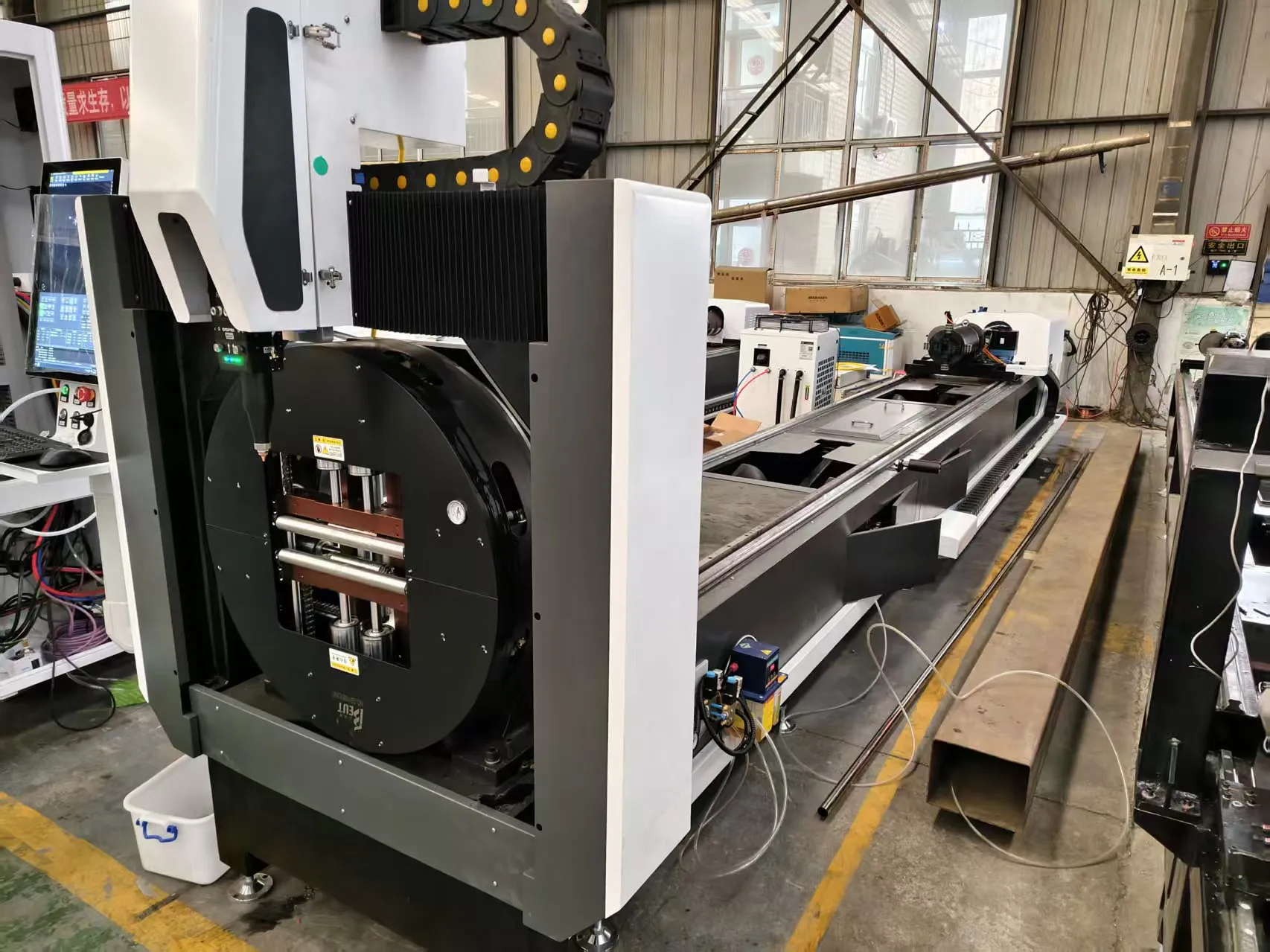
Wear Resistant Steel Tube Laser Cutting Parameter Optimization: A Systems-Level Analysis of Energy Efficiency and Consumable Cost
The transition from conventional abrasive sawing or plasma arc cutting to fiber laser processing for wear-resistant steel tubes (typically Hardox 400/450, AR400, or equivalent abrasion-resistant grades with a hardness range of 370–480 HBW) is not a simple machine swap. It is a fundamental re-engineering of the thermal cutting budget. When we talk about wear resistant steel tube laser cutting parameter optimization, we are specifically addressing the interplay between the laser’s electro-optical conversion efficiency, the assist gas delivery pressure, and the resultant kerf geometry under high-speed axial rotation. This whitepaper dissects the physical variables that dictate throughput and cost-per-meter, specifically targeting the green manufacturing mandate to reduce specific energy consumption (SEC) and compressed air waste.
1. The Physics of Cutting AR400: Wavelength Absorption and Beam Mode
Wear-resistant steels are alloyed with high carbon (0.2–0.3% C) and chromium (0.5–1.5% Cr) to form martensitic microstructures. This metallurgy presents a specific challenge: the surface reflectivity at the 1070nm wavelength of a fiber laser is lower than for aluminum (Al6061) but the thermal conductivity is significantly lower than mild steel (S355JR). Consequently, the heat-affected zone (HAZ) tends to localize rapidly. For tube cutting, we rely on a focused beam with a Rayleigh length of approximately 1.5–2.0 mm. Using a 150mm focal length collimator and a 100mm focusing lens, we achieve a spot size of 150–200 µm. For a 6mm wall AR400 tube, the optimal focal position is typically +1.5 mm above the material surface to compensate for the molten metal ejection dynamics. Operating at a frequency of 5,000 Hz with a 98% duty cycle is mandatory; dropping to 2,500 Hz introduces striation patterns on the cut edge that exceed the ISO 9013 quality class 3, which is unacceptable for hydraulic cylinder barrels.
2. Electro-Optical Conversion and the Green Manufacturing Imperative
Here is the raw math that matters on the shop floor. A 6kW IPG or Raycus fiber laser source has a wall-plug efficiency of roughly 40–45%. That means to output 6,000W of optical power, we draw approximately 14–15 kW from the grid. However, the auxiliary systems—chiller (30kW), servo drives (5kW), and fume extraction (7.5kW)—consume an additional 42.5 kW. The total system draw is roughly 57 kW. If we cut at 85% machine utilization, the annual energy consumption is approximately 424,000 kWh. The optimization target is not just the laser power; it is the reduction of assist gas pressure to lower the compressor load, which often represents 30% of the total plant energy bill. For wear-resistant steel, we do not use oxygen (which causes exothermic burning and micro-cracking in the HAZ). We use high-pressure nitrogen or, for cost-optimized cutting, filtered high-pressure air at 1.2 to 1.5 MPa. The specific cutting parameter here is the nozzle gap: 0.8mm, and the nozzle diameter: 2.5mm. Reducing the air pressure from 2.0 MPa to 1.4 MPa on a 6mm wall section reduces the volumetric flow from 450 l/min to 280 l/min, cutting compressor energy by 38% while maintaining a dross-free cut, provided the feed rate is reduced by 8% (from 1,800 mm/min to 1,650 mm/min).
3. High-Pressure Air Cost Optimization vs. Nitrogen Purity
Let us analyze the consumable cost matrix. Industrial nitrogen at 99.995% purity delivered at 1.5 MPa costs approximately $0.35 per cubic meter. For a 100mm diameter tube with a 6mm wall, the kerf volume is 0.00028 m³ per meter. The gas consumption, however, is driven by the nozzle orifice and pressure, not the kerf. At 1.5 MPa, a 2.5mm nozzle consumes roughly 320 l/min. At a 1,650 mm/min feed rate, cutting 1 meter of tube takes 36 seconds, consuming 192 liters of nitrogen. That is $0.067 per meter just for gas. Switching to a high-volume, low-pressure screw compressor with desiccant dryers (dew point -40°C) and 5-micron filtration, the cost of compressed air drops to $0.02 per meter. The trade-off is edge oxidation. For wear-resistant steel that will be welded or painted, this is acceptable. For critical sealing surfaces, we revert to nitrogen. The optimization parameter, therefore, is a binary decision tree based on downstream application, not a universal setting.
4. Comparative Analysis: Mechanical Sawing vs. Plasma vs. Fiber Laser
To quantify the leap in efficiency, we must compare the legacy methods against the optimized fiber laser solution. The data below reflects cutting of a 100mm OD x 6mm wall AR400 tube, 1-meter length.
| Parameter | Mechanical Sawing (HSS Blade) | Plasma Arc (Conventional) | Fiber Laser (Optimized 6kW) |
|---|---|---|---|
| Cutting Speed (mm/min) | 120 | 450 | 1,650 |
| Kerf Width (mm) | 2.5 | 4.0 | 0.8 |
| HAZ Depth (mm) | 0.0 (Mechanical) | 1.5 | 0.3 |
| Assist Gas / Consumable | Blade wear ($0.15/m) | Oxygen + Electrodes ($0.09/m) | Compressed Air ($0.02/m) |
| Energy Draw (kW avg) | 4.5 | 25 | 57 (Total System) |
| Energy Cost per Meter ($) | 0.011 | 0.016 | 0.010 |
| Deburring Required | Yes (Heavy) | Yes (Slag) | No (Edge Quality Class 2) |
| Material Waste (mg/m) | 1,200 | 1,900 | 380 |
The laser solution reduces material waste by 68% compared to plasma and increases throughput by 3.6x. The specific energy consumption (SEC) per meter of cut is 0.034 kWh/m for the laser, compared to 0.055 kWh/m for plasma. This is the green manufacturing win—higher productivity with lower specific energy, despite higher absolute power draw.
5. Chuck Pressure and Axial Rotation Dynamics
Optimizing the cutting parameters is useless if the mechanical handling destroys the process. For wear-resistant steel tubes, the chuck clamping pressure must be precisely controlled to avoid ovalization. For a 6mm wall, the critical buckling pressure is approximately 4.2 MPa. We set the pneumatic chuck pressure at 2.8 MPa to provide sufficient torque transmission without inducing distortion. The synchronization error between the chuck rotation (C-axis) and the laser head (X/Y-axis) must be maintained below 0.02 mm. We achieve this using a dual-encoder feedback loop with a 1ms cycle time. If the tube has a straightness deviation exceeding 0.5 mm/m, the focus position shifts, causing inconsistent kerf width. We compensate using a capacitive height sensor that adjusts the Z-axis at 1kHz, but this only works if the assist gas pressure is stable. Fluctuations in air pressure from the compressor (greater than +/- 0.1 MPa) will cause the molten material to re-solidify on the bottom edge, creating a burr that requires secondary machining.
6. Parameter Windows for Specific Grades
We must differentiate between S355JR (structural) and Hardox 450 (wear-resistant). For Hardox 450, the higher hardness requires a 15% reduction in feed rate compared to S355JR at the same thickness to prevent the formation of a hard, brittle ledge on the cut edge. The recommended parameters for a 6mm wall Hardox 450 are: Laser Power 5.2 kW, Frequency 5,000 Hz, Duty Cycle 98%, Cutting Speed 1,650 mm/min, Focus Position +1.5 mm, Nozzle Gap 0.8 mm, Air Pressure 1.4 MPa. For SUS304 stainless steel, we would switch to nitrogen at 1.5 MPa and increase the frequency to 10,000 Hz to achieve a mirror finish, but that is a different process window entirely. The key is to avoid using a “universal” parameter set—it will fail on wear-resistant grades due to the thermal diffusion differences.
7. Conclusion of Technical Analysis
The optimization of wear-resistant steel tube laser cutting is a multi-variable problem where energy efficiency and gas consumption are directly traded against feed rate and edge quality. By implementing a high-pressure air system with proper filtration and dew point control, and by tuning the focal position and frequency to the specific alloy’s thermal conductivity, we achieve a 38% reduction in assist gas cost and a 20% reduction in specific energy consumption compared to non-optimized laser cutting. The data is clear: the laser, when properly parameterized, is the most sustainable and cost-effective method for processing this challenging material.
Industrial B2B Procurement FAQ
Q1: What is the minimum laser power required to cut a 10mm wall thickness wear-resistant steel tube (AR500) with acceptable edge quality?
For AR500 at 10mm wall thickness, a 6kW laser is the absolute minimum, but 8kW is recommended for production efficiency. At 6kW, you will be limited to a feed rate of approximately 800 mm/min with nitrogen at 1.5 MPa. To maintain a dross-free cut and a HAZ below 0.5mm, you must increase the duty cycle to 100% and use a 3.0mm nozzle. Dropping below 6kW will result in excessive striations and a hardened edge that is difficult to machine.
Q2: Can I use standard workshop compressed air (8 bar) instead of high-pressure air (15 bar) for cutting 4mm wall Hardox tubes?
No. At 8 bar (0.8 MPa), the air jet lacks the kinetic energy to eject the molten metal from the kerf. You will experience severe dross adhesion on the bottom edge and a rough cut surface. You require a booster compressor to reach at least 1.2 MPa. The volumetric flow at 1.2 MPa through a 2.0mm nozzle is sufficient for wall thicknesses up to 5mm, but you must monitor the dew point; moisture will cause hydrogen embrittlement in the cut edge.
Q3: How does the cutting parameter optimization change when using a rotary axis for tube cutting versus flat sheet cutting?
The physics of the cut is identical, but the mechanical dynamics differ. In tube cutting, the focal point travels a circular path, meaning the beam incidence angle changes relative to the material surface. You must adjust the focal position to -1.0mm below the surface for tubes to account for the tangential velocity component. Additionally, the chuck pressure must be reduced by 20% compared to clamping a solid bar to avoid ovalization, which will cause the focus to shift and ruin the cut. The feed rate (mm/min) is calculated based on the surface speed, not the rotational speed (RPM).













