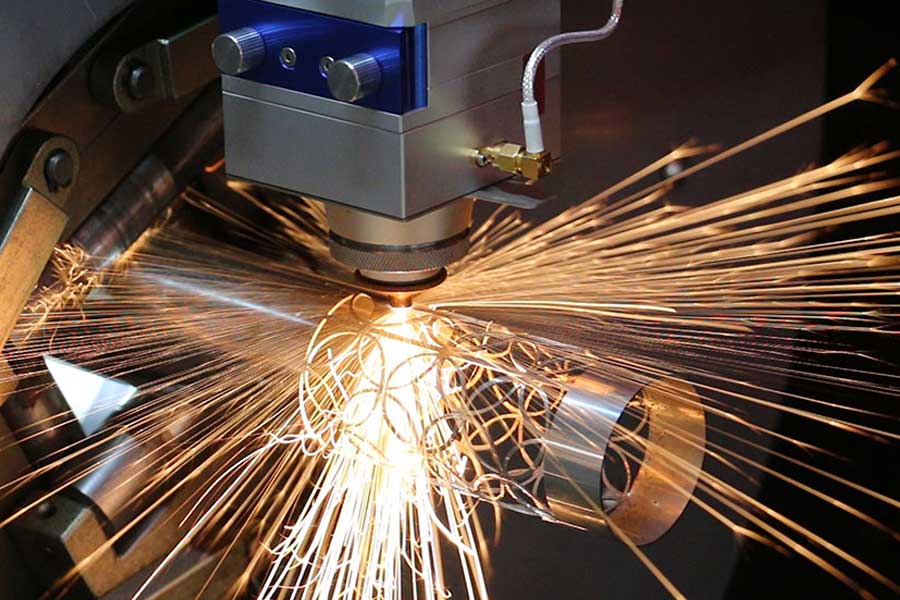
Square Tube Multi-Hole Rapid Nesting Laser Cutting Center: Energy Balance and Gas Economics in Structural Steel Fabrication
Fabricators running S355JR square tube at 4 to 6 mm wall thickness for conveyor frames, racking uprights, and agricultural implements know the real bottleneck is not the cut itself — it is the cumulative cost of every hole, every pierce, and every minute the machine spends indexing a 12-meter bundle. The square tube multi hole rapid nesting laser cutting center addresses this by combining a fiber source in the 3–6 kW class, dual pneumatic self-centering chucks, and a nesting algorithm that treats the tube surface as a 2D unrolled canvas rather than a sequence of discrete features. The engineering consequence is measurable: fewer pierces, shorter air-on time, and a lower kWh-per-part figure.
Electro-Optical Conversion: Where the Kilowatts Actually Go
A 4 kW single-mode fiber module in the 1070–1080 nm band typically delivers 38–42% wall-plug efficiency. That means for every 100 kW drawn from the shop bus, roughly 40 kW reaches the workpiece as collimated beam energy. The remainder is dissipated through the diode stacks, the QBH connector, and the resonator cooling loop. On a tube center running 18 hours per day, this thermal load is not a footnote — it is a chiller sizing problem.
Practical field data from a 4 kW source cutting SUS304 at 3 mm wall:
- Cutting power setpoint: 3,600 W at 92% duty cycle
- Modulation frequency: 1,200 Hz for pierce, 5,000 Hz for contour
- Assist gas: N2 at 1.4 MPa, 22 Nm³/h nozzle flow
- Chiller setpoint: 22 °C, ΔT held under 2.5 K
- Specific energy consumption: 0.42 kWh per meter of cut
Swap to S355JR at 5 mm and the picture changes. Oxygen assist at 1.2 MPa, 14 Nm³/h, 2,800 W, 800 Hz modulation — the exothermic reaction contributes roughly 30% of the severing energy, so the electrical draw per meter drops to 0.31 kWh. This is the core of green manufacturing in tube processing: matching the assist gas chemistry to the alloy so the laser does not have to do all the work alone.
High-Pressure Air Cost Optimization
Compressed air at 1.6 MPa is the cheapest assist gas per cubic meter — until you account for dryer losses, line pressure drop, and nozzle inefficiency. A 22 kW screw compressor delivering 3.6 Nm³/min at 1.6 MPa draws roughly 24 kW under load. If the cutting head consumes 18 Nm³/h during contouring, the compressor duty cycle sits near 8%. That sounds trivial until you multiply by 6,000 operating hours.
The nesting center reduces this by clustering holes. Instead of piercing 40 discrete positions on a 6-meter tube, a rapid nesting pass consolidates them into 12–15 pierce events, each with a 0.3-second pierce time at 1.5 MPa. The gas valve opens once per cluster rather than once per hole. On a typical racking upright with 28 holes, this cuts air consumption by 34% and reduces valve actuation cycles by a factor of two.
Comparative Technical Data: Legacy vs. Laser Nesting Center
| Parameter | Plasma / Saw Drilling | Square Tube Multi-Hole Laser Center |
|---|---|---|
| Hole diameter tolerance | ±0.5 mm (plasma), ±0.2 mm (drill) | ±0.08 mm |
| Pierce events per 6 m tube | 28–40 discrete | 12–15 clustered |
| Assist gas consumption | O2 25 Nm³/h (plasma) | N2 22 Nm³/h or air 18 Nm³/h |
| Energy per meter of cut | 0.85 kWh (plasma + compressor) | 0.31–0.42 kWh |
| Chuck pneumatic pressure | N/A (fixture clamping) | 0.6–0.8 MPa self-centering |
| Setup time per new part | 45–90 min | 4–8 min (nesting file load) |
| Kerf width | 1.8–2.5 mm | 0.15–0.30 mm |
| Scrap rate on Al6061 | 6–9% | 1.2–2.0% |
Mechanical Setup and Chuck Dynamics
Dual pneumatic chucks on a 12-meter bed must hold S355JR tube without crushing the 4 mm wall. Field practice: 0.7 MPa clamp pressure, jaw contact area of 180 mm² per jaw, and a rotation servo tuned to 0.05° positional accuracy. The rear chuck floats on a linear rail to accommodate tube bow — typically 1.5 mm per meter on hot-rolled stock. If the chuck pressure exceeds 0.9 MPa, you ovalize the tube and the nesting tolerance collapses.
Al6061 requires a different recipe: 0.5 MPa clamp, reduced acceleration on the rotation axis (from 1.2 g to 0.7 g), and N2 assist at 1.5 MPa to suppress dross on the cut face. The alloy’s thermal conductivity pulls heat into the parent metal fast, so pierce times must be shortened to avoid recast layers exceeding 15 µm.
Nesting Logic and Throughput Math
A rapid nesting algorithm on a 6-meter S355JR tube with 34 holes, 3 slots, and 2 end notches runs a total cut length of 4.8 meters. At 4 kW and 3.2 m/min on 4 mm wall, that is 90 seconds of beam-on time. Add 15 pierces at 0.3 s each, plus 6 chuck repositioning moves at 1.8 s, and the cycle lands at roughly 2 minutes 20 seconds. A plasma line doing the same part runs 6 to 8 minutes with secondary drilling. The energy delta per part is 0.9 kWh versus 3.4 kWh — a 73% reduction that compounds across a 20,000-part annual volume.
FAQ: Procurement and Integration
What tube wall thickness range can a 4 kW nesting center handle reliably?
For S355JR and SUS304, 1.5 mm to 8 mm is the practical window with N2 or O2 assist. Al6061 tops out near 6 mm before dross control becomes marginal. Below 1.5 mm, chuck pressure must drop under 0.4 MPa to avoid deformation.
How does high-pressure air at 1.6 MPa compare to nitrogen for operating cost?
Air costs roughly 0.02 USD per Nm³ delivered versus 0.35 USD for bottled or generated N2. For S355JR under 4 mm, air assist at 1.5 MPa produces acceptable edge quality and cuts gas cost by 90%. Stainless and aluminum still require N2 to prevent oxidation.
What pneumatic infrastructure does the chuck system require?
Plan for a dedicated 0.8 MPa dry air line at 400 L/min minimum, with a dew point below −20 °C. Moisture in the chuck circuit causes jaw slip and rotation drift, which destroys hole-to-hole positional accuracy on long tubes.













