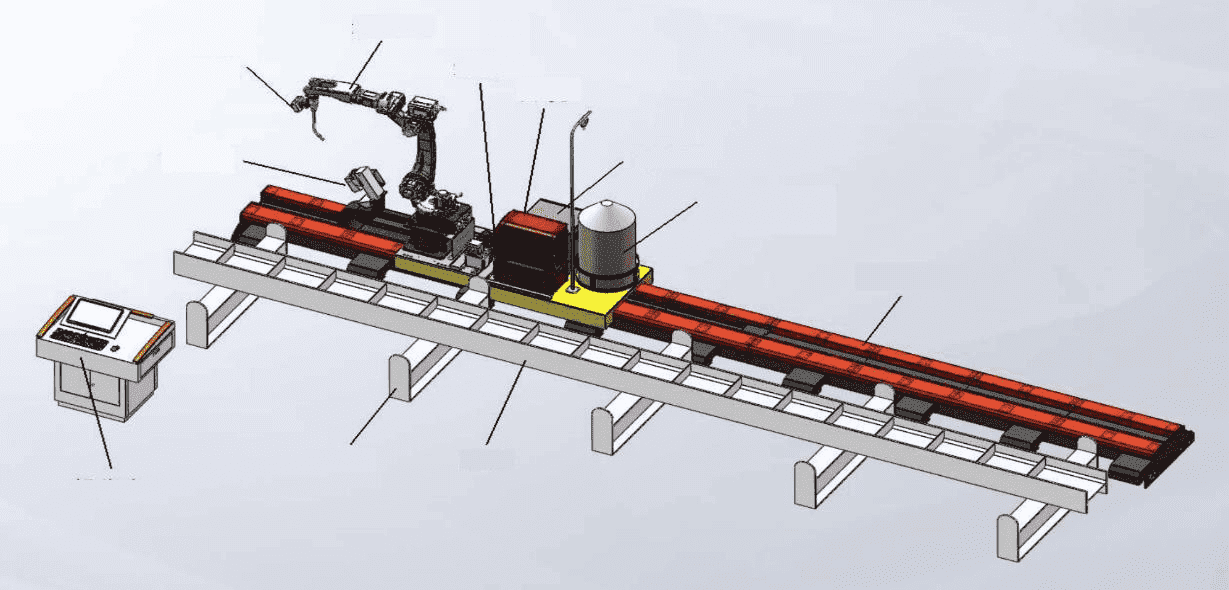
Refrigeration System Distributor Pipe Laser Slotting: Cost-Benefit Analysis, Gas Consumption Metrics, and Amortization Modeling
Distributor pipes in commercial refrigeration manifolds—typically 22 mm to 42 mm OD in AISI 304/304L or copper C12200—require a series of precision radial slots that meter two-phase refrigerant into the evaporator circuits. Slot geometry directly governs refrigerant distribution uniformity; a 0.05 mm deviation in slot width or a 0.3 mm axial misalignment shifts mass flow between branches by 8–14%, degrading evaporator superheat control. For shops evaluating capital deployment, a refrigeration system distributor pipe laser slotting machine must be assessed not on purchase price but on amortized cost per slot, gas overhead, and scrap reduction against legacy processes.
Baseline Process Limitations: Plasma and Mechanical Sawing
Conventional slotting on distributor tubes is dominated by two methods. Manual plasma cutting on 304 stainless produces a heat-affected zone of 0.4–0.9 mm with dross adhesion requiring secondary grinding; slot width tolerance typically lands at ±0.25 mm. Mechanical sawing with carbide slitting blades holds ±0.10 mm but introduces burrs on the internal bore that must be deburred with a rotary tool, and blade consumption runs 1 blade per 180–220 slots on stainless. Both processes struggle with the 0.8–1.5 mm slot widths and 6–12 mm axial pitch that modern CO2 and hydrocarbon cascade systems demand.
Laser Slotting Process Parameters
A fiber laser slotting platform for this application typically runs a 1.5–3 kW single-mode source at 1064 nm, coupled to a rotary chuck and a servo-driven linear axis. Representative parameters for 304 stainless (1.5 mm wall):
- Laser power: 1,800 W, continuous wave
- Frequency: 1,200–2,000 Hz (pulsed mode for edge definition)
- Cutting speed: 4.5–6.0 m/min along the slot path
- Assist gas: Nitrogen, 99.999% purity, delivery pressure 1.2–1.5 MPa at the nozzle
- Nozzle standoff: 0.8 mm, 1.2 mm orifice
- Chuck pneumatic clamping pressure: 0.6–0.8 MPa on a three-jaw self-centering fixture
- Duty cycle: 65–75% under continuous production
For copper C12200, power drops to 1,200 W with oxygen assist at 0.8 MPa to exploit the exothermic reaction, though nitrogen remains preferred where oxide-free bore surfaces are specified. Al6061 distributor prototypes run at 1,500 W with nitrogen to prevent recast layer formation above 15 µm.
Comparative Technical Data: Legacy vs. Fiber Laser Slotting
| Parameter | Plasma Cutting | Mechanical Sawing | Fiber Laser Slotting |
|---|---|---|---|
| Slot width tolerance | ±0.25 mm | ±0.10 mm | ±0.03 mm |
| HAZ width (SUS304) | 0.4–0.9 mm | None (mechanical) | 0.05–0.12 mm |
| Post-process deburring | Required | Required (internal) | Not required |
| Cycle time per slot (Ø32 mm) | 18–25 s | 12–16 s | 3.5–5.0 s |
| Consumable cost per 1,000 slots | $38–$52 (electrodes, tips) | $70–$95 (blades) | $6–$11 (nozzle, lens amortized) |
| Scrap rate | 4–7% | 2–4% | 0.3–0.8% |
| Assist gas consumption | Compressed air, 0.6 MPa | None | N₂ at 1.2–1.5 MPa, 18–24 L/min |
Gas Consumption and Operating Cost Modeling
Nitrogen consumption is the dominant variable cost. At 20 L/min average flow across a 4.2 s cycle, a single slot consumes approximately 1.4 L of N₂ at working pressure. A shop running 12,000 slots per month consumes roughly 16.8 m³ of nitrogen. Bulk liquid nitrogen (dewar supply) at $0.35–$0.55 per m³ delivered yields $6–$9 per 1,000 slots. Where a PSA nitrogen generator is installed, cost drops to $0.08–$0.14 per m³, cutting gas overhead by 70–80%—but requires 0.7 MPa inlet air at 1.5 m³/min and a 99.999% purity membrane rated for 25,000 hours.
Electrical draw for a 2 kW fiber source plus chiller and servo axes averages 4.8–6.2 kW at 70% duty. At $0.12/kWh, that is $0.40–$0.52 per production hour, or approximately $0.03 per slot at a 4.2 s cycle.
ROI and Amortization Projection
Assume a mid-volume refrigeration component manufacturer producing 150,000 distributor slots annually across 304 and copper tube. Legacy plasma cost per slot (labor, gas, consumables, deburring, scrap) lands at $0.42–$0.58. Fiber laser slotting reduces this to $0.11–$0.17 per slot, yielding annual savings of $46,500–$61,500. Against a capital outlay of $185,000–$240,000 for a turnkey rotary-axis fiber slotting cell, straight-line amortization lands at 3.2–4.1 years. Factoring scrap reduction alone—recovering 5,000–8,000 rejected tubes annually at $4.20–$7.80 each—compresses payback to 2.6–3.3 years. Shops running two shifts push amortization below 24 months.
Procurement FAQ
What wall thickness and alloy range can a fiber laser slotting machine handle on distributor pipes?
Typical rotary fiber slotting platforms handle 0.8–3.0 mm wall thickness on SUS304, SUS316L, copper C12200, and Al6061. Above 3.0 mm on stainless, nitrogen pressure must rise to 1.6–1.8 MPa and speed drops 30–40%, which erodes the cost advantage over sawing.
Is a PSA nitrogen generator economically justified versus dewar supply?
At consumption above 12 m³ per month, a PSA generator amortizes in 14–22 months. Below that threshold, dewar supply remains cheaper once generator maintenance and membrane replacement are factored.
What pneumatic clamping pressure is required for thin-wall copper distributor tubes?
Thin-wall copper (0.9–1.2 mm) requires 0.4–0.6 MPa on soft-jaw fixtures to prevent ovalization. Stainless above 1.5 mm wall tolerates 0.6–0.8 MPa. Exceeding 0.9 MPa on copper risks permanent deformation at the chuck contact zone.













