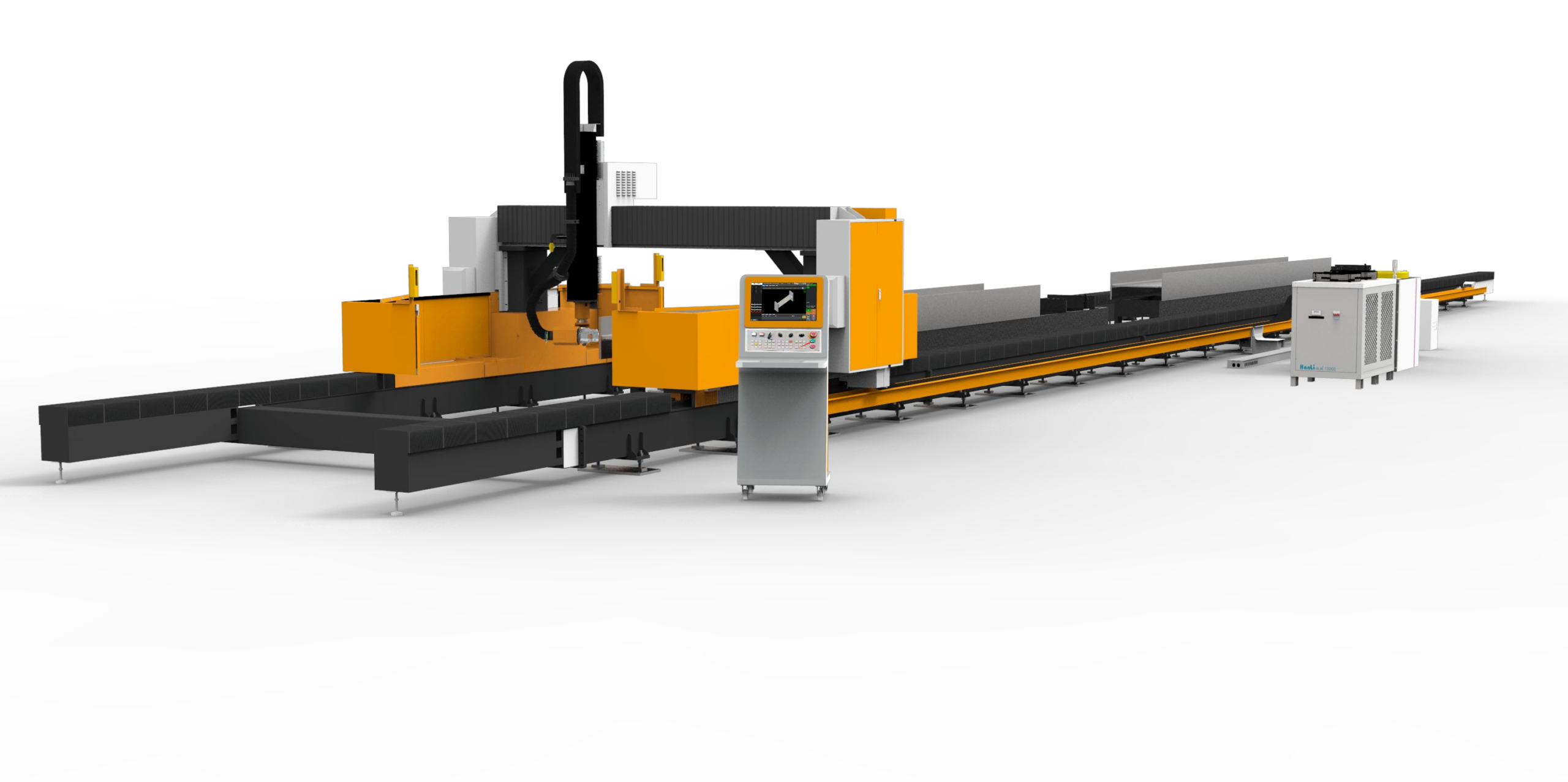
Operational Benchmarking: Square Tube Laser Cutting Throughput in Prefabricated Steel Construction
Walking a fabrication floor dedicated to prefabricated steel buildings, the bottleneck is rarely the welding station or the overhead crane. It is the cutting of square tube stock—specifically, the transition from raw S355JR or S235JR material to a dimensionally accurate, coped, or mitred component ready for fit-up. For decades, we accepted the thermal distortion of plasma or the tooling wear of cold saws. The economic shift toward fiber laser processing is not about novelty; it is a direct response to the physics of heat-affected zones (HAZ) and the mechanical limitations of chip removal. When we specify prefabricated steel building square tube laser cutting speed, we are not discussing a single feed rate. We are discussing a complex equation involving assist gas dynamics, resonator power stability, and the structural rigidity of the machine gantry under high acceleration.
Let us dissect the actual parameters that dictate cycle time. On a 6kW fiber laser source, cutting a 100x100x6mm S355JR square tube, we typically operate at a cutting speed of 3.5 to 4.2 meters per minute. This is not a theoretical maximum; this is the sustainable speed that ensures a dross-free bottom edge and a surface roughness (Ra) below 3.2 µm. Compare that to a 150x150x8mm section. Here, the mass of the material requires a reduction in feed to approximately 2.0 to 2.5 m/min. The critical variable is not just power—it is the focus position. For structural steel, we maintain a focal point at -4mm to -6mm relative to the top surface to maximize energy absorption in the mid-thickness zone. Pushing the speed higher than 4.5 m/min on the 6mm wall often results in a trailing edge lag, where the molten metal re-solidifies before the assist gas can eject it, creating a hard, difficult-to-remove slag that kills downstream robotic welding productivity.
Gas Consumption and the Hidden Cost of Nitrogen Purity
In the procurement phase, engineers obsess over kilowatt hours and laser source efficiency. In the field, the operational cost is dominated by the assist gas bill. For clean, oxidation-free cuts on stainless steel (SUS304) or for high-quality paint-ready edges on structural steel, we use Nitrogen (N₂) at delivery pressures between 1.2 and 1.5 MPa. At a 3.8 m/min cutting speed on a 6mm wall, a 6kW laser will consume roughly 120 to 150 liters per minute of N₂. This is a significant line item. If the specification allows for an oxidized edge—which is acceptable for components that will be welded and then painted—switching to Oxygen (O₂) at 0.8 to 1.0 MPa reduces gas costs by nearly 60%. However, the cutting speed drops by 15-20% due to the exothermic reaction requiring a slower feed to maintain a stable kerf. The decision matrix here is not about speed; it is about the downstream cost of secondary grinding. If the laser cut edge is going to be a visible architectural feature, the N₂ route is mandatory. If it is a hidden gusset plate, O₂ is the financially prudent choice.
Comparative Efficiency: Laser vs. Conventional Mechanical Sawing
To quantify the ROI, we must benchmark against the legacy equipment still operating in many prefab plants. A CNC cold saw with a 450mm HSS blade can cut a 100x100x6mm tube in approximately 45 seconds per cut, including clamping and blade return. A band saw is slower, around 60 seconds. The laser accomplishes the same cut in 12 seconds, including the high-speed positioning move between parts. The following table illustrates the operational delta based on a standard 8-hour shift, assuming 80% machine utilization.
| Parameter | CNC Cold Saw (HSS Blade) | Plasma Cutting (CNC) | 6kW Fiber Laser (N₂ Assist) |
|---|---|---|---|
| Cutting Speed (100x100x6mm S355JR) | 1.3 m/min (blade feed) | 2.0 m/min (with dross) | 3.8 m/min (dross-free) |
| Cycle Time per Cut (incl. indexing) | 45 seconds | 30 seconds | 12 seconds |
| Kerf Width | 3.5 mm | 4.5 mm (tapered) | 0.3 mm |
| Heat Affected Zone (HAZ) | 1.5 mm (work hardening) | 2.5 mm (recast layer) | 0.1 mm (minimal) |
| Tooling Cost per Part | $0.18 (blade wear) | $0.12 (electrode/nozzle) | $0.04 (nozzle & lens) |
| Secondary Operations (Deburring) | Required | Required (heavy) | Not Required |
| Material Waste (per 1000 cuts) | ~3500 mm of scrap | ~4500 mm of scrap | ~300 mm of scrap |
The data above highlights a critical financial metric: material yield. On a high-volume production run of 10,000 cuts per month, the laser saves approximately 32,000 linear millimeters of material compared to a cold saw. On a 6mm wall thickness, that is roughly 1,500 kg of steel saved annually—a direct contribution to the bottom line that offsets the higher initial capital expenditure.
ROI Projection and Amortization Dynamics
Let us run the numbers for a mid-sized prefabricated building manufacturer producing 500 tons of structural steel per month. The current method is a CNC plasma table for plates and a cold saw for tubes. The labor burden for secondary cleaning (grinding plasma dross) is 2 full-time equivalents (FTEs). By integrating a 6kW fiber laser tube cutting system, we eliminate the grinding station entirely. The labor cost reallocation alone—assuming a fully loaded cost of $45,000 per FTE—yields $90,000 in annual savings. Add to that the reduction in consumables (saw blades, coolant, plasma nozzles) at roughly $25,000 per year. The gas consumption increase (N₂ vs. air plasma) is a real cost, estimated at $18,000 annually for this volume.
The net operational savings are approximately $97,000 per year. The capital cost of a robust, high-quality 6kW fiber tube laser with a 12-meter loading magazine and 9-meter unloading rack is in the range of $450,000 to $550,000, fully installed. This yields a simple payback period of 4.5 to 5.5 years based purely on operational savings. However, the ROI calculation is incomplete without factoring in throughput capacity. The laser processes tube components 3.5 times faster than the cold saw. This means the laser can handle the current volume in 6-hour shifts, leaving 2 hours of capacity for new business—or allowing the plant to accept rush orders without overtime premiums. If we value that latent capacity at a conservative 15% of the machine’s annual throughput value ($300,000), the effective payback drops to under 3 years. The amortization schedule should also consider the residual value; a well-maintained fiber laser retains 40-50% of its value after 5 years, whereas a cold saw is nearly scrap metal.
Mechanical Rigidity and Chuck Pressure Parameters
Speed is meaningless if the material moves. In tube cutting, the chuck system is the silent partner. For square tubes up to 200mm, we set the front and rear chucks to a pneumatic pressure of 2.5 MPa to 3.0 MPa. This is critical for preventing torsional deflection during high-speed rotation (for profile cutting) or during the rapid traverse of the gantry. If the pressure drops below 2.0 MPa, the tube can micro-shift, causing a 0.5mm positional error that cascades into a failed weld fit-up. We also monitor the chuck jaw wear; hardened steel jaws with a serrated grip are mandatory for S355JR, as the mill scale acts as a lubricant, reducing friction coefficient by up to 30%.
Regarding the laser source duty cycle, we run the resonator at a continuous wave (CW) mode for cutting speeds above 2 m/min. For contour cutting of complex coped ends—where the path involves sharp corners—we switch to pulsed mode at 500 Hz to 1000 Hz with a 20% duty cycle. This prevents corner burn-out, where the heat accumulates at the pivot point and melts the corner radius beyond the programmed geometry. The acceleration of the gantry is set to 1.2 G with a jerk control algorithm that prevents mechanical vibration. If the machine vibrates at resonance frequencies during a high-speed cut, the resultant striation marks on the cut edge will fail the visual inspection criteria for architectural steel.
In practice, the transition from legacy cutting to laser processing is a systems engineering challenge, not just a machine replacement. The upstream material handling must deliver square tubes with a straightness tolerance of 1mm per meter. If the incoming tube is bent, the laser’s autofocus system will chase the surface, causing inconsistent focal points and variable cut quality. We specify a straightening press before the laser if the incoming stock is not certified to EN 10219-2. The downstream sorting and kitting area must be redesigned to handle the increased part flow. A laser cutting 100 parts per hour will overwhelm a manual sorting station designed for 30 parts per hour. The bottleneck simply moves downstream.
From a metallurgical standpoint, the edge quality of a laser cut is superior for welding. The narrow HAZ (0.1mm) means the weld pool is not contaminated by recast material. This reduces the incidence of porosity in the weld seam, which is a common rejection reason in cyclic load applications. The squareness of the cut edge—typically within 0.1 degrees—ensures that the root gap for a butt weld is consistent, reducing the skill required of the welder and increasing deposition efficiency.
Procurement FAQ for Fabrication Engineers
Q1: What is the realistic cutting speed for a 150x150x10mm S355JR square tube on a 6kW fiber laser, and what gas pressure is required?
For a 10mm wall thickness in S355JR, you will operate at a feed rate of 1.8 to 2.2 meters per minute using Nitrogen at 1.5 MPa. If you switch to Oxygen at 0.9 MPa, the speed increases to 2.5 m/min, but you will have a thin oxide layer on the cut edge that must be removed before galvanizing. The laser power should be set to 5.5 kW to maintain a stable keyhole. Do not exceed 2.5 m/min with N₂ on this thickness, as the risk of incomplete penetration and slag adhesion increases exponentially.
Q2: How does the initial capital investment in a fiber laser compare to the long-term maintenance costs of a CNC cold saw?
The laser’s initial cost is 3 to 4 times higher than a high-end cold saw. However, the cold saw requires blade replacement every 200 to 300 cutting hours, costing $800 to $1,200 per blade. Additionally, the saw requires coolant management, chip disposal, and regular gearbox maintenance. The laser requires only periodic lens cleaning (every 40 hours) and nozzle replacement (every 200 hours). Over a 5-year period, the total cost of ownership for the laser is typically 20% lower than the cold saw, primarily due to the elimination of tooling costs and the reduction in manual labor for deburring.
Q3: What is the impact of laser cutting speed on the structural integrity of the final building frame?
Faster cutting speeds, when optimized correctly, produce a finer recast layer and a lower surface roughness. This reduces the stress concentration factors at the cut edges, which is critical for fatigue-loaded connections. However, if you push the speed beyond the recommended parameters for the specific material thickness, you risk creating a “drag line” pattern that acts as a crack initiation site. We recommend a maximum speed that yields a striation frequency of less than 500 lines per inch. This ensures the edge profile meets the ISO 9013 Class 2 quality standard, which is the industry benchmark for structural welding.













