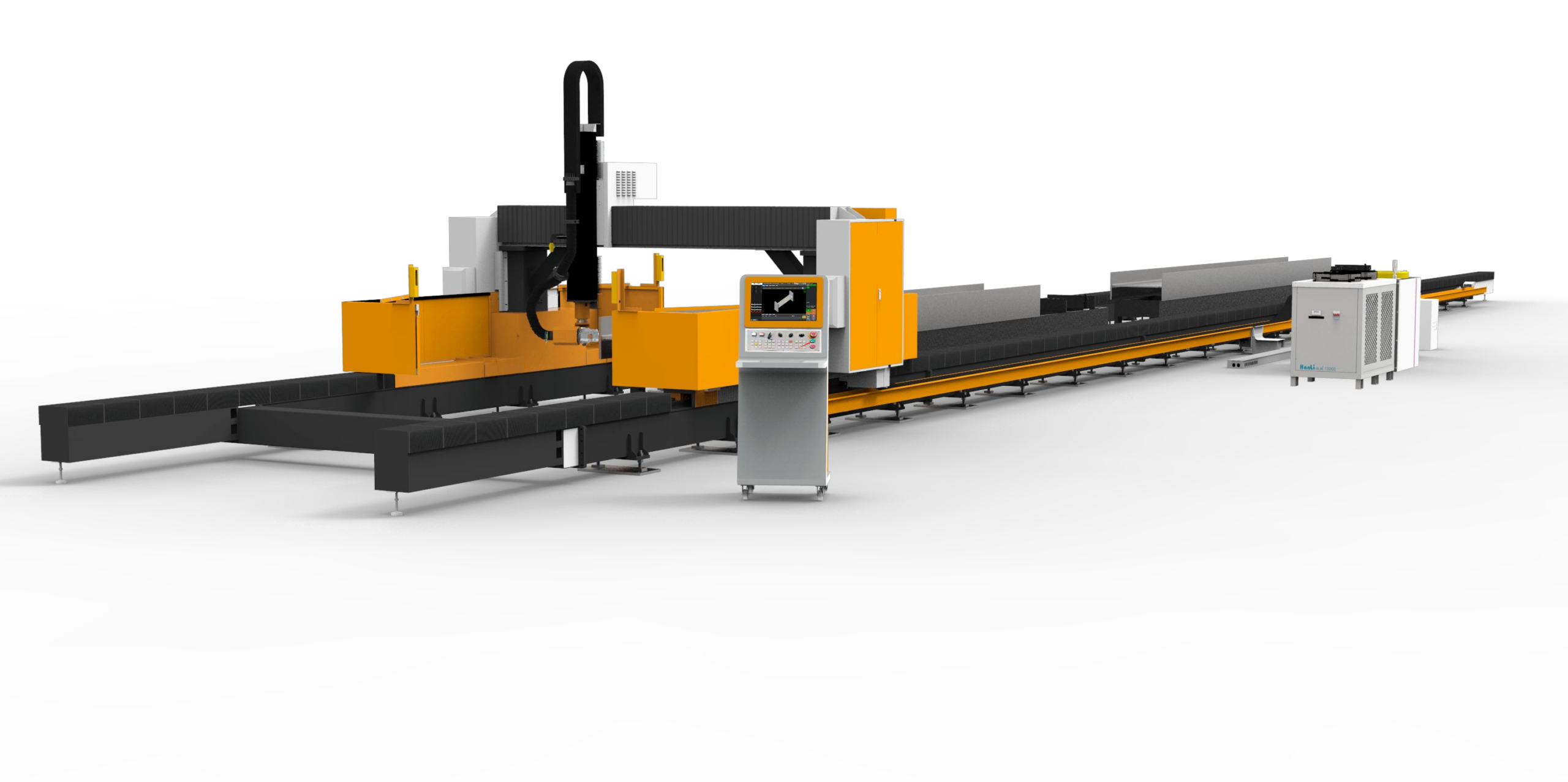
Processing Efficiency, Dynamic Speed Benchmarks, Structural Beveling and Root Gap Tolerances in Pallet Rack Beam Fabrication
The fabrication of pallet rack beams is a volume-driven discipline where dimensional repeatability and weld-prep quality dictate downstream throughput. A typical roll-formed or tube-based beam profile—whether a 120×60×3.0 mm rectangular hollow section or a C-channel upright—must be cut, notched, and beveled at rates that keep pace with automated welding cells. When a shop integrates an industrial storage pallet rack beam tube laser machine, the bottleneck shifts from mechanical tooling changeover to the actual photon-material interaction. This paper dissects the physics, parameters, and tolerance windows that separate a functional installation from a high-yield production asset.
Material Behavior and Alloy-Specific Cutting Regimes
Pallet rack beams are rarely a single alloy. A standard mixed batch on the shop floor includes S355JR (EN 10025-2) for load-bearing uprights, SUS304 for cold-storage or food-grade racking, and Al6061-T6 for lightweight pick modules. Each demands a distinct laser recipe. For S355JR at 3.0 mm wall thickness, a 6 kW fiber source running 1.2–1.5 MPa nitrogen assist gas achieves a clean, oxide-free cut at 18–22 m/min. The same thickness in SUS304 requires a frequency shift to 1,200–1,500 Hz with a duty cycle near 80% to manage dross adhesion; oxygen assist is avoided due to chromium carbide precipitation risk at the heat-affected zone. Al6061-T6 is the outlier—its high reflectivity and thermal conductivity force a reduction to 8–10 m/min with 1.5 MPa nitrogen and a defocused spot of +1.5 mm to prevent recast layer formation exceeding 15 µm.
Chuck pneumatic pressure is a non-negotiable variable. For a 120×60 mm tube with 3.0 mm wall, the front and rear chucks must maintain 0.6–0.8 MPa clamping pressure. Below 0.5 MPa, the tube slips during high-speed contouring, producing a 0.3–0.5 mm dimensional drift over a 6-meter beam. Above 1.0 MPa, thin-wall SUS304 (2.0 mm) collapses at the clamping jaw contact points, creating an ovality of 0.8 mm that fails the rack beam’s straightness tolerance of 1.5 mm/m.
Dynamic Speed Benchmarks: Laser vs. Legacy Methods
The comparative advantage of a tube laser over plasma or mechanical sawing is not linear—it is exponential when beveling and hole patterning are integrated. The table below reflects field data from a 6 kW fiber laser with a 3D bevel head versus a 200 A plasma table and a carbide-tipped cold saw.
| Parameter | Plasma Cutting (200 A) | Mechanical Cold Saw | Fiber Laser (6 kW, 3D Bevel) |
|---|---|---|---|
| Cut speed (S355JR, 3.0 mm) | 2.5–3.5 m/min | 1.2–1.8 m/min | 18–22 m/min |
| Bevel capability | None (secondary op) | None | 0–45° in single pass |
| Root gap tolerance | ±0.8 mm | ±0.5 mm | ±0.05 mm |
| Hole diameter tolerance | ±0.4 mm | Not applicable | ±0.08 mm |
| Heat-affected zone (HAZ) | 1.2–2.0 mm | 0.1–0.3 mm (mechanical) | 0.15–0.25 mm |
| Setup time per profile change | 15–25 min | 8–12 min | 2–4 min (program recall) |
| Consumable cost per meter | $0.45–$0.70 | $0.30–$0.55 | $0.08–$0.15 (gas + nozzle) |
The laser’s 0.05 mm root gap tolerance is the critical enabler for robotic MIG welding of rack beams. A gap exceeding 0.15 mm forces the welder to increase wire feed by 15–20%, introducing spatter and burn-through on 2.5 mm walls. With laser-cut bevels, the weld joint fit-up is consistent enough to run a 1.2 mm wire at 180 A, 22 V, and 6.5 m/min travel speed without gap-fill adjustments.
Structural Beveling and Root Gap Tolerances: The Physics of Fit-Up
Beveling a pallet rack beam end for a full-penetration weld requires more than a 45° angle. The laser head must compensate for the tube’s corner radius—typically 2.5–3.0 mm on a 120×60 mm section. A static bevel program produces a 0.2–0.3 mm mismatch at the corner. The solution is dynamic focus control: the laser’s Z-axis oscillates at 10–15 Hz while the bevel head rotates, maintaining a constant 0.8 mm standoff. This yields a root face of 1.0 ± 0.05 mm and a bevel angle of 37.5° ± 0.5°, which is the sweet spot for a 1.2 mm wire to penetrate without excessive dilution.
Root gap tolerance is governed by two variables: chuck runout and thermal expansion. A chuck runout exceeding 0.1 mm TIR (total indicator reading) will produce a gap variation of 0.15 mm over a 6-meter beam. For SUS304, the thermal expansion coefficient of 17.3 µm/m·K means a 10°C ambient swing between morning and afternoon shifts changes the beam length by 1.04 mm. The laser’s CNC must apply a real-time compensation factor of 0.017 mm per meter per degree Celsius. Without this, the root gap drifts from 0.05 mm to 0.20 mm, forcing manual rework.
Nitrogen purity is another silent killer. A 99.999% N2 supply at 1.2–1.5 MPa is mandatory for S355JR. A drop to 99.95% introduces oxygen content that forms a 5–10 µm oxide layer on the cut face, raising contact resistance for subsequent spot welding by 30–40%. The gas delivery system must maintain a dew point below -40°C and a flow rate of 25–30 L/min at the nozzle.
Procurement FAQ: Industrial Pallet Rack Beam Tube Laser Systems
What laser power is required for 4.0 mm S355JR pallet rack beams at 15 m/min?
A 6 kW fiber laser with a 100 µm core diameter delivery fiber is the minimum. At 4.0 mm thickness, 6 kW yields 12–15 m/min with 1.5 MPa nitrogen. For sustained 20 m/min, an 8 kW source with a 120 µm fiber is required, but the chuck clamping pressure must be reduced to 0.5 MPa to avoid tube deformation.
How does the machine handle root gap tolerance for robotic welding?
The system uses a closed-loop capacitive height sensor with 0.01 mm resolution and a dynamic bevel head that adjusts the root face in real time. Combined with thermal compensation, the root gap is held at 0.05–0.10 mm across a 6-meter beam, eliminating the need for weld gap-fill wire adjustments.
What is the nitrogen consumption cost per 1,000 meters of cut?
At 1.3 MPa and 28 L/min, a 6 kW laser cutting 3.0 mm S355JR at 20 m/min consumes approximately 1.4 L per meter of cut. For 1,000 meters, that is 1,400 L, or roughly 1.4 cubic meters. At industrial N2 pricing of $0.15–$0.25 per cubic meter, the cost is $0.21–$0.35 per 1,000 meters—negligible compared to the 40% reduction in weld rework.













