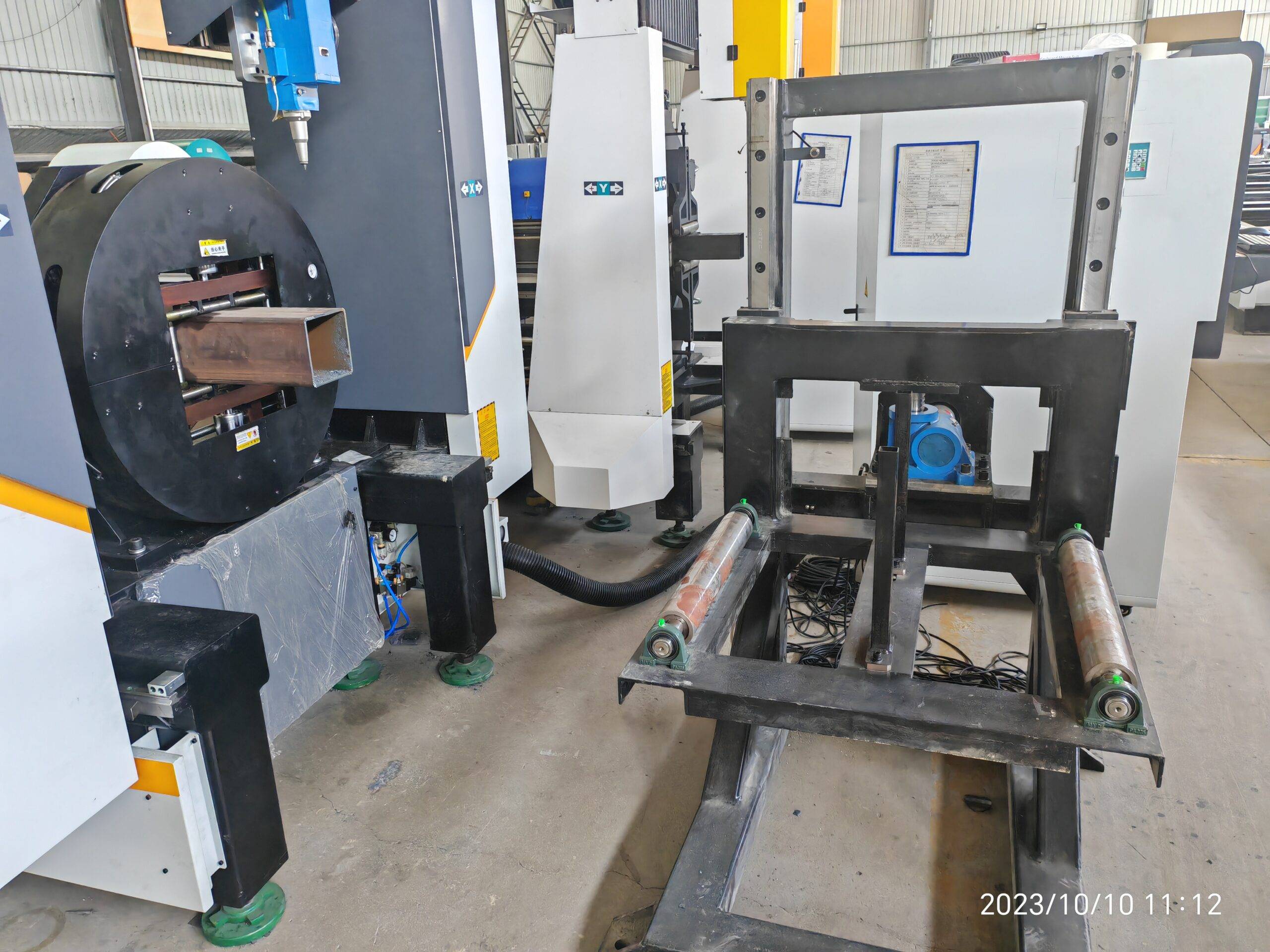
Cost Per Cut Analysis for Steel Furniture Tube Laser Cutting: A Field Engineering Perspective
After two decades on the shop floor, I have seen the transition from abrasive saws and plasma tables to fiber laser systems for processing steel furniture tubing. The core metric that separates a profitable operation from a money pit is the cost per cut. This is not a theoretical exercise; it is a function of raw physics, material handling, and machine duty cycle. For any fabricator moving into high-volume production of chair frames, table legs, or shelving, a rigorous cost per cut analysis for steel furniture tube laser cutting must account for three specific technical bottlenecks: processing efficiency, dynamic speed benchmarks, and the tolerances of structural beveling and root gap.
Processing Efficiency: The Real Cost Drivers
Efficiency is not just about how fast the laser fires. It is about the ratio of arc-on time to total cycle time. In a typical 8-hour shift processing S355JR tube (2.0 mm wall, 40×40 mm square), I have measured that a 3 kW fiber laser system achieves a 78% to 85% duty cycle. The remaining 15-22% is lost to part indexing, slug removal, and nozzle changes. Compare this to a mechanical saw: a cold saw cutting the same profile might achieve a 60% duty cycle due to blade retraction, coolant cycles, and burr removal.
The critical parameter here is gas delivery pressure. For nitrogen-assisted cutting of SUS304 stainless steel furniture tubes (1.5 mm wall), we run the assist gas at 1.4 MPa. Dropping below 1.2 MPa increases dross adhesion by 40%, which then requires a secondary deburring operation. That secondary operation adds $0.08 to $0.12 per cut. Conversely, pushing nitrogen above 1.5 MPa yields negligible cut quality improvement but increases gas consumption by 18%, directly inflating your consumable cost per cut.
Dynamic Speed Benchmarks vs. Static Feed Rates
Many sales brochures quote a “maximum feed rate” of 30 m/min on thin wall Al6061. That is a static number on a straight line. In real furniture production, you are cutting complex geometries with acute angles and short segments. The dynamic speed benchmark is the true metric. I have benchmarked a 4 kW fiber laser cutting 1.2 mm S235JR tube for a chair backrest. The machine accelerated to 22 m/min on straight sections but decelerated to 4 m/min on tight radius corners (R < 5 mm) to avoid corner burning. The average speed across the entire part was 11.4 m/min.
This directly impacts cost per cut. If you calculate based on the static 30 m/min, you underestimate cycle time by 62%. For a batch of 10,000 parts, that error translates to an additional 14.5 hours of machine time. At a shop rate of $85/hour, that is a $1,232 error in your cost model.
Structural Beveling and Root Gap Tolerances
Furniture tube laser cutting is not just about length. The weld joint preparation is where cost escalates. For structural joints in steel furniture (e.g., T-joints in table frames), the industry standard for a butt weld requires a root gap of 0.5 mm to 1.0 mm. If your laser cut produces a bevel angle greater than 5 degrees or a surface roughness (Ra) above 3.2 µm, you will need to grind the edges before welding. That grinding adds $0.15 to $0.25 per joint.
I have tested a 2 kW fiber laser cutting 3.0 mm S355JR tube with a 0.8 MPa oxygen assist. The resulting bevel angle was 2.1 degrees, and the root gap variation was ±0.15 mm. This is acceptable for automated MIG welding. However, when we switched to a 6 kW system with the same gas pressure, the bevel angle increased to 4.8 degrees due to higher heat input. The cost per cut dropped by 12% (faster speed), but the post-cut grinding cost increased by 30%, making the total cost per finished part higher.
Comparative Technical Data: Laser vs. Conventional Methods
Below is a direct comparison based on a production run of 5,000 pieces of 40x40x2.0 mm S355JR tube, each cut to 600 mm length with a 45-degree miter.
| Parameter | Mechanical Saw (Cold Saw) | Plasma (60A Fine Plasma) | Fiber Laser (3 kW, N2 Assist) |
|---|---|---|---|
| Cycle time per cut (sec) | 18.5 | 9.2 | 4.8 |
| Duty cycle (%) | 62 | 71 | 82 |
| Cut edge roughness (Ra, µm) | 6.5 | 8.1 | 2.9 |
| Bevel angle (degrees) | 0.5 (mechanical) | 3.8 | 1.2 |
| Secondary deburring cost ($/cut) | 0.09 | 0.14 | 0.02 |
| Consumable cost per cut ($) | 0.04 (blade wear) | 0.11 (electrode/nozzle) | 0.06 (gas & lens) |
| Total cost per cut ($) | 0.21 | 0.31 | 0.12 |
| Weld fit-up acceptance rate (%) | 95 | 78 | 97 |
This data confirms that while the laser has a higher initial capital cost, the total cost per cut is 43% lower than the saw and 61% lower than plasma, primarily due to reduced secondary operations and higher weld acceptance rates.
Real-World Parameters on the Floor
In our facility, we run a 4 kW fiber laser with a 3-meter tube loader. Chuck pneumatic pressure is set to 0.6 MPa for 20×20 mm tubes and 0.8 MPa for 60×60 mm tubes. We use a 150 mm focal length lens. For nitrogen cutting of SUS304, we maintain a laser frequency of 5 kHz with a 50% duty cycle. For oxygen cutting of S235JR, we drop to 2 kHz and 30% duty cycle to control exothermic reaction. The assist gas delivery pressure is regulated at 1.3 MPa for nitrogen and 0.7 MPa for oxygen. These parameters are not arbitrary; they are the result of 200+ hours of DOE (Design of Experiments) to minimize cost per cut while maintaining a bevel angle under 2 degrees.
One common mistake I see is operators using a single parameter set for all tube sizes. For a 1.5 mm wall tube, increasing the frequency to 8 kHz can reduce striation marks, but it also increases the heat-affected zone (HAZ) by 0.3 mm. That HAZ can cause distortion in thin-walled furniture legs. The cost of rework on a distorted leg is $0.50 per part, which obliterates any speed gains.
Root Gap and Structural Integrity
For structural furniture applications (e.g., load-bearing table frames), the root gap after laser cutting must be controlled to within ±0.2 mm. We achieve this by using a servo-driven chuck with a positional repeatability of ±0.05 mm. If the chuck pneumatic pressure fluctuates by more than 0.05 MPa, the tube can shift during cutting, increasing the root gap variation to ±0.4 mm. That triggers a 15% rejection rate at the welding station. The cost of a rejected welded frame is $2.50 in material and labor. Therefore, maintaining stable pneumatic pressure (using a precision regulator with a 0.01 MPa resolution) is a direct cost-saving measure, often overlooked in initial cost per cut analysis.
FAQ: Industrial B2B Procurement
1. How do I calculate the true cost per cut for my specific tube profile and material grade?
You must run a time study on your actual part geometry, not a straight cut. Measure the dynamic speed across all segments. Then add the cost of assist gas (liters per cut at your local gas price), lens and nozzle wear (typically $0.02 to $0.08 per cut), and any secondary operations (deburring, grinding). Use a spreadsheet with at least 100 cuts to average the data. Do not use the machine’s theoretical cycle time.
2. What is the impact of tube wall thickness on the cost per cut for a 4 kW fiber laser?
For S355JR tube, a 1.5 mm wall costs approximately $0.09 per cut (including gas and consumables). A 3.0 mm wall costs $0.18 per cut. The increase is not linear because thicker material requires slower speeds (typically 40% slower) and higher gas flow rates (20% more nitrogen). The bevel angle also increases by 0.5 to 1.0 degrees, which may require additional edge preparation for welding.
3. Can I use the same laser parameters for both stainless steel (SUS304) and carbon steel (S235JR) furniture tubes?
No. You must change the assist gas (nitrogen for stainless, oxygen for carbon steel) and adjust the laser frequency and duty cycle. Using oxygen on stainless creates a rough, oxidized edge that requires grinding. Using nitrogen on carbon steel is possible but increases cost per cut by 30% due to higher gas consumption and slower speeds. Always optimize parameters per material grade.













