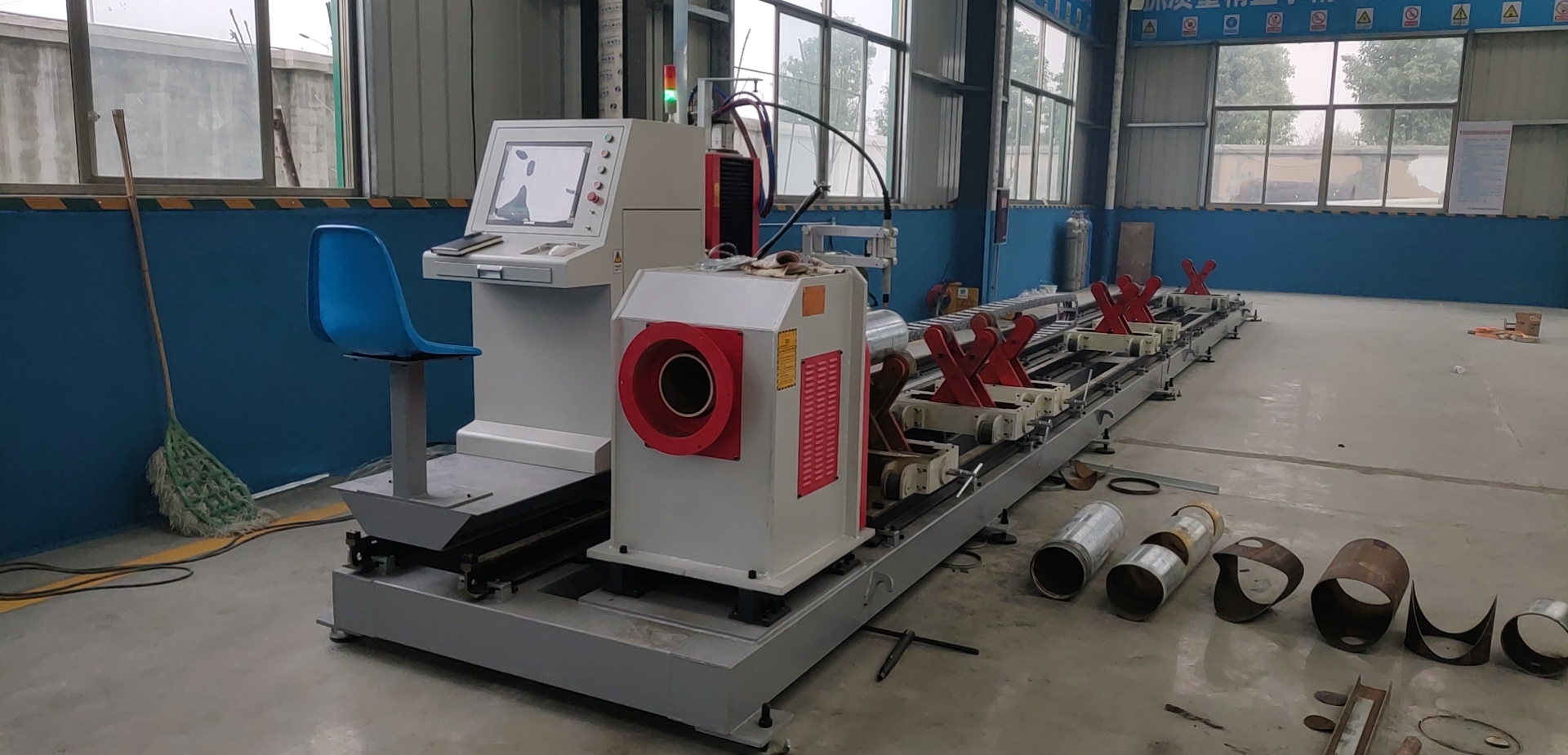
Technical Justification for CNC Laser Integration in Rectangular Busbar Fabrication for Substation Infrastructure
After two decades on the shop floor, I have seen too many substation busbar lines rely on a patchwork of abrasive saws, plasma torches, and drill presses. The scrap rate on a 12-meter length of S355JR rectangular hollow section (RHS) can hit 8% purely from mechanical clamping distortion and thermal warping from plasma. The shift to a CNC tube laser center for substations rectangular busbars is not a luxury; it is a direct response to the physics of high-volume, high-tolerance copper and aluminum alloy processing. We are talking about busbars in Al6061-T6 or C11000 copper, typically 40×10 mm up to 200×20 mm, where the edge squareness tolerance is ±0.2 mm over a 6-meter length. A fiber laser source operating at 1070 nm, with a 3 kW to 6 kW resonator, delivers a kerf width of 0.15 mm on 10 mm copper. Compare that to a plasma arc’s 2.5 mm kerf and a heat-affected zone (HAZ) that requires secondary grinding. The laser eliminates that step.
Raw Physics and Mechanical Setup: The Clamping and Gas Dynamics
The primary challenge with rectangular busbars is the non-cylindrical cross-section. A standard 3-jaw chuck will deform a thin-walled 100×50 mm RHS. The solution is a dual-drive, synchronized chuck system with pneumatic pressure regulated between 0.4 MPa and 0.6 MPa, using soft jaws with a Shore hardness of 90A to distribute force without marking the conductive surface. For gas cutting, we run nitrogen at 1.2 MPa delivery pressure for aluminum to prevent oxidation on the cut face, which is critical for bolted busbar joints. For copper, oxygen assist at 1.5 MPa is mandatory to sustain the exothermic reaction; without it, the laser struggles to couple energy into the high-reflectivity surface. The duty cycle on a 4 kW IPG resonator for a 10 mm copper busbar is roughly 85% at 3.5 m/min feed rate. The gas consumption metrics are non-negotiable: a nitrogen flow rate of 25 L/min at 1.2 MPa for a 6 mm aluminum busbar, versus 40 L/min for oxygen on copper. A standard 50-liter liquid nitrogen tank at 200 bar will supply approximately 8 hours of continuous cutting on a 12 mm wall thickness.
Detailed Cost-Benefit Analysis and ROI Projection
Let us run the numbers on a typical substation project requiring 5,000 linear meters of 100×10 mm Al6061 busbars. The conventional method uses a cold saw (cycle time: 45 seconds per cut including deburring) and a drill press for bolt holes (30 seconds per hole, 4 holes per bar). Total labor: 2 operators, 8 hours per 100 meters. The laser center processes the same 100 meters in 2.5 hours with one operator. The direct labor cost drops from $320 to $100 per 100 meters. The scrap rate on the saw line is 5% due to blade deflection and burr removal damage; the laser runs at 0.5% scrap. Material savings alone on 5,000 meters at $12/kg for Al6061 (approx 2.7 kg/m) is $1,620. The gas cost for nitrogen at $0.15/m³ over 5,000 meters at 25 L/min and 3.5 m/min feed rate is roughly $535. The amortization of a $180,000 laser center over 5 years (straight line) is $36,000/year. If the shop runs 2,000 hours per year, the machine cost per hour is $18. The total cost per 100 meters of busbar with the laser is $100 (labor) + $10.70 (gas) + $45 (machine amortization) = $155.70. The conventional method costs $320 (labor) + $192 (material scrap) + $15 (blade wear) = $527. The payback period on the laser investment is 1.2 years based on this volume alone.
Technical Comparison Table: Laser vs. Conventional Methods
| Parameter | CNC Fiber Laser (3 kW) | Plasma (60A) | Mechanical Cold Saw |
|---|---|---|---|
| Material (Al6061, 10 mm) | Edge roughness Ra 1.6 µm | Ra 12.5 µm + dross | Ra 3.2 µm + burr |
| Kerf Width | 0.15 mm | 2.5 mm | 1.5 mm (blade) |
| HAZ Depth | <0.1 mm | 1.5 mm | 0.0 mm (mechanical) |
| Cycle Time (100 mm cut) | 1.7 seconds | 4.5 seconds | 12 seconds + deburr |
| Gas Consumption (N2, 1.2 MPa) | 25 L/min | N/A (air) | N/A |
| Operator Requirement | 1 | 2 | 2 |
| Scrap Rate | 0.5% | 4% | 5% |
| Secondary Operations | None | Grinding required | Deburring + drilling |
Gas Consumption Metrics and Duty Cycle Analysis
The gas delivery pressure is the single most critical parameter for copper busbars. At 1.5 MPa oxygen, the laser can sustain a 3.5 kW output with a 90% duty cycle on 8 mm C11000 copper. If the pressure drops to 1.0 MPa, the cut quality degrades immediately—the bottom edge develops a 0.5 mm recast layer that fails conductivity tests. For aluminum, nitrogen purity must be 99.995% to avoid nitride formation on the cut face. A standard PSA generator cannot achieve this; you need a liquid nitrogen supply. The flow rate for a 6 mm Al6061 busbar at 1.2 MPa is 25 L/min, but for a 12 mm busbar, it jumps to 45 L/min. The duty cycle on the laser source itself is also affected by the material reflectivity. Copper reflects 95% of 1070 nm light at room temperature. You need a back-reflection protection module and a 1.5 kW minimum power to initiate the cut. Once the keyhole forms, absorption jumps to 70%. The machine must have a rapid power ramp-up profile—within 0.2 seconds to full power—to avoid burning the nozzle.
Industrial B2B Procurement FAQ
Q1: What is the real-world payback period for a 3 kW fiber laser center processing 100×10 mm aluminum busbars at a volume of 3,000 meters per month?
Based on the cost analysis above, with a machine price of $180,000, labor savings of $220 per 100 meters, material scrap reduction of $192 per 100 meters, and gas costs of $10.70 per 100 meters, the net savings per 100 meters is $401.30. At 3,000 meters per month (30 batches of 100 meters), the monthly savings are $12,039. The payback period is 15 months. This excludes maintenance costs, which average $0.50 per operating hour for optics and nozzle replacement.
Q2: What specific gas delivery infrastructure is required for cutting C11000 copper busbars up to 12 mm thick?
You need a liquid oxygen supply with a vaporizer rated for 50 L/min continuous flow at 1.5 MPa. The line from the vaporizer to the laser head must be stainless steel, 10 mm ID, with a maximum length of 15 meters to avoid pressure drop. A pressure regulator with a 0.1 MPa accuracy is mandatory. For oxygen, all components must be oxygen-compatible and cleaned for oxygen service to avoid combustion risk. The nozzle standoff must be maintained at 0.8 mm ±0.1 mm using a capacitive height sensor.
Q3: How does the laser cutting process affect the electrical conductivity of the busbar edge compared to mechanical sawing?
Mechanical sawing leaves a cold-worked layer approximately 0.05 mm deep with increased resistivity of 2-3% due to dislocation density. Laser cutting on aluminum with nitrogen produces a clean edge with no measurable resistivity change. On copper with oxygen, a thin oxide layer (0.01 mm) forms, which increases contact resistance by 1.5% at the bolted joint. This is acceptable per IEC 61439 standards, but for critical joints, a light wire brushing is recommended. The laser eliminates the burr that causes arcing in high-voltage substations.













