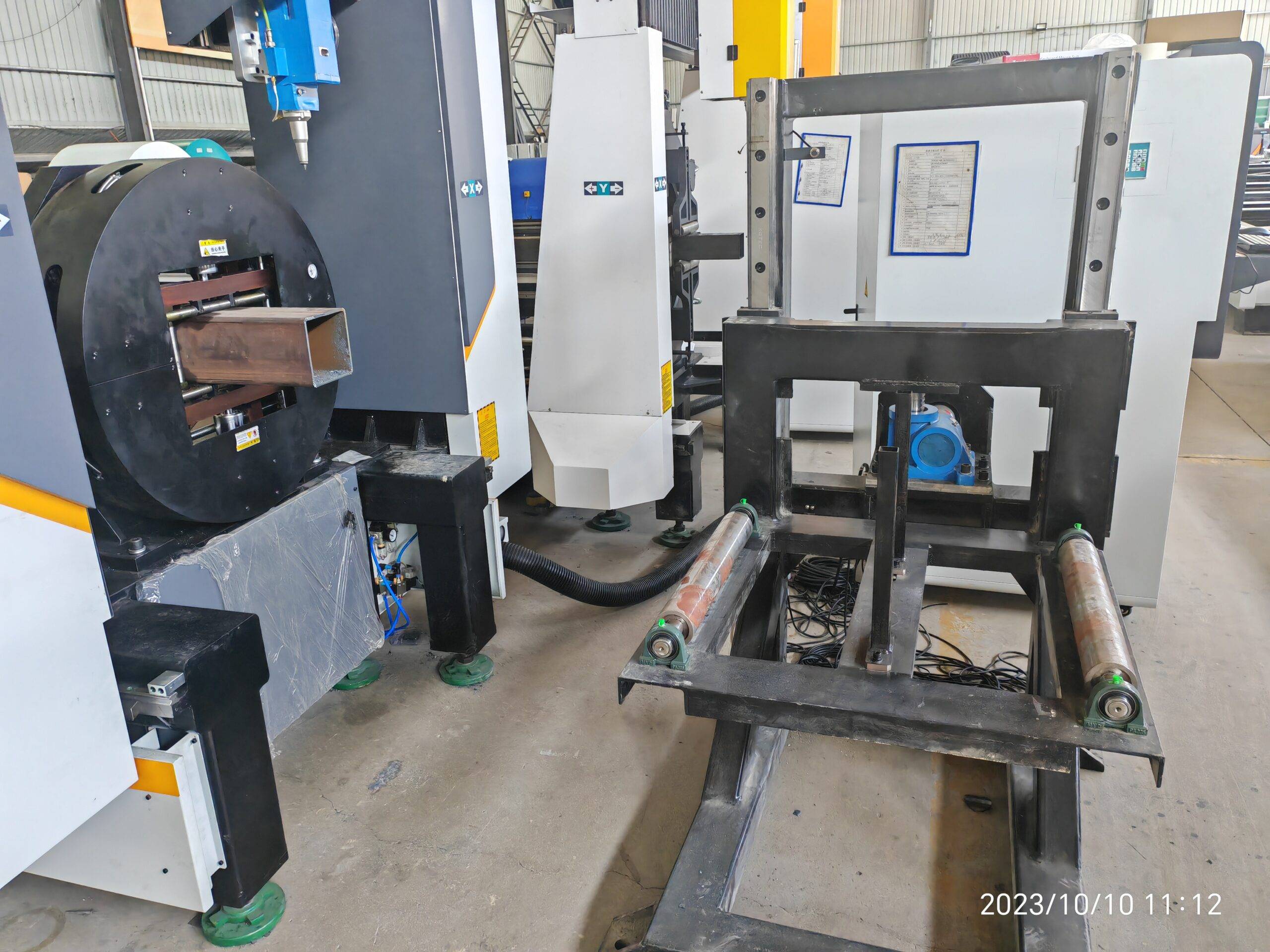
CNC Automatic Pipe Cutter for Forklift Telescopic Mast Production: Cost-Benefit, Gas Consumption, and Amortization Analysis
Forklift telescopic masts are not cosmetic weldments. They are dynamic load-bearing structures subjected to cyclic bending, torsional whip, and rail-guided shear during every lift cycle. The mast channel and outer/inner rail tubes—typically rolled from S355JR or, in corrosive environments, SUS304—must maintain straightness tolerances under 0.15 mm per meter, or the roller bearings will bind and the mast will chatter under load. This is why the selection of a CNC automatic pipe cutter for forklift telescopic mast production is not a procurement formality; it directly dictates downstream weld fit-up, mast parallelism, and the total cost per finished mast section. What follows is a field-derived analysis of where the money actually goes.
Why the Cut Edge Determines the Whole Mast Assembly
Conventional mast tube cutting has relied on band saws and plasma for decades. Both introduce defects that propagate downstream. A band saw leaves a burr that must be ground before the rail is inserted into the mast channel; plasma leaves a heat-affected zone (HAZ) of 0.8–1.5 mm with dross adhesion and a tapered kerf edge. When the tube wall is 6 mm to 12 mm S355JR, that taper translates into a 0.3–0.6 mm gap at the butt joint, forcing the welder to increase wire feed and heat input. The result is angular distortion of the mast rail—a defect that only surfaces at final alignment, when the mast is already welded.
Fiber laser cutting eliminates the mechanical burr and reduces the HAZ to 0.05–0.15 mm. For SUS304 mast tubes, this matters even more: plasma cutting of austenitic stainless induces chromium depletion at the cut face, creating a corrosion initiation site that will bloom under outdoor forklift duty. Laser cutting with nitrogen assist produces an oxide-free, metallurgically clean edge that requires no post-processing before robotic MIG welding.
Comparative Technical Data: Legacy Methods vs. Fiber Laser Tube Cutting
| Parameter | Mechanical Band Saw | Conventional Plasma | CNC Fiber Laser (3–6 kW) |
|---|---|---|---|
| Cut edge squareness | ±0.5 mm/m | ±0.8 mm/m (taper) | ±0.05 mm/m |
| HAZ width (S355JR, 8 mm) | None (mechanical) | 0.8–1.5 mm | 0.05–0.15 mm |
| Burr / dross | Heavy burr, requires grinding | Dross on underside | Negligible |
| Cutting speed (Ø89 × 6 mm tube) | 25–40 s/cut | 12–18 s/cut | 4–7 s/cut |
| Consumable cost per cut | Blade amortization ~$0.18 | Electrode/nozzle ~$0.35 | Nozzle + lens ~$0.06 |
| Assist gas | None | O2/N2 at 0.6–0.8 MPa | N2 at 1.2–1.5 MPa (SUS), O2 at 0.8 MPa (carbon) |
| Post-cut processing | Deburr + chamfer | Grind dross + HAZ removal | None |
| Dimensional repeatability (Cpk) | 1.1–1.3 | 1.0–1.2 | 1.67+ |
Gas Consumption Metrics: The Hidden Line Item
Assist gas is where most ROI projections go wrong. A 4 kW fiber laser cutting 8 mm S355JR mast tube with oxygen assist consumes roughly 18–22 Nm³/h at 0.8 MPa. Cutting SUS304 with nitrogen at 1.4 MPa for a clean edge pushes consumption to 28–35 Nm³/h. At a duty cycle of 65% across a two-shift operation (4,000 hours/year), that is 112,000–140,000 Nm³ of nitrogen annually. At bulk liquid nitrogen pricing of $0.35–$0.55/Nm³ (depending on regional supply and on-site tank vs. dewar delivery), the annual gas bill lands between $39,000 and $77,000.
This is why gas selection is a production engineering decision, not a purchasing afterthought. For carbon steel mast tubes that will be painted, oxygen cutting at 0.8 MPa is acceptable and cuts gas cost by 40%. For SUS304 or Al6061 mast components, nitrogen at 1.4–1.5 MPa is non-negotiable—anything lower produces an oxidized edge that fails salt-spray testing. A well-specified CNC automatic pipe cutter will support dual-gas manifolds with automatic switching, so the operator does not manually swap regulators between alloy batches.
Chuck and Fixturing Parameters for Mast Tube Geometry
Forklift mast tubes are long—often 2.5 to 4.5 meters—and thin-walled relative to length. Pneumatic chuck pressure must be tuned to avoid crushing. For Ø89 × 6 mm S355JR, a clamping pressure of 0.5–0.7 MPa on the front chuck and 0.4–0.6 MPa on the rear is typical. For Al6061 tubes with 4 mm wall, drop to 0.3–0.4 MPa. Exceeding these values ovalizes the tube, and the ovality will show up as mast rail misalignment at assembly. Servo-driven chuck rotation with closed-loop feedback keeps the tube concentric during the cut, which is what allows the ±0.05 mm/m squareness figure in the table above.
Cost-Benefit Analysis and ROI Projection
Assume a mast production line running 40,000 cuts per year on mixed S355JR and SUS304 tube. The legacy plasma cell requires two operators, one dedicated grinder, and a deburring station. Fully loaded labor and consumable cost runs approximately $4.80 per cut. A CNC fiber laser tube cutter with automatic loading reduces this to $1.35 per cut—including gas, nozzle, electricity, and one operator overseeing the cell.
Annual savings: 40,000 × ($4.80 − $1.35) = $138,000. A mid-range 4 kW CNC automatic pipe cutter with 6-meter bed and automatic bundle loader carries a capital cost of $280,000–$340,000 installed. Simple amortization: 2.0–2.5 years. But the real ROI is faster than that, because the laser eliminates the downstream rework loop. Mast rail rework and re-alignment on the legacy line consumes 6–9% of production hours. Removing that rework recovers an additional $45,000–$60,000 annually in throughput, pulling payback under 20 months.
Amortization Strategy and Residual Value
Fiber laser sources degrade gradually—a 4 kW module typically holds 85% power output at 60,000 operating hours. Amortize the source over 7 years and the motion system over 12. This staggered depreciation matches the actual wear curve. Residual value at year 7 for a well-maintained CNC tube cutter remains 30–40% of original capital, provided the chucks and linear guides have documented service intervals. Budget $8,000–$12,000 annually for preventive maintenance: lens replacement, nozzle stock, chuck seal kits, and servo calibration.
FAQ: Industrial B2B Procurement
What wall thickness and alloy range can a CNC automatic pipe cutter handle for forklift mast tubes?
Most production-grade fiber laser tube cutters handle 0.5 mm to 12 mm wall on carbon steel, 0.5 mm to 8 mm on SUS304, and 0.5 mm to 6 mm on Al6061. For forklift mast tubes specifically, the working range is 4–12 mm S355JR and 3–8 mm SUS304. Confirm the chuck clamping pressure range supports your thinnest wall without ovalization.
How does nitrogen consumption at 1.4 MPa affect annual operating cost?
At 65% duty cycle and 4,000 annual hours, nitrogen consumption for SUS304 cutting runs 112,000–140,000 Nm³/year. Bulk liquid supply at $0.35–$0.55/Nm³ yields $39,000–$77,000 annually. On-site nitrogen generation can cut this by 60–70% if purity requirements are below 99.999%.
What is a realistic payback period for replacing plasma with fiber laser on a mast line?
For 40,000 cuts/year on mixed alloy tube, payback is typically 20–30 months when including rework elimination. Without rework savings, 24–30 months. The variable that moves payback most is gas cost and whether the line runs two or three shifts.













