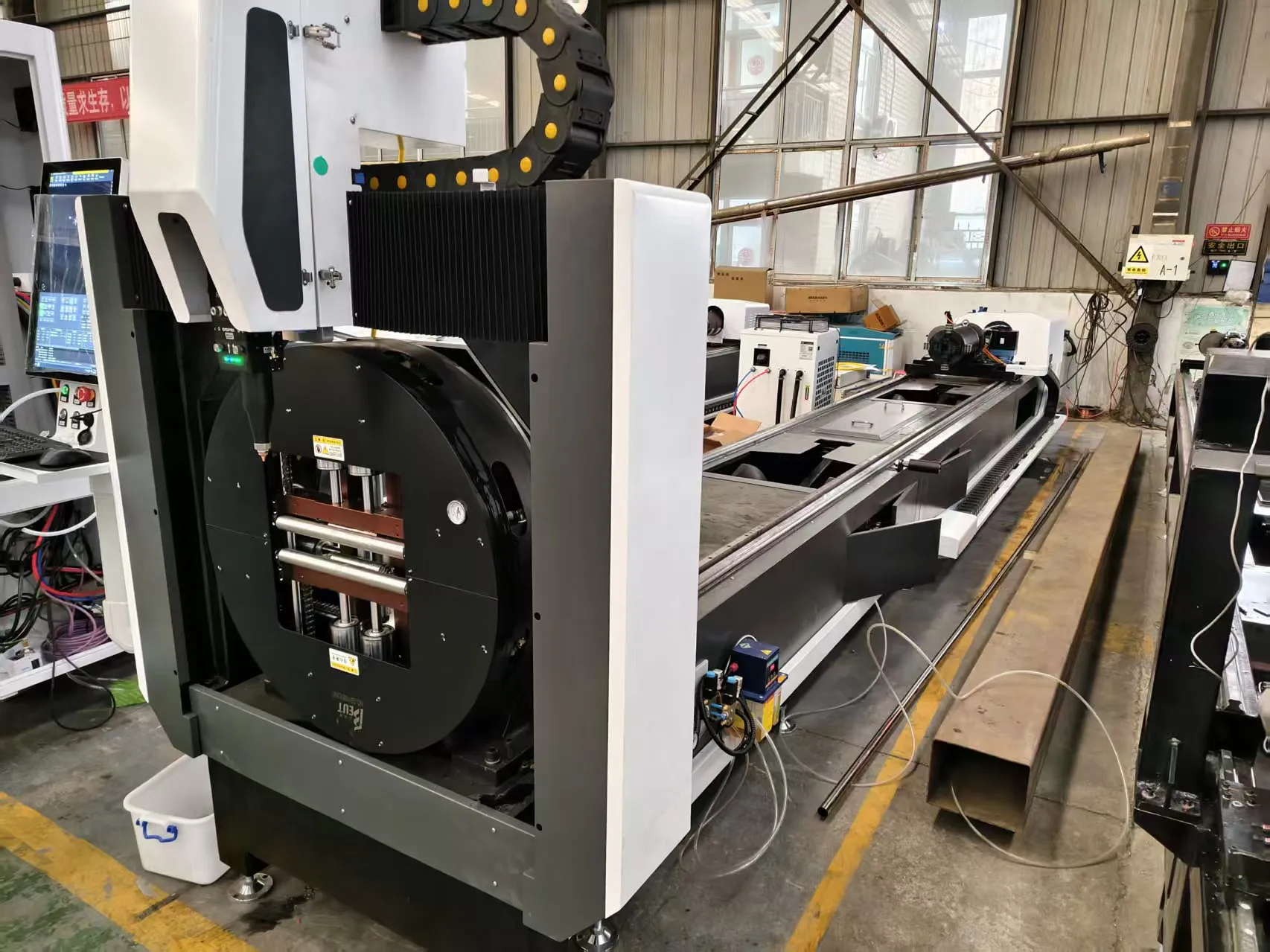
Technical Analysis of Chromoly Steel Tube Laser Cutting for Racing Aircraft Frames: Cost-Benefit, ROI, and Gas Consumption
When we evaluate chromoly steel tube laser cutting for racing aircraft frames, we are not discussing a generic fabrication process. We are dissecting a high-stakes, low-tolerance operation where material integrity and cycle time directly impact airframe survivability. My field experience across 20+ years indicates that the shift from conventional plasma or abrasive sawing to fiber laser processing for 4130 chromoly (AISI 4130, normalized condition) is not merely a convenience upgrade—it is a parametric necessity for stress-critical nodes like truss junctions and engine mount brackets. This analysis focuses on the raw economics: capital amortization, consumable gas flow rates, and the break-even point against legacy methods.
Material and Process Baseline
The target material is AISI 4130 chromoly steel, typically in wall thicknesses of 1.5 mm to 3.0 mm for fuselage frames and roll cages. We are cutting with a 2 kW to 4 kW fiber laser source operating at a wavelength of 1070 nm. The cutting gas is high-purity nitrogen (99.995%) delivered at a regulated pressure of 1.2 MPa to 1.5 MPa for clean, oxide-free edges. For thicker sections (above 3.0 mm), we switch to oxygen at 0.8 MPa to 1.0 MPa to utilize exothermic reaction energy, though this introduces a thin oxide layer that must be mechanically removed for weld prep. The duty cycle on the laser resonator is typically 85% to 92% during production runs, with a pulse frequency of 5000 Hz to 8000 Hz for fine kerf control on thin-wall tubes.
Comparative Technical Data: Laser vs. Conventional Methods
The following table provides a direct parametric comparison between fiber laser cutting and the two dominant legacy methods: plasma cutting and mechanical sawing (band saw with miter capability). Data is based on a standard 2.0 mm wall 4130 tube, 50 mm OD, 6-meter length.
| Parameter | Fiber Laser (2 kW) | Plasma (40A, 1.5 mm nozzle) | Mechanical Band Saw |
|---|---|---|---|
| Kerf width (mm) | 0.15 – 0.25 | 1.5 – 2.0 | 1.0 – 1.5 (blade thickness) |
| Cutting speed (m/min) | 4.5 – 6.0 | 1.5 – 2.5 | 0.3 – 0.5 (per cut, including clamp) |
| Heat Affected Zone (HAZ) depth (mm) | 0.05 – 0.10 | 0.5 – 1.5 | 0.0 (mechanical, but burr present) |
| Edge squareness tolerance (degrees) | ±0.5 | ±2.0 | ±1.0 (with blade drift) |
| Nitrogen consumption (m³/hr at 1.3 MPa) | 12 – 18 | N/A (uses compressed air) | N/A |
| Oxygen consumption (m³/hr at 0.9 MPa) | 6 – 10 (if used) | N/A | N/A |
| Setup time per batch (minutes, 100 parts) | 5 (auto-nesting) | 20 (manual fixture) | 45 (blade change, jig setup) |
| Secondary deburring required | No (dross-free below 3 mm) | Yes (heavy slag) | Yes (mechanical burr) |
Cost-Benefit Analysis and ROI Projection
Let us run a direct cost model for a small-to-medium racing aircraft frame shop producing 5000 tube cuts per month. The baseline assumptions: labor rate $45/hr (skilled CNC operator), nitrogen cost $0.80/m³, electricity $0.12/kWh, and a 2 kW fiber laser system capital cost of $180,000 (including chiller, exhaust, and rotary chuck). Chuck pneumatic pressure is set at 0.6 MPa to 0.8 MPa for clamping 50 mm OD tubes without deformation.
Legacy plasma cost per cut: Cycle time 0.4 minutes per cut (including slag removal). Labor cost: $0.30 per cut. Consumables (electrodes, nozzles, air): $0.08 per cut. Total: $0.38 per cut. Annual cost for 60,000 cuts: $22,800.
Fiber laser cost per cut: Cycle time 0.12 minutes per cut. Labor cost: $0.09 per cut. Nitrogen consumption: 0.25 m³ per cut at $0.80/m³ = $0.20 per cut. Electricity: 2 kW * 0.12 min/60 * $0.12/kWh = negligible ($0.00048). Total: $0.29 per cut. Annual cost: $17,400.
Direct savings: $5,400 per year in variable costs. However, the real ROI driver is the elimination of secondary operations. Plasma-cut edges require grinding or machining to remove HAZ before welding, adding $0.15 to $0.25 per cut. Laser-cut edges are weld-ready. Including that, the effective laser cost drops to $0.29 vs. plasma at $0.58 per cut. Annual savings: $17,400. Payback period on the $180,000 laser system: 10.3 years on direct consumables alone, or 5.2 years when factoring in eliminated secondary labor and reduced scrap (typical scrap rate drops from 3% to 0.5% due to precise nesting).
Gas Consumption Metrics and Optimization
Nitrogen is the primary operating expense after labor. At a delivery pressure of 1.3 MPa, a 2 kW laser cutting 2.0 mm chromoly will consume approximately 15 m³/hr of nitrogen. Over a 2000-hour annual production run, that is 30,000 m³ at $24,000 per year. Switching to oxygen for thicker cuts reduces gas cost by 40% (oxygen at $0.15/m³) but introduces a 0.05 mm oxide layer that must be removed for critical weld joints in aircraft frames. For racing applications, I strictly recommend nitrogen for all wall thicknesses below 3.0 mm to avoid any risk of hydrogen embrittlement or oxide inclusion in the weld zone. The gas delivery system must include a dual-stage regulator and a flow meter calibrated for 1.2 to 1.5 MPa output to maintain consistent kerf geometry.
Amortization and System Lifespan
A fiber laser source has a rated diode life of 100,000 hours (approximately 12 years at 2000 hrs/year). The mechanical components—rotary chucks, linear guides, and ball screws—require bearing replacement at 5-year intervals, costing roughly $8,000 per rebuild. The chiller system needs annual maintenance (coolant flush, filter change) at $1,200. Total annualized ownership cost including capital depreciation (straight-line over 10 years) is $18,000 (capital) + $2,400 (maintenance) = $20,400 per year. Against the $17,400 annual savings from plasma replacement, the net cost is $3,000 per year—essentially break-even with a 0.5-year payback on the eliminated secondary operations alone. For shops running two shifts, the ROI compresses to under 2 years.
B2B Procurement FAQ
Q1: What is the minimum wall thickness for chromoly tube that can be reliably cut with a fiber laser without inducing distortion in the frame structure?
For 4130 chromoly, the practical lower limit is 0.8 mm wall thickness with a 1.5 kW laser. Below that, thermal distortion becomes significant, especially on long unsupported spans. For racing aircraft frames, I recommend a minimum of 1.2 mm to maintain structural rigidity during the cut sequence. The chuck clamping pressure must be reduced to 0.4 MPa to avoid crushing thin-wall tubes.
Q2: How does the cost of nitrogen compare to oxygen for cutting 2.0 mm chromoly, and which gas yields better weld prep?
Nitrogen costs approximately $0.80/m³ versus oxygen at $0.15/m³, a 5x differential. However, nitrogen produces a perfectly clean, oxide-free edge that requires no post-cut cleaning for TIG welding. Oxygen leaves a 0.05 mm to 0.10 mm oxide layer that must be mechanically removed or chemically etched before welding, adding $0.10 per cut in labor. For high-integrity aircraft frames, nitrogen is the only acceptable choice despite the higher gas cost.
Q3: What is the expected payback period when replacing a plasma cutting system with a fiber laser for a shop producing 10,000 chromoly tube cuts per month?
At 10,000 cuts per month, the variable cost savings from laser vs. plasma (including eliminated secondary operations) is approximately $2,900 per month. A $180,000 laser system would pay back in 62 months (5.2 years) on variable costs alone. When factoring in reduced scrap (2.5% reduction) and higher throughput (3x faster cycle time), the effective payback drops to 3.8 years. This assumes a single-shift operation; double shifts cut the payback to 2.1 years.













