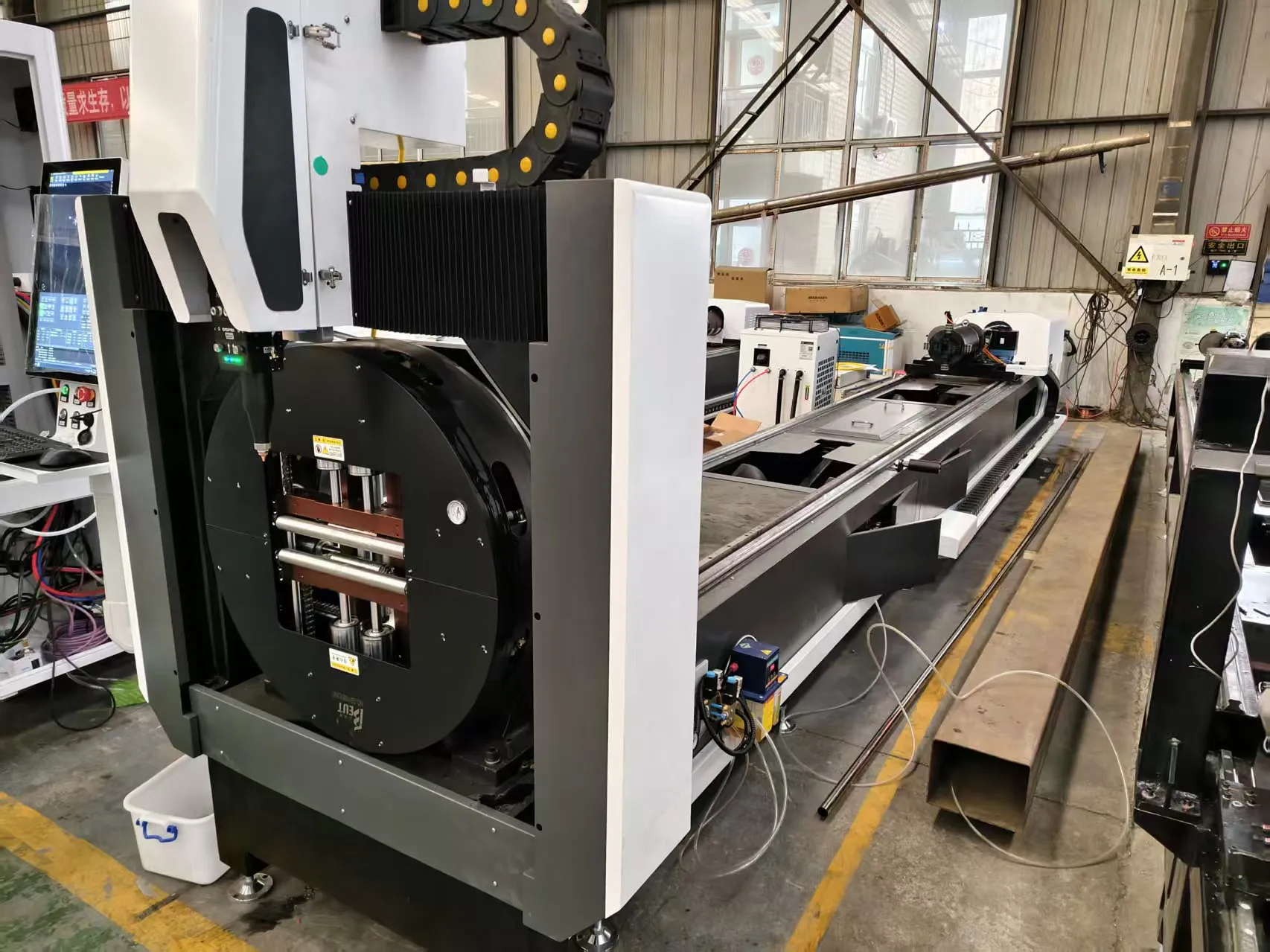
System Architecture and Energy Dynamics in Tube Laser Processing
Ergonomic office chair frames present a distinct set of fabrication challenges. The tubular geometries—typically 25mm to 50mm OD with wall thicknesses between 1.2mm and 2.5mm—must accommodate compound miter cuts, elliptical coped joints, and slot features for gas struts and lumbar mechanisms. When production scales exceed 800 units per shift, the selection of an automatic fiber laser tube cutter for ergonomic office chair frames becomes a thermodynamic and economic calculation rather than a simple capital equipment decision. The dominant cost drivers are not the laser source itself, but the electro-optical conversion efficiency, the high-pressure assist gas consumption, and the duty cycle management of the chucking system.
This analysis focuses on the green manufacturing metrics of a 3kW single-mode fiber laser integrated with a 6-meter automatic loading tube cutter, specifically configured for S355JR, SUS304, and Al6061-T6 chair frame alloys. The objective is to quantify the energy and gas savings achievable when replacing conventional plasma and mechanical sawing lines.
Electro-Optical Conversion and Wall-Plug Efficiency
Modern fiber laser sources achieve wall-plug efficiency (WPE) between 30% and 40% for 1µm wavelength emissions. In contrast, CO2 laser sources operate at 8% to 12% WPE. For a 3kW fiber source, this translates to a total electrical draw of approximately 8.5kW to 10kW, versus 30kW for an equivalent CO2 system. When multiplied across a two-shift operation (16 hours), the energy delta exceeds 300kWh per day. At an industrial tariff of $0.12/kWh, this yields annual savings north of $13,000 per machine—before accounting for chiller loads, which are reduced by 60% due to lower thermal waste.
The electro-optical conversion also dictates beam quality. A 3kW single-mode source (BPP < 0.4 mm·mrad) delivers a focused spot diameter of 80µm to 120µm with a 125mm focal length lens. This is critical for cutting 1.5mm SUS304 at 12 m/min with a kerf width of 0.15mm. The narrow kerf reduces material waste by 8% compared to plasma cutting, which typically produces a 3mm to 4mm kerf on the same alloy.
High-Pressure Assist Gas Optimization: Nitrogen vs. Oxygen
Assist gas is the second-largest operational cost after electricity. For chair frame tubes, the choice between nitrogen (N2) and oxygen (O2) is dictated by alloy and edge quality requirements.
- SUS304 (1.5mm): Nitrogen at 1.4 MPa to 1.6 MPa, purity 99.999%, nozzle diameter 1.5mm. Flow rate: 18 to 22 Nm³/h. Cutting speed: 10 to 12 m/min. Edge quality: bright, oxide-free, suitable for welding.
- S355JR (2.0mm): Oxygen at 0.8 MPa to 1.2 MPa, purity 99.5%. Flow rate: 6 to 8 Nm³/h. Cutting speed: 4.5 to 5.5 m/min. Edge quality: slight oxidation, acceptable for powder coating.
- Al6061-T6 (2.5mm): Nitrogen at 1.5 MPa to 1.8 MPa, purity 99.999%. Flow rate: 25 to 30 Nm³/h. Cutting speed: 6 to 7 m/min. Edge quality: dross-free with proper focus offset of -0.5mm.
The cost disparity is significant. Nitrogen generated on-site via PSA systems costs approximately $0.15/Nm³, while bottled nitrogen costs $0.80/Nm³. For a shop running 4,000 hours annually, the difference between on-site generation and bottled supply for a single machine can exceed $45,000. Oxygen, while cheaper per Nm³, cannot be used on stainless or aluminum without compromising weld integrity and requiring post-processing.
Chuck Pneumatic Pressure and Duty Cycle Management
Automatic tube cutters for chair frames typically employ a dual-chuck system with pneumatic clamping. The clamping pressure must be tuned to prevent tube deformation while maintaining grip during high-speed rotation. For 1.5mm SUS304 tubes with 32mm OD, the recommended clamping pressure is 0.6 MPa to 0.8 MPa. Exceeding 1.0 MPa causes ovalization of the tube cross-section, leading to fitment issues in downstream welding fixtures.
The duty cycle of the chucking system is equally critical. A typical chair frame requires 12 to 18 cuts per tube, with each cut involving a chuck rotation, clamp, and unclamp sequence. At 0.8 seconds per clamp cycle, the pneumatic consumption is approximately 0.02 Nm³ per cycle. For a production run of 2,000 tubes per shift, this equates to 40 Nm³ of compressed air per shift—a cost that is often overlooked but adds up to $1,200 annually at $0.03/Nm³.
Comparative Technical Data: Conventional vs. Fiber Laser
| Parameter | Plasma Cutting | Mechanical Sawing | Fiber Laser (3kW) |
|---|---|---|---|
| Cutting Speed (1.5mm SUS304) | 2.5 m/min | 0.8 m/min | 12 m/min |
| Kerf Width | 3.5 mm | 4.0 mm | 0.15 mm |
| Heat Affected Zone (HAZ) | 1.2 mm | 0.5 mm (mechanical) | 0.08 mm |
| Edge Preparation Required | Yes (grinding) | Yes (deburring) | No |
| Energy Consumption per Cut | 0.45 kWh | 0.22 kWh | 0.06 kWh |
| Assist Gas Cost per Cut | $0.12 (O2) | $0.00 | $0.04 (N2 on-site) |
| Material Waste per Tube | 8% | 12% | 2% |
| Duty Cycle (Chuck/Clamp) | N/A | Manual | 0.8 sec automatic |
Green Manufacturing Metrics and ROI
The cumulative effect of these parameters is a reduction in CO2 emissions per chair frame. Assuming a grid emission factor of 0.5 kg CO2/kWh, the fiber laser process emits 0.03 kg CO2 per cut, versus 0.225 kg for plasma and 0.11 kg for sawing. For a production volume of 500,000 cuts annually, the fiber laser avoids 97.5 metric tons of CO2 compared to plasma.
From a financial perspective, the total cost of ownership (TCO) over five years for a 3kW fiber tube cutter, including capital, maintenance, gas, and electricity, is approximately $0.18 per cut. Plasma is $0.42 per cut, and sawing is $0.31 per cut. The payback period for the fiber laser investment typically falls between 14 and 18 months when replacing a plasma line, and 20 to 24 months when replacing a sawing line—assuming a two-shift operation and on-site nitrogen generation.
Procurement FAQ for Industrial Buyers
What is the optimal laser power for cutting 2.5mm Al6061-T6 chair frame tubes?
A 3kW single-mode fiber laser is the minimum for consistent 6 m/min cutting of 2.5mm Al6061-T6 with nitrogen assist gas. Higher power (4kW to 6kW) improves speed but increases kerf taper and may require dual-chuck synchronization to manage thermal expansion. For mixed alloy production, a 3kW source with adjustable focus and 1.5mm to 2.0mm nozzle diameter is recommended.
How does on-site nitrogen generation impact the operational cost of a tube laser?
On-site PSA nitrogen generation reduces gas cost from $0.80/Nm³ (bottled) to $0.15/Nm³. For a machine consuming 22 Nm³/h over 4,000 hours annually, the annual savings exceed $57,000. The PSA system requires a 0.5 MPa to 0.8 MPa feed pressure and a dedicated compressor, but eliminates delivery logistics and cylinder handling.
What pneumatic clamping pressure is safe for thin-wall stainless steel chair frames?
For SUS304 tubes with 1.2mm to 1.5mm wall thickness, clamping pressure should not exceed 0.8 MPa. Exceeding this causes ovalization and work-hardening at the clamp interface. Use soft jaws with polyurethane inserts and a pressure regulator set to 0.6 MPa for 1.2mm walls and 0.8 MPa for 1.5mm walls. Always verify roundness within 0.05mm after clamping.













