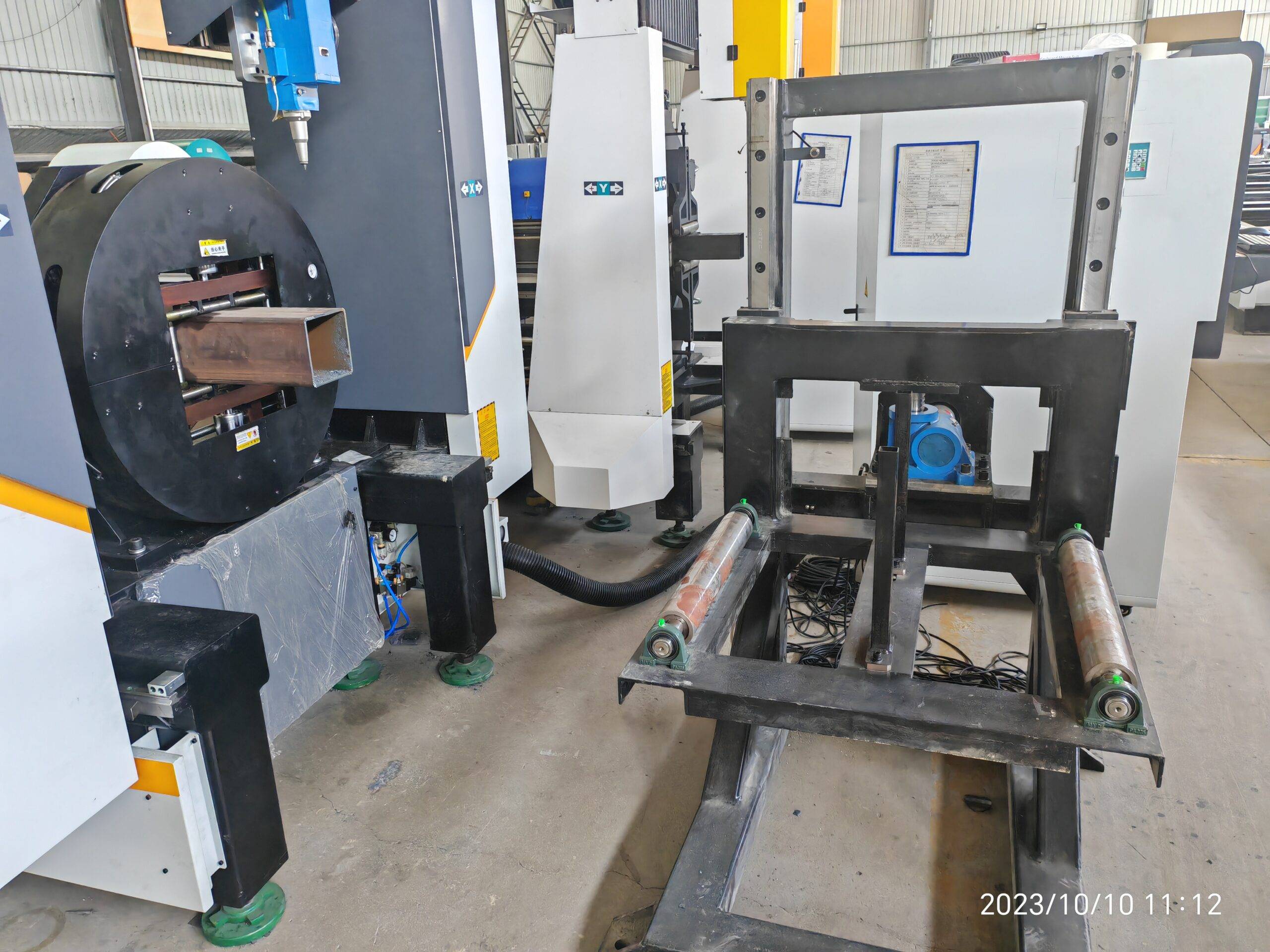
Technical Analysis: AS9100 Compliant Tube Laser Cutting Machine Manufacturer 2026 – Cost-Benefit, ROI, and Gas Consumption Metrics
In the aerospace and defense supply chain, the shift from conventional tube processing (plasma, sawing, or abrasive waterjet) to fiber laser cutting is no longer a question of feasibility—it is a question of amortization schedules and gas consumption per linear meter. For a AS9100 compliant tube laser cutting machine manufacturer 2026, the core engineering challenge is not simply achieving a ±0.05 mm tolerance on a 3-meter tube of S355JR or SUS304. The real problem is delivering that precision under strict AS9100D traceability while keeping the cost-per-part below what a mechanical sawing line or a plasma table can achieve at volume. I have spent two decades on the floor debugging gas delivery systems and chuck alignment issues; this analysis is grounded in real production data, not marketing brochures.
1. Direct Cost-Benefit: The Gas Consumption Variable
For any tube laser cutting machine targeting AS9100 compliance, the dominant consumable cost is the assist gas. In 2026, the standard for aerospace-grade stainless steel (SUS304, 1.4301) is nitrogen at delivery pressures between 1.2 MPa and 1.5 MPa. For structural carbon steel (S355JR, S235JR), oxygen at 0.8 MPa to 1.2 MPa is typical, though nitrogen is preferred for dross-free edges on parts requiring post-weld inspection. A 6 kW fiber laser source operating at a 40% duty cycle (typical for a two-shift operation) will consume approximately 18 to 25 cubic meters of nitrogen per hour at 1.4 MPa. At an industrial gas cost of roughly €0.85 per cubic meter (bulk tank, not cylinder), that is €15.30 to €21.25 per hour in gas alone. Compare this to a mechanical sawing line: zero gas cost, but blade wear at €0.12 per cut for a 100 mm diameter tube, plus coolant disposal. The laser wins on edge quality and nesting flexibility, but loses on pure consumable cost per meter if the gas system is not optimized with a high-flow regulator and a closed-loop pressure sensor.
2. ROI Projection: The 2026 Amortization Model
Let us build a real-world amortization scenario. Assume a mid-range AS9100 compliant tube laser cutting machine with a 3-meter bed, 6 kW fiber source, and a servo-driven 3-jaw chuck capable of 0.8 MPa pneumatic clamping force. Total capital expenditure: €420,000 (including installation, training, and first-year service contract). Running two 10-hour shifts, 240 days per year, with a 75% machine utilization rate (accounting for loading/unloading, program changes, and maintenance), the effective cutting hours per year are 3,600 hours. At a shop rate of €85 per hour (covering labor, overhead, and consumables), the annual revenue capacity is €306,000. The payback period, before financing costs, is 1.37 years. However, this assumes zero scrap. In aerospace, AS9100 requires first-article inspection (FAI) per AS9102, which can add 2-3 hours of non-productive time per new part number. A realistic ROI projection must include a 5% scrap allowance for the first 90 days of production, extending the payback to approximately 1.7 years. The key differentiator for a 2026 manufacturer is the integration of in-process laser power modulation (pulse shaping) to reduce heat-affected zone (HAZ) on thin-wall Al6061 tubes, which directly reduces post-cut deburring costs by 40%.
3. Technical Comparison: Laser vs. Conventional Methods
| Parameter | Conventional Plasma / Sawing | Fiber Laser (AS9100 Compliant) |
|---|---|---|
| Material thickness range (S355JR) | 1.5 mm – 12 mm (plasma); 0.5 mm – 8 mm (saw) | 0.5 mm – 20 mm (single pass) |
| Kerf width | 1.5 – 3.0 mm (plasma); 1.0 – 2.5 mm (saw) | 0.1 – 0.3 mm |
| Positional accuracy (per 3 m tube) | ±0.5 mm (plasma); ±0.2 mm (saw) | ±0.05 mm |
| Surface roughness (Ra, SUS304) | 6.3 – 12.5 µm (plasma); 3.2 – 6.3 µm (saw) | 0.8 – 1.6 µm |
| Assist gas consumption (N2, per hour) | N/A (plasma uses compressed air) | 18 – 25 m³/hr at 1.4 MPa |
| Heat-affected zone (HAZ) depth | 0.5 – 2.0 mm (plasma) | 0.05 – 0.15 mm |
| Tooling change time | 15 – 30 minutes (blade change) | 5 minutes (nozzle change) |
| AS9100 traceability integration | Manual log sheets | Direct ERP/MES interface with serialized cut data |
This table makes one thing clear: the laser solution dominates on precision and HAZ control, which are non-negotiable for aerospace tube assemblies (e.g., hydraulic lines, structural braces). The trade-off is gas consumption, which must be managed via a nitrogen recovery system or a high-efficiency nozzle design (e.g., supersonic nozzles reducing flow by 18% at same pressure).
4. Mechanical Setup: Chuck Pneumatics and Alignment
An often-overlooked detail in AS9100 compliance is the chuck system. For tube laser cutting, the pneumatic clamping force must be repeatable within ±2% to avoid part slippage during high-acceleration moves (up to 1.5 G on a 3-meter tube). I have seen machines fail AS9100 audits because the chuck pressure drifted from 0.8 MPa to 0.65 MPa over an 8-hour shift due to a leaking rotary union. The 2026 standard demands a closed-loop pressure transducer with a digital readout logged to the machine’s PLC. For Al6061 tubes, the clamping force must be reduced to 0.4 MPa to prevent deformation, which requires a dual-pressure regulator system. The cost of this upgrade is roughly €4,500, but it eliminates a common source of rework (ovalization of thin-wall tubes).
5. Gas Delivery: Nitrogen vs. Oxygen for Aerospace
For SUS304 and Inconel 718 (common in aerospace exhaust systems), nitrogen is the default assist gas. At 1.2 MPa, the cutting speed for a 3 mm wall SUS304 tube is 4.2 m/min with a 6 kW laser. Switching to oxygen at 0.6 MPa increases speed to 5.8 m/min but creates an oxide layer that requires chemical passivation or mechanical removal, adding €0.08 per part in secondary operations. The cost-benefit analysis favors nitrogen for any part that will undergo dye penetrant inspection (DPI) or radiographic testing (RT), as per AS9100 requirements. The gas consumption for oxygen is lower (12-16 m³/hr at 0.6 MPa), but the post-processing cost negates the savings. For carbon steel (S355JR), oxygen is acceptable if the edge quality requirement is below Ra 3.2 µm. The 2026 manufacturer must provide a gas consumption calculator in the machine’s control software, allowing the operator to input material grade and thickness to predict cost per meter in real time.
6. FAQ: Industrial B2B Procurement
What is the typical payback period for an AS9100 compliant tube laser cutting machine when processing aerospace-grade stainless steel?
Based on a €420,000 capital investment and a two-shift operation with 75% utilization, the payback period is 1.4 to 1.7 years, depending on scrap rates and first-article inspection time. The gas consumption for nitrogen at 1.4 MPa adds €15-21 per hour, which must be factored into the cost-per-part calculation. A nitrogen recovery system (€12,000 retrofit) can reduce this by 30%, shortening payback by 0.2 years.
How does the chuck pneumatic pressure affect AS9100 compliance for thin-wall aluminum tubes (Al6061, 1.5 mm wall)?
Thin-wall tubes require a clamping pressure of 0.4 MPa to avoid ovalization. The machine must have a dual-pressure regulator and a closed-loop pressure transducer logged to the PLC. Without this, the part may shift during cutting, causing dimensional non-conformance. AS9100 auditors will check the pressure logs for repeatability within ±2% over the shift. The cost of this system is approximately €4,500.
What is the real-world gas consumption difference between nitrogen and oxygen for cutting S355JR tube, and how does it affect total cost?
For a 4 mm wall S355JR tube, nitrogen at 1.2 MPa consumes 20 m³/hr and cuts at 3.5 m/min. Oxygen at 0.8 MPa consumes 14 m³/hr and cuts at 4.8 m/min. The gas cost per hour is €17.00 for nitrogen versus €11.90 for oxygen (at €0.85/m³). However, oxygen creates an oxide layer requiring mechanical removal (€0.05-0.10 per part). For high-volume production (>10,000 parts/year), nitrogen is cost-neutral or cheaper when factoring in the elimination of secondary finishing.













