Engineering Integration of a Smart Sorting Tube Laser Line for High-Mix Logistics Sorting Frame Production
The specification of structural steel frames for automated parcel sorting hubs has compressed tolerances down to ±0.3 mm on hole pattern locations while requiring throughput rates that outpace traditional band saw and drill-line cells by a factor of four. The frames—fabricated predominantly from square and rectangular ERW tubes in S235/S355 grades ranging from 40 × 40 × 2 mm up to 120 × 80 × 4 mm—must be cut, feature-processed, and kitted in exact sequence to feed downstream robotic welding cells. Manual sortation after cutting introduces non-value-added transport and mismatched component risk. To collapse these process steps, forward-leaning engineering teams have adopted a smart sorting tube laser line for logistics sorting frame that fuses fiber laser cutting, in-line part sortation, and automated bundling into a single, scriptable work cell. This whitepaper details the upstream/downstream automation interfaces, the role of auto-bundling loaders, and the tight coupling to MES/ERP backbones that turns the line from a standalone cutter into a demand-driven segment of a digital factory.
1. Upstream Automation: Auto-Bundling Loaders and Infeed Logic
A production run on logistics frame elements rarely starts with loose, singulated tubes. Mill deliveries arrive in 3- to 6-tonne strapped bundles containing up to 120 bars per pack. The auto-bundling loader—a gantry or articulated-arm destacker—picks entire layers from a cassette buffer, shears the banding, and indexes individual tubes onto a powered alignment conveyor. A laser-based cross-section scanner validates profile dimensions and wall thickness within 0.6 seconds; out-of-spec profiles divert to a reject lane before entering the laser enclosure. This upstream island communicates with the MES via OPC UA, reading the batch material certificate and cross-referencing it against the ERP material master to confirm heat number compliance. The loader’s CNC teaches incremental layer heights, and a spring-loaded centering station eliminates any residual twist that would degrade nest accuracy. The result is a consistent feed rate of 18–22 bars per minute, eliminating the need for an operator to spend 35% of shift time simply breaking bundles and staging material.
2. The Core: Laser Cutting with Dynamic Pneumatic Sorting
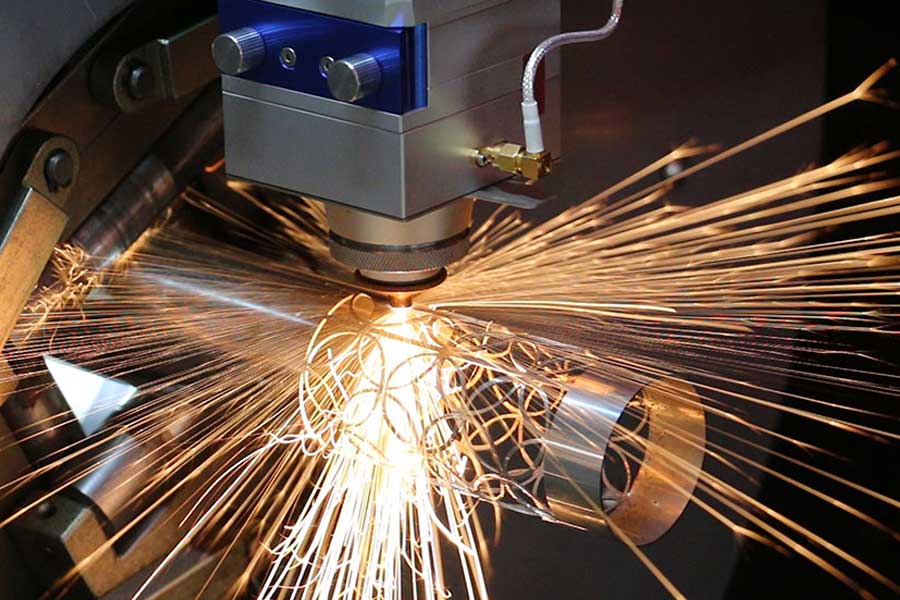
The cutting station utilizes a 4 kW or 6 kW continuous-wave fiber laser with a proprietary auto-focus head capable of ±45° bevel cutting for weld prep on interlocking frame nodes. Tubes advance on a high-acceleration servo gripper that permits push-pull cutting for component lengths as short as 150 mm without slug fall-away. Nested toolpaths on a single parent tube often include six distinct part numbers for different frame sections—uprights, cross-braces, hinge brackets, and mounting tabs. As soon as the last pierce on a part is completed, a synchronized array of pneumatic or servo-driven flippers activates; the cut part drops onto a segmented take-away belt whose speed and divert gates are mapped to the active nest layout. This smart sorting architecture eliminates downstream manual part picking because the part’s destination chute—pre-assigned by the MES kitting logic—is already physically determined the instant the laser head moves to the next feature. Part-per-pick accuracy stays above 99.5% for runs exceeding 2,000 mixed components per shift.
3. Downstream Automation: Kitting, Bundling, and Labeling
Discharged components gravity-feed into parallel lane bins, each dedicated to a single sub-assembly weldment. A double-deck conveyor system separates left-hand and right-hand symmetrical parts to avoid assembly-side confusion—a persistent issue in manual sortation lines. At the end of each lane, a counting sensor triggers an automatic bundle strapper when the exact kit quantity, as defined in the ERP BOM, is reached. The strapper uses PET band with flush tension control to avoid indenting tube walls. The completed bundle then indexes to an inline thermal transfer print station that applies a DuraLabel-grade tag carrying the work order number, destination weld cell, heat/lot trace code, and a unique DataMatrix code. Critically, the bundling signal loops back to the MES to update real-time WIP inventory, thereby triggering the next raw bar call-off from the upstream loader.
4. MES/ERP System Integration: The Data-Driven Execution Layer
The entire line operates on a decentralized architecture where a Siemens or Beckhoff PLC functions as a real-time gateway to the MES layer. The ERP—often SAP S/4HANA or Microsoft Dynamics—releases planned manufacturing orders with full multi-level BOMs and routing times to the MES. The MES, in turn, performs on-the-fly nesting optimization across pending work orders to maximize material yield, considering inventory of residual tube remnants stored in a dynamic remnant database. At the cut-program generation stage, the system assigns a unique serial number to each component instance, linking it to the parent steel heat certificate, the laser process parameters (power, speed, assist gas pressure), and a post-cut dimensional validation record taken by a laser profile scanner integrated after the sortation gate. If a drift in kerf width exceeds 0.08 mm, the system automatically adjusts the tool offset and logs a QA event to the MES’s SPC module. Managers access a tablet-based dashboard that visualizes OEE in real time, broken down into availability (auto-bundling loader uptime), performance (cutting speed vs. theoretical), and quality (first-pass yield per nest). This data flow completely displaces error-prone paper-based job packets and reduces part genealogy investigations from hours to minutes.
5. Operational Outcomes: Throughput, Waste, and Labor Efficiency
One installation processing 350,000 kg of hollow sections per month for multi-tier sortation frames transitioned from two shifts of 11 operators (handling saws, drill lines, and manual sortation) to a single shift run by two technicians supervising the line and loading raw bundles every 90 minutes. Straight-cut scrap dropped from 6.8% to 2.1% of raw material weight because of aggressive nesting that used remnant tubes for small bracket components. More significantly, the welding cell’s fit-up cycle shortened by 11% because stacked tolerances from individual saw cuts were eliminated; components arrived pre-sorted with consistent edge geometry. The ERP-triggered bundling sequence also flattened the WIP curves at weld station buffers, exposing an over-ordering habit that had tied up €120,000 in raw tube inventory.
Procurement FAQ
What tube diameter and wall thickness ranges does a typical smart sorting tube laser line support for logistics sorting frames?
A standard industrial configuration handles round, square, and rectangular profiles with cross-sections between 20 mm and 160 mm and wall thicknesses from 1.5 mm to 6.0 mm. For heavy-duty sorting frame applications using thick-walled S355 structural hollow sections, a 6 kW fiber laser with auto-focus is recommended. Machines can be designed to accept lengths up to 12 meters for auto-bundling loaders, with cut-part lengths as short as 100 mm depending on the gripper system.
How does the auto-bundling loader integrate with an existing ERP system to ensure batch traceability?
The loader’s PLC supports OPC UA or Modbus TCP, enabling bidirectional communication with the MES layer. Upon destacking a new bundle, the operator scans the mill test certificate barcode; the MES queries the ERP inventory module, retrieves the heat number and mechanical properties, and writes them to the tag memory that follows every cut component. The ERP acknowledges consumption and adjusts on-hand stock in real time, preventing mix-ups and providing full lot-level genealogy down to the finished welding assembly.
What are the typical lead time and facility requirements for integrating a full line into an existing structural fabrication shop?
Integration lead time spans 22–26 weeks from order acceptance to production readiness, including 4 weeks for foundation preparation and power/data drops. The line generally requires a footprint of 38 m × 12 m, a compressed air supply rated at 12 bar, and a 400V/50Hz power feed of 150 A. Pre-integration testing at the OEM’s facility validates the nesting algorithm and MES handshake against the customer’s specific frame BOMs, reducing on-site commissioning to two weeks of mechanical leveling, full-load cycling, and dry-run sequence verification.













