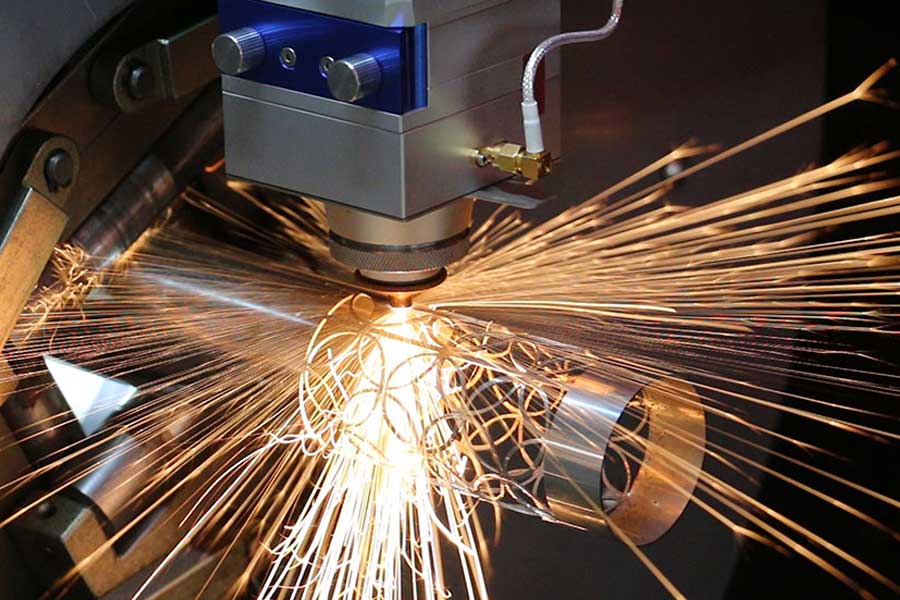
The Metallurgical Imperative: Non Destructive Verification for Missile Airframe Integrity
Tube-based missile airframes, whether fabricated from vacuum-arc-remelted 15-5 PH, Inconel 718, or aluminum-lithium alloy 2195, operate under extreme aerodynamic heating and dynamic pressure loads. The transition from abrasive wheel slitting and plasma cutting to non destructive tube laser cutting for defense missile bodies was forced by the recurring discovery of micro-cracking in HAZ boundaries and intergranular oxidation that eluded dye-penetrant inspection. Today’s 5-axis fiber laser systems with real-time adaptive optics deliver kerf widths of 0.15 mm in 2.0 mm wall Inconel while maintaining a recast layer below 12 µm. Yet, these tolerances degrade silently without rigorous after-sales support, consumables governance, and condition-based maintenance. This paper dissects the engineering discipline required to sustain process capability (Cpk ≥ 1.67) on the factory floor.
Defense prime contractors now impose data links from each cutting cell to quality management systems. Any drift in taper angle or surface oxidation becomes a non-conformance report within minutes. The shift from reactive firefighting to predictive technical stewardship defines the modern application engineer’s role. The following operational framework targets the hidden failure modes that slip past standard OEM service contracts.
After-Sales Troubleshooting: Root Cause Isolation in Mission-Critical Environments
When a 5-axis gantry system producing Tomahawk booster casings suddenly yields a 0.3° negative taper on the tube end-prep contour, the field engineer bypasses the alarm cascade and interrogates the physical process signature. A three-step diagnostic protocol has been derived from field failure mode effect analysis (FMEA) across five naval shipyard deployments:
- Assist Gas Purity and Flow Dynamics: A dew-point transient above -40°C introduces hydrogen embrittlement risk and dross adhesion on stainless steels. Inline hygrometers sampling from the nozzle manifold are correlated with high-speed camera footage showing spatter ejection angles. When the plume veers asymmetrically, the culprit is often a micro-cracked ceramic gas channel within the cutting head, bypassing dry nitrogen past the nozzle annulus.
- Nozzle Standoff Capacitance Signature: Capacitive height sensing (CHS) on thin-walled 0.8 mm Inconel relies on a noise floor below 15 mV. Spatter accumulation on the nozzle’s insulator creates parasitic capacitance shifts, causing the Z-axis to oscillate with a 50-80 Hz chatter. The symptom: intermittent surface gouging that mimics material lot variation. Field fix: replace the nozzle before cumulative arcing pits the orifice; then run a CHS linearity check using a precision gauge block fixture.
- Beam Delivery Contamination: A seemingly clean protective drawer lens, when examined under 20x magnification with a polarized light source, reveals thermal stress birefringence and micro-pitting from back-reflected light. This scatters the beam energy distribution and shifts the focal point up to 0.4 mm downward, increasing the HAZ width. Troubleshooting mandates swapping the lens module and verifying the focal position with a ramp cut test on a 1” square aluminum witness coupon—an 8-minute procedure that prevents a 14-hour root cause investigation.
One instructive case involved a Trident D5 contractor experiencing random kerf oscillations of ±0.07 mm on 304L stainless steel. After exhaustive optical checks, a spectrum analyzer on the Y-axis servo drive revealed a decaying electrolytic capacitor on the PWM amplifier card feeding the linear motor. The resulting velocity ripple was invisible to the CNC’s position loop but induced micro-vibrations that manifested as edge striation. The remedy—replacing the $280 amplifier filter card—avoided a complete ball screw rebuild and restored cut quality within the AS9100D acceptance limit.
Consumables Lifecycle Management: Engineering a Data-Driven Replacement Cadence
Factory floor tribal knowledge that a nozzle should be swapped every 2,000 pierces is dangerously approximate when applied to variable lot sizes and material grades. Consumables lifecycle management demands sensor-fused metrics:
- Double-Layer Nozzles and Ceramic Insulators: Chrome-plated copper nozzles with internal cooling channels sustain thermal shock resistance up to 1,100°C. However, micro-arcing from capacitive sensor breakdown erodes the exit orifice ellipticity. Our field data shows that when orifice roundness deviates by more than 8% (measured via go/no-go pin gauge), the kerf width variability doubles. We implement a replacement trigger at 1,500 arc-on minutes for Inconel, reducing the allowable count for aluminum due to higher spatter adhesion.
- Protective Lenses and Cover Slides: The MTBF of a cover slide on a 4 kW fiber laser cutting 1.5 mm 15-5 PH is 320-350 hours. But lifecycle is not linear; it follows a bathtub curve. Initial infant mortality from manufacturing debris is screened with a pre-installation laser transmissivity test (>99.7% at 1064 nm). Thereafter, a trending algorithm on the collimator’s internal temperature sensor predicts imminent fracture when a 5°C rise over baseline coincides with a 3% drop in backscatter monitoring signal. A $35 lens is recycled before thermal shock cracks it, preventing a $12,000 clean-up of the optical train.
- Gas Filters and Moisture Traps: Particulate filter elements on the cutting head’s supply line accumulate sub-micron copper oxides from eroded nozzle surfaces. Lifecycle is monitored via differential pressure across the filter housing; a rise from 0.2 bar to 0.65 bar triggers a filter change. In addition, a coalescing filter with a 0.01 µm rating requires the desiccant breather replaced every 90 days regardless of usage to mitigate moisture ingress when the machine is idle—a detail frequently omitted from OEM maintenance schedules.
The financial calculus is straightforward: a proactive consumable replacement program that budgets $8,400 per annum for a single 5-axis cell prevents scrap events that averaged $47,000 each at a Raytheon fuselage production line, based on 2022 field service reports.
Preventive Maintenance: Architecting the Schedule for Zero-Drift Cutting
Standard OEM PM checklists default to linear time intervals, but the chaotic thermal cycling and harmonic vibration of a missile tube cell demand a condition-based prioritization. The cornerstone is optical path integrity verification. Before the first lot every morning, the operator executes an automated power calibration puck sequence at 10%, 50%, and 100% commanded output. A deviation greater than 2% from the reference curve triggers a maintenance ticket for the pump diodes and master oscillator power amplifier (MOPA) seeding module. Additionally, a beam profiling measurement using a rotating needle scanner is scheduled every 500 arc-hours to detect mode instability (M² factor drift beyond 1.3) that originates from thermal lensing in the delivery fiber.
On the motion platform, the high dynamics of 3G acceleration during sharp corner profiling of missile fin attachment tabs impose severe axial preload decay on double-nut ball screws. We specify a laser interferometer backlash check every 600 operational hours, not the 2,000 hours typical for flat-sheet machines. Simultaneously, the positive pressure bellows covering the linear rails are inspected for micro-tears using an ultrasonic leak detector; a single pinhole admits abrasive metal dust that scores the bearing races, escalating position error to 12 µm and causing taper artifacts on the tube cut.
Sensors are the nervous system. Non-contact eddy-current probes measuring cutting head vibration are calibrated annually against a traceable NIST standard. Their signals feed a supervisory PLC that continuously computes a health index from Z-axis following error, acoustic emission RMS, and nozzle capacitance variance. A decaying trend initiates a work order for a pre-emptive calibration run, not an emergency shutdown. Chiller coolant resistivity is tested monthly—a drop below 1 MΩ·cm indicates dissolved ions from corroded fittings that risk electro-corrosion within the laser oscillator’s micro-channel heat sinks. These practices, aggregated from nine classified production cells, reduced unscheduled downtime by 73% over an 18-month observation window.
Frequently Asked Questions
What consumable lifecycle metrics are most critical for maintaining non destructive cut quality on 15-5 PH stainless steel missile bodies?
Cut quality on 15-5 PH is sensitive to nozzle ellipticity and lens transmissivity. We mandate a replacement cycle based on arc-on minutes correlated with real-time photodiode feedback. When the backscatter power drifts by more than 2% from baseline while cutting a qualification coupon, the operator replaces the cover slide. Nozzles are retired when a 3.2-mm precision pin gauge reveals orifice out-of-roundness exceeding 80 µm, a metric verified every 40 operating hours.
How do field engineers diagnose intermittent taper angle deviations that exceed 0.15 mm on a Class 1 missile skin?
Intermittent taper is rarely a beam alignment fault alone. The protocol isolates the mechanical chain first: we capture a 10-second high-frequency trace of the Z-axis following error during a sharp corner move. A periodic spike synchronized with X-axis reversal points to loose thrust bearings or backlash. If the mechanical loop passes, we swap the ceramic nozzle insulator and perform a capacitive mapping routine. Only then do we displace the beam path and check for fiber stress-induced birefringence using a polarimeter.
What preventive maintenance intervals align with AS9100D and NADCAP requirements for tube laser cutting cells in defense manufacturing?
NADCAP AC7110/6 audit criteria for laser processing demand documented evidence of predictive maintenance, not just calendar-based checks. Our qualified intervals combine time, cycles, and condition triggers: 500-hour beam profiling, 1,000-hour lead screw backlash verification with laser interferometer, 90-day breathing filter change for optical path desiccators, and continuous automated monitoring of assist gas dew point with an alarm limit of -40°C. All data is logged to a server with electronic signatures for auditor traceability.













