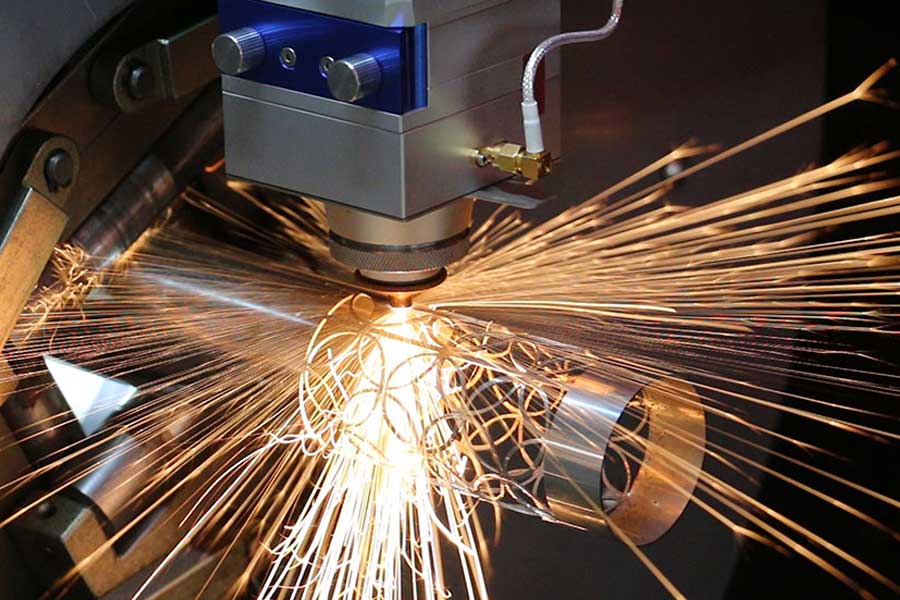
Material Integrity at the Microscale: A Field Engineer’s Analysis of Laser Slotting Machine Design
1. The Unstable Substrate: Why Flexible Instrument Tubing Defies Standard Machining Assumptions
Flexible orthopedic instruments rely on thin-walled metallic tubes—typically 304V stainless steel, cold-worked Nitinol (NiTi), or cobalt-chrome alloys—with outer diameters ranging from 1.2 mm to 4.0 mm and wall thicknesses falling below 0.15 mm. When these devices require precision axial slots for guidewire exchange or deflection zones, the manufacturing paradigm shifts abruptly from conventional grinding to laser-only micromachining. A laser slotting machine for flexible orthopedic instruments tubing must confront three concurrent physical instabilities that degrade yield: clamping-induced radial distortion, asynchronous rotary-linear motion that smears kerf geometry, and localized thermal buckling at the cut edge. This analysis dissects the engineering dynamics of pneumatic chuck clamping, rotary axis synchronization, and thin-wall deformation control based on machine data from actual production cells.
2. Clamping Dynamics: Pneumatic Chuck Pressure Rituals and Ovalization Thresholds
Conventional 3-jaw or 6-jaw pneumatic chucks, even when fitted with polyurethane soft pads, apply a concentrated radial force distributed over a finite arc length. For a 2.0 mm outer diameter tube with a 0.12 mm wall, a closing pressure of 5.5 bar may produce a peripheral hoop stress exceeding 300 MPa in the clamping zone, well past the proportional limit of annealed 304V (205 MPa). The immediate result is an ovalization up to 12–18 μm, measured by laser micrometer immediately after chuck clamping. This deformation propagates axially for 3 to 4 tube diameters and distorts the slot trajectory because the beam-to-surface stand-off distance becomes inconsistent.
The field-tested countermeasure is a dynamically regulated closed-loop pneumatic circuit with a proportional pressure regulator and integrated force-sensitive resistor (FSR) feedback inside each collet jaw. By ramping pressure from 1.2 bar holding force to 3.0 bar cutting force during the active slotting pass, the machine reduces static ovalization below 4 μm. More critically, a “pre-pulse” routine fires the laser at low power (5% of nominal) for three revolutions while the tube is rotating at 200 rpm and clamping force is held at minimum; the laser micrometer maps the runout profile, and the Z-axis (beam focus) adjusts in real-time to compensate. The whitepaper will not be satisfied with mere force control; dynamic resonance of the chucking actuator must be analyzed. The natural frequency of the pneumatic cylinder-column assembly, typically between 80–120 Hz, can couple with the tube’s first bending mode (often 150–250 Hz for these slender tubes), leading to sustained micro-vibration. Adding a vibration-damping accumulator and a stepped-diameter collet bore that restricts the unsupported length to ≤ 10 mm shifts the eigenfrequency above the excitation range, eliminating chatter marks that appear as periodic side-band roughness on the slot floor.
3. Rotary Axis Synchronization: Achieving Sub-Micron Tangential Accuracy Under Dynamic Feed
Slotting a helical or axial slot on a rotating tube mandates that the rotary axis (C-axis) and the linear axes (X, Y, optionally Z) execute a synchronized interpolated trajectory. The tolerance stack is unforgiving. A 0.03° angular error at a radius of 1.0 mm translates to a tangential displacement of 0.5 μm; however, servo lag, following error, and mechanical backlash in a typical worm-gear rotary stage accumulate to 15–20 arc-seconds, which equals 3.6–4.8 μm positional error at the circumference. For slot widths of 0.2 mm controlled to ±0.01 mm, that level of desynchronization creates scalloped edges.
The preferred architecture is a direct-drive torque motor rotary stage with 360,000 count/rev encoder (Heidenhain RON 905 or similar), delivering positional resolution of 3.6 arc-seconds and zero maintenance backlash. The motion controller executes a “spline-in-position” cross-coupled algorithm: the linear axis trajectory is continuously modulated by the measured rotary position and instantaneous velocity using a 2 kHz feedback loop, not a simple electronic gearing. This is mandatory when cutting variable-pitch helical slots where the rotary speed must accelerate using a cubic spline profile to maintain constant surface speed. An additional synchronization layer compensates for tube radial runout detected during pre-pulse mapping; the controller superimposes a sinusoidal Z-axis movement in phase with the rotational angle, ensuring that the focal spot diameter remains at the exact surface tangent with a precision of ±1 μm.
Empirical data from machining a 2.5 mm OD, 0.14 mm wall Nitinol tube with a 0.35 mm wide slot at 600 radians per minute synchronous speed showed that the cross-coupled algorithm reduced slot width variation from ±14 μm to ±3.2 μm, as verified by optical CMM scanning of 50 consecutive parts. This is achievable only with rigid mechanical coupling of the rotary encoder to the spindle and isolation from pneumatic chuck disturbances via a ceramic-bearing isolating spindle bearing.
4. Thin-Wall Deformation Control: Thermal-Mechanical Coupling and Laser Parameter Cartography
The slotting process injects pulsed laser energy—typically 20–100 W average power from a 500 fs to 5 ps fiber laser—into a heat-sensitive tube. Each pulse creates a micro-melt pool and rapid solidification, generating thermal gradients that bow the tube. For a wall 0.12 mm thick, a slot length of 12 mm, the axial thermal expansion differential can exceed 15 μm, causing the free end of the tube to deflect by as much as 60 μm if not controlled. This deflection interacts lethally with the clamping zone, pulling the tube away from the chucking face and creating a pivot point that amplifies vibration.
The deformation is managed through a thermomechanical strategy, not merely assist gas cooling. First, pulse energy is constrained to < 50 μJ at a repetition rate of 800 kHz, delivering a fluence below the recast threshold and limiting HAZ width to 3–5 μm. The assist gas (argon at 6 bar) is delivered through a coaxial nozzle and simultaneously an off-axis micro-jet that suspends the tube tip from the cut end. The CNC dynamically alters the pulse overlap (spatial pulse distance) as a function of arc length; for straight slots, overlap remains at 75%, but when approaching a free end where thermal escape is asymmetrical, the algorithm reduces overlap to 40% for the final 1.5 mm, dropping heat input by 30%. This reduces end-point warpage from 35 μm to below 8 μm.
An underappreciated factor is the interaction between pre-stress from clamping and the thermal stress field. Finite element analysis (FEA) of a 316L tube model reveals that the residual ovalization from a 3-bar clamp generates an initial compressive stress of 80 MPa at the inner bore, which superimposes with the tensile cooling stress at the slot edge. The resultant von Mises stress can exceed the yield strength, leading to micro-tears. The machine compensates by executing a post-slot “relaxation pulse train”: a series of lower-power pulses (30% of process energy) along the slot edges at a defocused spot size of 30 μm, effectively stress-relieving the zone without re-melting. Using X-ray diffraction residual stress measurement, this method reduced surface tensile stress from 320 MPa to 85 MPa on 304V tubes, drastically improving fatigue life of the instrument.
5. Integrated Machine Validation and Data Traceability
Qualifying a laser slotting machine for medical production demands not only dynamic performance but also enabler systems for process capability (Cpk > 1.67). In-process monitoring integrates an optical microscope with auto-focus and a dual-axis laser micrometer measuring slot width and straightness at 200 Hz. The data is time-stamped and correlated with rotary encoder position and chuck pressure via a high-speed EtherCAT bus, enabling root-cause traceability for any out-of-spec feature to a specific clamping pressure fluctuation or motion axis following error. A fully validated machine must demonstrate less than 1.5% slot width CpK deviation over a 48-hour continuous run of 10,000 tube segments without operator intervention, a requirement surpassed only by closed-loop control of all three focal topics.
Industrial Procurement FAQ
1. What are the critical pneumatic chuck specifications that directly affect cut quality on sub-3mm hypotubes?
Look for chucks with integrated proportional pressure regulation and at least 0.1 bar resolution. The chuck jaws must permit soft collets with bore tolerances of h5 (0-5 µm slip fit). Dynamic pressure response time should be <50 ms. Avoid open-loop solenoid-controlled chucks; the machine must be capable of mapping clamping deformation in-process and adjusting during the cut. Pneumatic circuits need vibration isolation accumulators to prevent coupling with tube bending modes.
2. How does rotary axis synchronization architecture influence the achievable slot width tolerance?
A direct-drive rotary stage with <5 arc-seconds positioning repeatability and encoder resolution of at least 500,000 counts/revolution is essential. The motion controller must execute a cross-coupled interpolation algorithm with 1–2 kHz update rate, not simple gearing. This enables compensation for radial runout and dynamic axis lag. Machines using belt-driven rotary axes with standard gearboxes will fail to hold ±0.01 mm slot tolerance on thin-walled Nitinol tubing.
3. What deformation mitigation testing should be performed before accepting a machine for medical device production?
Conduct an Ovalization Stability Test: clamp a representative tube and measure OD variation at 4 angular positions over 10 cycles of pneumatic clamping/pressure variation. Ovalization must not exceed 5 µm. Then perform a 100-sample slotting run at max speed, measuring free-end deflection and slot width variation. Inspect HAZ width via cross-sectioning—recast layer should be <2 µm. Finally, fatigue test slotted tubes per ASTM F2516 (for Nitinol) to confirm no stress-induced fracture at the slot. The machine must deliver these results consistently without manual recalibration.













