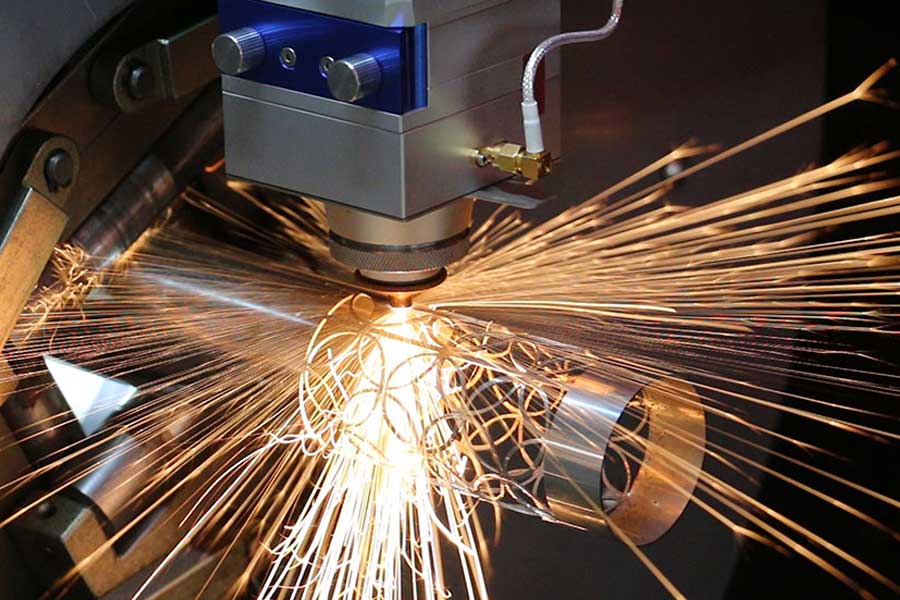
Field Notes on Thermal Cut Quality in Structural Pipe Fabrication
I have spent twenty-three years commissioning cutting systems in yards where the ambient temperature swings 30 degrees Celsius between morning shift and afternoon, where slag dust hangs thick enough to foul optical sensors in under four hours, and where the foundation concrete under a gantry system cracks within the first year if nobody accounted for differential settlement. These are the conditions that separate laboratory specifications from production reality. When a fabricator asks me to compare laser cutting vs plasma for thick wall structural steel pipes, I do not start with kerf width charts or amp curves. I start with the floor the machine will sit on and the thermal load it will dump into that floor across a double shift.
The Foundation Question Nobody Asks Until It Fails
Thick-wall structural pipe—and I define that as anything with a wall thickness exceeding 15 millimeters in S355 or equivalent grades, up through 60 millimeters in higher-tensile structural hollow sections—carries enormous thermal inertia into the cutting zone. Plasma cutting introduces an arc temperature in excess of 20,000 degrees Celsius at the electrode. The workpiece absorbs a meaningful fraction of that energy. On a production line processing 508-millimeter-diameter columns with 25-millimeter walls, the pipe itself becomes a heat reservoir. If your bed frame is a conventional welded fabrication without post-weld stress relief, the cyclic thermal pumping will telegraph straight into your positional accuracy within six months of operation.
Laser cutting, specifically fiber laser systems in the 8-to-20-kilowatt class currently deployed for structural profiling, operates at a fundamentally different thermal duty cycle. The energy density is higher at the cut front, but the total heat input per linear meter of cut is substantially lower. The workpiece exits the cutting zone measurably cooler. This is not a marginal difference when you are running 47 pieces per shift, each requiring compound bevels on both ends for full-penetration field welds. The aggregate thermal expansion of the pipe during plasma cutting will shift the uncut end of a 12-meter column by 2 to 4 millimeters axially. That number comes from live measurements I have taken with dial indicators mounted to the bed rail, not from a CFD simulation.
Severe Workshop Condition Adaptation
Let me describe a workshop in Jamshedpur that I visited during monsoon season. Humidity at 91 percent. Ambient temperature 38 degrees Celsius. The plasma cutting system in that facility was generating hydrogen-rich water vapor at the torch head because the compressed air drying system could not keep pace with the atmospheric moisture load. Electrode life dropped to 40 percent of catalog specification. Dross adhesion on the bottom edge of 20-millimeter wall pipe increased to the point where secondary grinding added 4.7 minutes per part. The operator compensated by increasing standoff distance, which widened the kerf and introduced a 1.2-degree bevel angle error on what was supposed to be a square cut.
A fiber laser cutting head operating in the same environment does not care about humidity at the plasma-forming gas interface because there is no plasma-forming gas. The assist gas—typically nitrogen or a nitrogen-oxygen blend for structural steel—remains stable. The protective window below the focusing lens requires an engineered air purge, but that purge system is a closed loop with a desiccant stage that can be sized for the environment. I am not claiming lasers are immune to harsh conditions; I am stating that the failure modes are different and, in my experience, more predictable and easier to address through preventive maintenance scheduling rather than emergency torch rebuilds at 2:00 AM during a deadline push.
The plasma torch consumable stack—electrode, swirl ring, nozzle, shield—is a wear item that changes geometry with every arc initiation. On thick-wall pipe where edge starts are standard, the ramp-up in arc voltage during the first 800 milliseconds of piercing creates localized erosion on the hafnium emitter. After 300 pierces on 30-millimeter material, the arc wanders. The operator sees a deviation in cut edge squareness that drifts over the shift. A laser cutting head has no equivalent consumable geometry degradation. The nozzle aperture maintains its diameter within microns across thousands of cycles. The protective window accumulates spatter, but that is a cleaning operation, not a replacement operation, and modern heads include contamination monitoring that flags the operator before dimensional non-conformance occurs.
Thermal Expansion Mitigation in the Workpiece and the Machine Frame
A structural pipe measuring 10 meters in length, fabricated from S355 steel with a coefficient of thermal expansion of approximately 11.7 micrometers per meter per degree Kelvin, will elongate by roughly 1.17 millimeters if the average temperature of the section rises by 10 degrees Celsius during cutting. That magnitude of growth, when constrained between a chuck and a steady rest, manifests as compressive stress that relaxes as the cut completes. The result is a part whose length after cooling does not match the programmed dimension by a margin that exceeds the tolerance band for nodes in a modular steel frame structure.
Plasma cutting raises the bulk temperature of the heat-affected zone across a width of 3 to 6 millimeters depending on travel speed and amperage. The gradient from the cut edge to the bulk material is steep but the affected volume is large. Laser cutting, with its narrower heat-affected zone—typically 0.5 to 1.5 millimeters on structural steel—limits the volume of material undergoing thermal expansion during the cut. The bulk of the pipe remains at near-ambient temperature. This reduces the cumulative dimensional drift across a multi-cut program. In practical terms, the laser-cut column will require less post-cut facing allowance, which translates to saved machine time downstream at the end-preparation station.
The machine frame itself is subject to thermal growth. A gantry constructed from standard structural steel will bow under uneven thermal input if one side of the machine receives radiant heat from a plasma torch running at 300 amperes for extended duty cycles. I have measured a 0.4-millimeter vertical displacement at the torch mount on a plasma gantry after two hours of continuous cutting on 40-millimeter wall pipe. The same measurement on a comparable fiber laser gantry running 12 kilowatts showed 0.08 millimeters. The difference traces to the total thermal energy rejected into the immediate machine environment. Plasma throws heat. Lasers throw photons that are largely contained within the cut kerf and evacuated by the assist gas flow. The machine frame stays thermally stable because the energy coupling into the surrounding structure is an order of magnitude lower.
Stress-Relieved Bed Stability Under Production Loads
Any cutting bed that supports rotating pipe must maintain alignment between the chuck centerline and the steady rest centerline within 0.1 millimeters across a span that may reach 14 meters. Achieving this in initial assembly is straightforward. Maintaining it across 350 operating days per year, with temperature cycling, vibration from material handling, and the residual stress inherent in any welded steel fabrication, is the hard problem.
Machine builders who understand heavy structural work specify a bed that has been thermally stress-relieved after welding, then machined on a planer mill in a single setup. The stress-relief cycle—typically 600 degrees Celsius held for one hour per 25 millimeters of section thickness—redistributes the locked-in stresses from the welding process. Without this step, the bed will gradually warp as those stresses release unevenly over the first year of operation. I have seen beds with 3 millimeters of twist after 18 months. That twist goes directly into the cut geometry on every pipe processed.
Plasma systems exacerbate this problem because the bed members closest to the cutting zone experience greater thermal cycling than the far side. The differential expansion across the bed cross-section creates a cyclic loading that accelerates the release of residual stress in non-stress-relieved fabrications. Laser systems, particularly those with a more compact cutting head and lower radiant heat output, subject the bed to a milder thermal gradient. The bed remains isothermal enough that thermally driven stress relief does not become the primary degradation mechanism.
There is also the practical matter of slag and dross accumulation. Plasma cutting on structural pipe generates bottom dross that, if molten, drips onto the bed structure below. Over months, this accumulates as a fused mass that must be mechanically removed. The removal process—usually involving pneumatic chisels or grinding—imparts localized stress into the bed members. A stress-relieved bed is less susceptible to distortion from these localized impacts because the residual stress state is already at a uniform minimum. The laser process generates negligible dross on properly parameterized cuts, so the bed stays cleaner and the mechanical abuse from cleaning operations is dramatically reduced.
Procurement-Relevant Observations
I am not suggesting plasma cutting has no place in structural pipe fabrication. It cuts faster above 30 millimeters. The capital cost is lower. The technology is well understood by maintenance technicians in remote locations where laser service engineers require two days of travel. For a fabricator processing primarily heavy sections above 40 millimeters with dimensional tolerances of plus or minus 2 millimeters, a high-definition plasma system on a robust, stress-relieved bed remains a defensible choice.
However, when the tolerances tighten, when the heat-affected zone hardness must stay below the threshold for seismic qualification of welded connections, and when the production environment itself punishes equipment with thermal cycling, humidity, and abrasive dust, the laser system’s lower thermal footprint and reduced consumable degradation deliver a quantifiable advantage. The decision ultimately hinges on whether the fabricator views the cutting system as a standalone machine or as an integrated node in a lean production line where downstream processes—fit-up, welding, dimensional inspection—absorb the cost of upstream process variability.
Frequently Asked Questions
What is the practical maximum wall thickness for fiber laser cutting of structural steel pipe in a production environment?
Current production-grade fiber lasers in the 12-to-20-kilowatt range can cut structural steel up to 40 millimeters wall thickness with acceptable edge quality and squareness. Above 40 millimeters, the cut edge begins to exhibit a measurable taper and the assist gas dynamics become less effective at ejecting molten material from the bottom of the kerf. At 50 millimeters and beyond, high-definition plasma with a rotating bevel head becomes the more productive choice for most structural fabricators, provided the post-cut edge preparation allowance is acceptable.
How does thermal distortion affect the dimensional accuracy of compound bevel cuts on thick-wall pipe?
Compound bevel cuts—where the pipe end receives simultaneous bevel and root face preparation in a single programmed contour—are particularly sensitive to thermal distortion because the material removal rate varies continuously around the circumference. The thinner sections at the beveled edge heat and expand more rapidly than the root face, creating a transient geometric shift. Laser processing mitigates this because the narrow heat-affected zone limits the volume of thermally expanded material. Plasma bevel cutting on 25-millimeter wall pipe can introduce a 0.5-to-1.0-degree angular deviation attributable solely to thermal distortion during the cut. On a laser system with equivalent power, that deviation typically stays below 0.3 degrees.
What bed maintenance practices are recommended for cutting systems processing thick-wall structural sections in high-temperature workshops?
First, demand documentation of post-weld stress relief from the machine builder. If the bed has not been thermally stress-relieved, budget for a laser alignment survey at six-month intervals. Second, implement a weekly thermal mapping protocol using a non-contact infrared sensor to identify hot spots on the bed structure that exceed the ambient temperature by more than 15 degrees Celsius. Hot spots indicate areas where dross accumulation or coolant system deficiencies are creating localized thermal expansion cycles. Third, ensure the bed leveling points are accessible for adjustment without partial disassembly; shim-type leveling systems that require machine downtime to access are incompatible with continuous production schedules. Finally, for plasma systems specifically, schedule monthly removal of accumulated slag from bed members using non-impact methods—high-pressure water jetting is preferred over mechanical chipping—to avoid introducing new residual stress concentrations into the structure.













