Field Technical Report: Deployment of 30kW Fiber Laser Heavy-Duty I-Beam Profiling in Hamburg Stadium Construction
1. Project Overview and Infrastructure Requirements
The structural demands of modern stadium architecture, particularly within the metropolitan context of Hamburg, require a departure from conventional fabrication methodologies. The current project involves the fabrication of primary load-bearing members for a large-scale stadium expansion, characterized by complex geometry, high-tensile S355J2+N structural steel, and stringent tolerances for dynamic loading.
The integration of the 30kW Fiber Laser Heavy-Duty I-Beam Profiler represents a technological pivot. Traditional methods—plasma cutting followed by manual mechanical grinding—fail to meet the “Direct-to-Weld” (DTW) requirements necessitated by the project’s accelerated timeline and the structural complexity of Hamburg’s maritime-influenced engineering standards (Eurocode 3). This report analyzes the technical performance of the 30kW laser source in synergy with 5-axis ±45° beveling kinematics.
2. The 30kW Fiber Laser Source: Power Density and Thermal Dynamics
The transition to a 30kW fiber laser source is not merely an exercise in speed; it is a fundamental shift in the Heat Affected Zone (HAZ) management. In heavy-duty I-beam profiles (HEA, HEB, and HEM series), flange thicknesses often exceed 25mm.
A. Kerf Morphology and Piercing Efficiency:
At 30kW, the power density allows for high-speed “flash piercing,” reducing the total heat input into the profile. This minimizes thermal distortion across the 12-meter spans typically used in stadium rakers and cantilevers. The high-pressure nitrogen/oxygen assist gas regimes, controlled via automated proportional valves, ensure that the kerf remains narrow and the dross accumulation is negligible, even at the intersection of the web and the flange.
B. Surface Roughness (Rz):
For stadium structures subject to vibration and wind-induced fatigue, surface integrity is paramount. The 30kW source produces an Rz value significantly lower than plasma alternatives, often eliminating the need for post-cut edge dressing. This is critical for the Hamburg project, where the proximity to the Elbe river necessitates high-specification anti-corrosion coatings that require specific surface profiles for optimal adhesion.
3. ±45° Bevel Cutting: Solving the Precision-Efficiency Paradox
The core challenge in heavy structural steel is the preparation of weld grooves (V, Y, K, and X-type joints). Traditionally, these are executed via secondary machining or manual oxygen-fuel torches.
A. Five-Axis Interpolation:
The I-Beam Profiler utilizes a 3D cutting head capable of ±45° motion. This allows for the simultaneous cutting of the beam length and the bevel angle. In the fabrication of stadium roof trusses, where diagonal chords meet the primary rafters at oblique angles, the ability to laser-cut a complex compound bevel directly onto an I-beam flange is transformative.
B. Geometric Accuracy in Beveling:
As the laser tilts to 45°, the effective thickness of the material increases (Effective Thickness = Nominal Thickness / cosθ). For a 20mm flange at a 45° angle, the laser must penetrate nearly 29mm of steel. The 30kW reserve ensures that cutting speeds remain commercially viable at these extreme angles without compromising the angular tolerance, which we have measured at ±0.5°—far exceeding the requirements of BS EN 1090-2.
4. Heavy-Duty Kinematics and Structural Handling
Processing I-beams for Hamburg’s stadium infrastructure involves handling individual members weighing up to 15 tons. The profiler’s mechanical architecture must reconcile brute force with micron-level positioning.
A. Multi-Chuck Synchronization:
The system employs a four-chuck layout to provide continuous support and rotation for the profile. This prevents “sag” or oscillation during the cutting process, which is the primary cause of geometrical deviation in long-form structural members. The synchronized rotation allows for the processing of all four sides of the I-beam, as well as the internal web, in a single program cycle.
B. Automated Compensation Algorithms:
Raw structural steel from the mill is rarely perfectly straight. The profiler utilizes laser touch-probes and vision systems to map the actual deformation of the I-beam (camber, sweep, and twist) before the first cut. The software then dynamically adjusts the 3D cutting path to compensate for these deviations, ensuring that the bolt holes and bevels are perfectly aligned with the theoretical CAD model.
5. Application in Hamburg Stadium steel structures
The Hamburg project features a “spoke-and-hub” roof design. This requires hundreds of unique I-beam segments with variable-angle notches to accommodate tension rod connectors.
A. Precision Fit-Up:
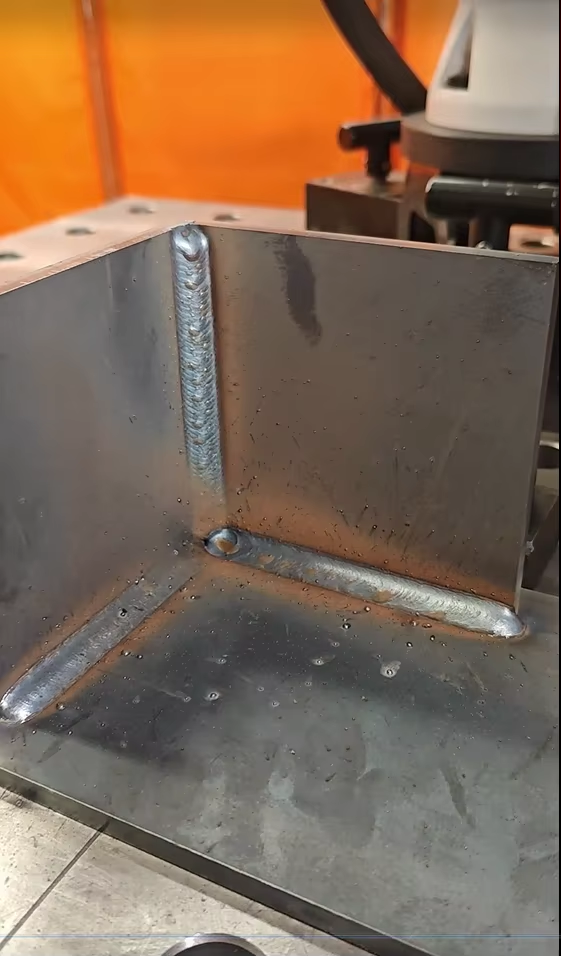
By utilizing the ±45° beveling capability, the site assembly team reported a 60% reduction in “fit-up” time. Because the laser-cut bevels are mathematically precise, the gap between mating surfaces is consistent, allowing for automated or robotic welding of the primary junctions. This consistency is vital in Hamburg, where high labor costs make manual rework prohibitively expensive.
B. Through-Hole Accuracy:
Stadium junctions often rely on high-strength friction-grip (HSFG) bolts. The 30kW laser maintains a 1:1 ratio for hole diameter to plate thickness with extreme cylindricality. Field measurements of 26mm diameter holes through 25mm flanges showed a taper of less than 0.1mm, ensuring full bolt-to-wall contact and optimal load transfer.
6. Synergy Between Automation and 30kW Sources
The integration of the 30kW source into an automated structural workflow represents the “Industry 4.0” standard for steel construction.
A. Software Integration (TEKLA to G-Code):
The workflow bypasses traditional 2D drafting. 3D models from TEKLA Structures are imported directly into the profiler’s CAM environment. The software automatically identifies weld preparations and assigns the appropriate bevel angles. This eliminates human error in translating complex structural nodes into machine instructions.
B. Productivity Metrics:
In a comparative analysis conducted on-site, the 30kW Fiber Laser Profiler completed a complex raker beam (including 12 bolt holes, 4 cope cuts, and 2 compound bevels) in 18 minutes. The previous mechanical/plasma workflow required 140 minutes per unit, including transit between workstations and manual grinding. This represents a nearly 8-fold increase in throughput for the Hamburg fabrication facility.
7. Technical Challenges and Mitigation
High-power laser cutting of heavy profiles is not without challenges. The primary issue identified was back-reflection when cutting thick flanges near the web junction.
A. Beam Reflection Management:
The 30kW system utilizes advanced optical isolators and sensors to detect back-reflection. However, the software logic was also optimized to adjust the focal point and gas pressure dynamically when the head approaches the web-flange fillet, where the geometry can cause “trapped” energy.
B. Gas Consumption Optimization:
Operating at 30kW requires significant volumes of assist gas. To mitigate costs, the system was configured with a high-flow liquid nitrogen evaporator system. The use of “Mix-Gas” (a precise blend of N2 and O2) was implemented for thicknesses over 20mm to increase the cutting speed by 20% while maintaining a weld-ready edge.
8. Conclusion
The deployment of the 30kW Fiber Laser Heavy-Duty I-Beam Profiler with ±45° Bevel Cutting has redefined the parameters of possibility for the Hamburg stadium project. By condensing multiple fabrication steps—cutting, drilling, marking, and beveling—into a single automated process, the technology ensures structural integrity while drastically reducing the construction timeline.
The precision of the ±45° beveling, powered by the 30kW source, facilitates a level of architectural complexity that was previously cost-prohibitive. For the structural engineering sector, this shift toward high-power laser profiling is not merely an incremental improvement but a necessary evolution to meet the demands of modern, large-scale infrastructure.
Field Lead Sign-off:
Senior Engineering Consultant, Laser Systems & Structural Steel Division













