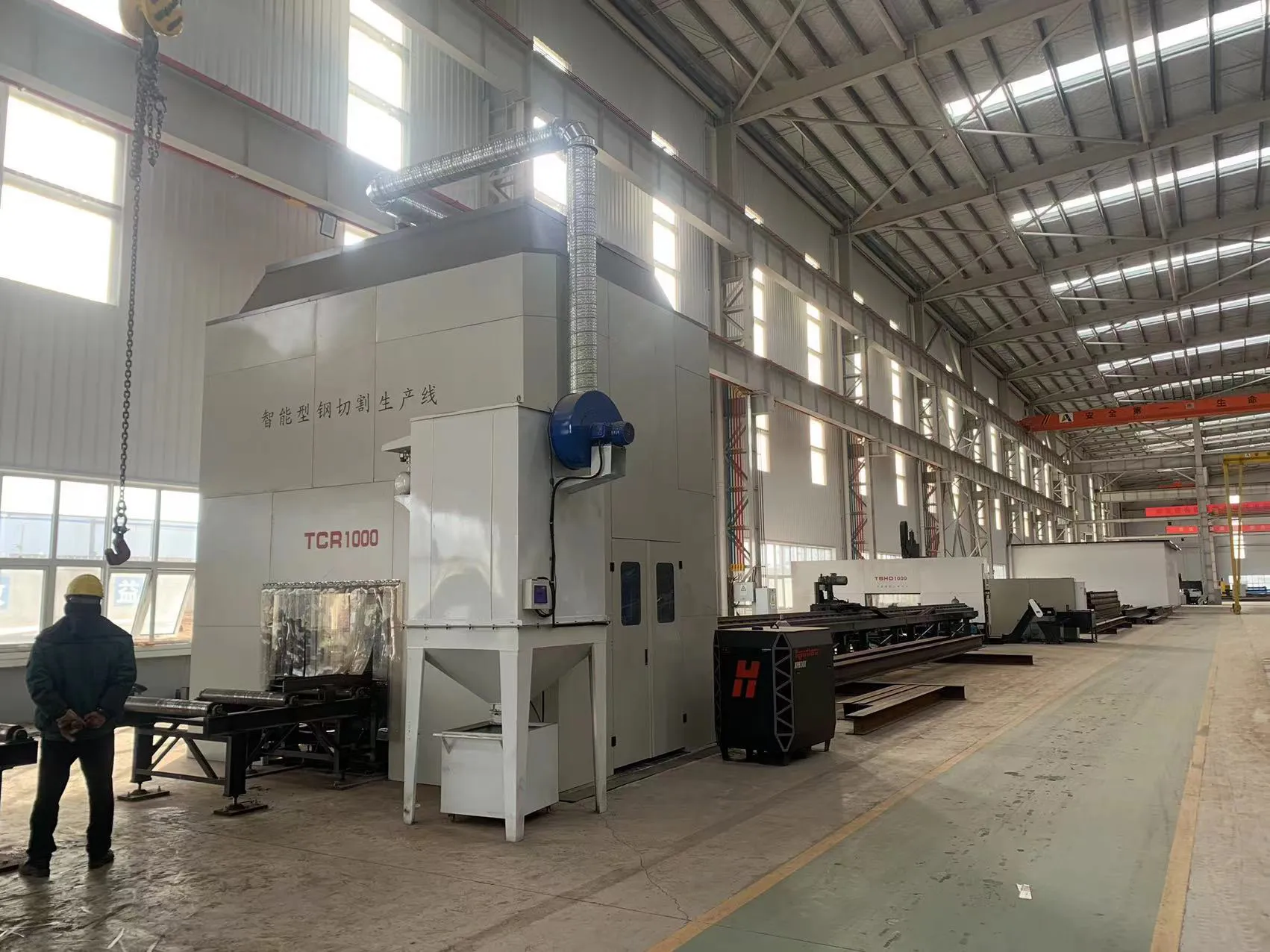
Technical Field Report: 30kW Fiber Laser Integration for Large-Scale Structural Engineering
System Overview and Thermal Dynamics of 30kW Fiber Sources
The deployment of 30kW fiber laser sources in the structural steel sector represents a paradigm shift from traditional plasma or low-wattage laser cutting. In the context of heavy-duty beam and channel processing, the 30kW threshold is not merely about speed; it is about the physics of the Heat Affected Zone (HAZ) and the ability to maintain a stable keyhole during high-thickness penetration.
In Dubai’s high-temperature environment, thermal stability of the laser source is paramount. The 30kW units utilize advanced chiller systems to manage the heat load generated by the ytterbium-doped fiber modules. For structural steels such as S355JR or S460—commonly used in stadium trusses—the 30kW source provides a power density that allows for nitrogen cutting on thicknesses up to 20mm with zero dross, and oxygen-assisted cutting on sections up to 50mm. The primary engineering advantage here is the reduction of secondary grinding operations. The edge quality achieved at 30kW meets the ISO 9013 Range 2 or 3 standards, which is critical for fatigue-sensitive structures like stadium roof cantilevers.
Kinematics of the Infinite Rotation 3D Head
The core innovation in this field deployment is the Infinite Rotation 3D Head. Traditional 5-axis heads are often limited by cable-wrap constraints, requiring “unwinding” movements that interrupt the cutting path and increase cycle times. The infinite rotation capability utilizes high-torque servo motors integrated with specialized slip-ring technology and liquid-cooled optical paths to allow the cutting head to rotate continuously around the C-axis.
In the processing of I-beams (Universal Beams) and U-channels (PFC), the 3D head must navigate the transition from the flange to the web. The Infinite Rotation head maintains a constant perpendicularity or a specific bevel angle relative to the material surface, even when executing complex miter cuts or “bird-mouth” joints for tubular intersections. This eliminates the “dead zones” typical of standard CNC rotators, ensuring that the transition between the flange and the web is seamless, preventing stress concentrations in the finished structural member.
Structural Applications in Dubai Stadium Projects
Complex Geometry in Architectural Steelwork
Dubai’s stadium architecture is characterized by non-linear geometries and massive spans that require precision-engineered moment connections. The 30kW CNC Beam Cutter is specifically utilized to process the primary and secondary steel for these large-span roofs.
Stadium trusses often involve complex miter joints where multiple hollow sections or I-beams converge at a single node. Using the Infinite Rotation 3D head, we can achieve high-precision beveling (V, X, Y, and K types) directly on the machine. This is a critical improvement over manual oxy-fuel beveling. Because the 30kW laser maintains a narrow kerf width, the volumetric accuracy of the bevel is significantly higher, leading to superior fit-up during site assembly. In the context of Dubai’s Mohammed bin Rashid Stadium or similar high-capacity venues, the speed of assembly is dictated by the precision of these joints.
Weld Preparation and Fatigue Life Enhancement
In structural engineering, the weld is often the point of failure, especially under the dynamic loads of a stadium environment (wind loads, spectator movement). The 30kW laser allows for “Ready-to-Weld” edges. The Infinite Rotation head can be programmed to provide a variable bevel angle along a single cut path. For example, a beam intersecting a curved chord can be cut with a bevel that transitions from 30 degrees to 45 degrees to maintain a constant throat thickness for the weld.
This level of precision ensures full penetration welds (FPW) are achievable with minimal filler material. The 30kW laser also minimizes the HAZ compared to plasma cutting. A smaller HAZ means the base metal’s metallurgical properties—specifically its toughness and yield strength—remain intact near the joint, which is a non-negotiable requirement for Dubai’s stringent building codes and third-party inspections (e.g., TUV or Bureau Veritas).
Operational Efficiency and Synergy in Automatic Processing
BIM Integration and CAD/CAM Workflow
The synergy between the 30kW fiber laser and automatic structural processing is realized through direct Building Information Modeling (BIM) integration. Using software pipelines from Tekla Structures or Autodesk Revit directly to the CNC controller, we bypass manual layout marking.
The CNC Beam and Channel Laser Cutter utilizes integrated probing systems to detect the actual dimensions of the raw steel, which often vary from nominal mill specifications (e.g., flange tilt or web eccentricity). The 3D head’s software compensates for these deviations in real-time. For a typical 12-meter H-beam, the system can execute all bolt holes, cope cuts, and weld-prep bevels in a single nesting cycle. In the Dubai sector, where labor costs and project timelines are under constant pressure, reducing the “touch-time” per ton of steel is the primary driver of ROI.
Throughput Analysis: Laser vs. Conventional Methods
A technical audit of the 30kW system in a Dubai fabrication facility shows a throughput increase of approximately 300% compared to conventional drilling and sawing lines.
1. **Hole Precision:** Laser-cut holes for high-strength friction grip (HSFG) bolts exhibit circularity tolerances within ±0.1mm, eliminating the need for reaming on-site.
2. **Marking and Traceability:** The laser is used for etching part numbers and layout lines for stiffener plates, ensuring 100% traceability—a requirement for structural certification in the UAE.
3. **Material Optimization:** The nesting software for beams minimizes “off-cut” waste, which, given the current volatility of global steel prices, provides a significant cost advantage.
Technical Challenges and Solutions in High-Power Laser Cutting
Management of Reflectivity and Plasma Clouds
When cutting thick structural sections at 30kW, the management of back-reflection is critical. While structural steel is less reflective than copper or aluminum, the high power can still damage optical components if the beam isn’t properly modulated. Our field systems utilize optical sensors that monitor back-reflection in real-time, adjusting the laser parameters if a high-reflectivity event is detected during the initial pierce.
Furthermore, at 30kW, the ionization of the cutting gas can create a plasma cloud that interferes with the laser beam. To mitigate this, the 3D head employs high-pressure coaxial gas delivery systems. In Dubai’s humid coastal environment, the compressed air used for cutting (if nitrogen is not used) must be processed through high-efficiency dryers and filters to prevent moisture-induced lens contamination, which can be catastrophic at 30kW power levels.
Nozzle Longevity and Calibration
The 3D Infinite Rotation head requires precise calibration of its focal point across all axes of movement. We implement an automated nozzle cleaning and calibration station within the machine envelope. Every 5 to 10 cuts, the head undergoes a touch-probe calibration to ensure the TCP (Tool Center Point) remains accurate to within 0.05mm. This is vital for maintaining the integrity of bevel angles on heavy-duty channels where even a 1-degree deviation can result in a significant gap for the welding robots to fill.
Conclusion: The Future of Dubai’s Steel Infrastructure
The integration of 30kW Fiber Laser technology with Infinite Rotation 3D heads is no longer an optional upgrade for Tier-1 contractors in Dubai; it is a structural necessity. The ability to process complex S355/S460 sections with high-precision bevels and perfect hole geometry directly from BIM data allows for the construction of stadium geometries that were previously cost-prohibitive. By minimizing the heat input and maximizing geometric accuracy, the industry is seeing a marked improvement in the safety, longevity, and aesthetic execution of steel structures in the Middle East. High-power fiber laser processing has effectively moved the bottleneck from the fabrication shop to the site assembly, setting a new benchmark for structural engineering efficiency.













