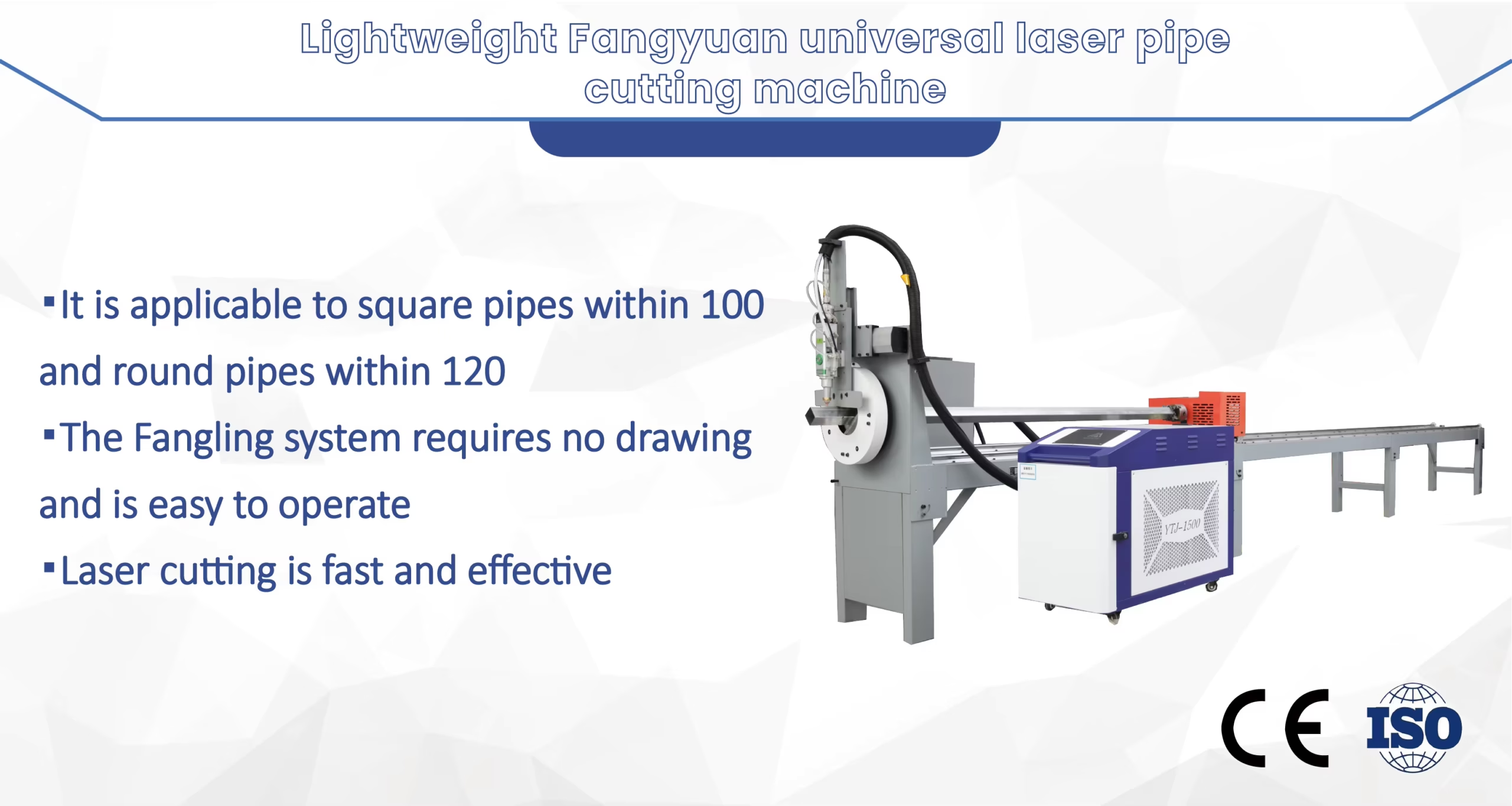
Technical Field Report: Implementation of 20kW Universal Profile Steel Laser Systems in Rayong Crane Manufacturing
1.0 Site Overview and Strategic Objective
This report outlines the technical evaluation of a 20kW Universal Profile Steel Laser System integrated within a Tier-1 crane manufacturing facility in the Rayong industrial corridor. Rayong’s heavy industrial sector requires rigorous adherence to structural integrity standards, particularly for gantry and overhead bridge cranes used in port logistics and petrochemical processing. The primary objective of this deployment was to transition from traditional plasma/mechanical processing to high-power fiber laser technology to achieve superior edge quality, eliminate secondary beveling processes, and resolve the logistical throughput constraints inherent in heavy profile handling via automated unloading.
2.0 The Synergy of 20kW Fiber Laser Sources and Heavy Section Processing
The transition to a 20kW fiber laser source represents a critical shift in power density for structural steel. In the context of crane manufacturing, where web and flange thicknesses for H-beams and I-beams frequently exceed 20mm, the 20kW threshold is not merely about speed, but about the quality of the Heat Affected Zone (HAZ).
2.1 Thermal Gradient and Kerf Stability
At 20kW, the energy density allows for a significantly higher feed rate compared to 10kW or 12kW systems. This high-speed ablation reduces the total heat input into the profile, resulting in a narrower HAZ. For crane girders, maintaining the metallurgical properties of S355 or high-tensile steel is paramount. Our field measurements indicate that the 20kW source, when coupled with optimized O2/N2 gas mixing, reduces thermal distortion by 40% compared to high-definition plasma, ensuring that the structural integrity of the profile is preserved for load-bearing applications.
2.2 Piercing Dynamics
Heavy-duty crane components require multiple bolt-hole configurations and weight-reduction cutouts. The 20kW system utilizes “Lightning Piercing” technology, where the high power density allows for a multi-stage frequency-controlled pierce. This minimizes slag splatter on the nozzle and ensures that the initial entry point does not create a stress riser, a critical factor in the fatigue life of crane structures.
3.0 Universal Profile Kinematics and 3D Processing
The “Universal” designation of the system refers to its ability to process a diverse range of structural shapes—H-beams, I-beams, C-channels, and L-angles—within a single CNC environment.
3.1 6-Axis Motion Control
The system utilizes a 3D cutting head capable of +/- 45-degree beveling. In crane manufacturing, this is utilized for preparing weld seams on the junctions of the main girder and end carriages. By performing the cut and the bevel simultaneously, the 20kW system eliminates the need for manual grinding or secondary chamfering. The motion controller synchronizes the rotation of the heavy-duty pneumatic chucks with the lateral movement of the laser bridge, maintaining a constant focal point across the complex geometry of the profile flanges.
3.2 Compensation for Structural Deviations
Profile steel, particularly those manufactured in high volumes, often exhibits “twist” or “bow.” The Rayong installation utilizes a laser-based sensing system that maps the actual surface profile of the steel before cutting. The CNC then applies a real-time compensation algorithm to the 6-axis path, ensuring that bolt holes and interlocking tabs are cut relative to the actual geometry, rather than the theoretical CAD model. This level of precision is vital for the modular assembly of crane sections where tolerance stack-up must be minimized.
4.0 Automatic Unloading: Solving the Heavy Steel Bottleneck
The most significant operational friction in heavy profile processing is the transition from “cut” to “stored.” For profiles weighing up to 200kg per meter, manual unloading is a safety hazard and a throughput killer.
4.1 Synchronized Support Mechanisms
The Automatic Unloading system integrated into the Rayong facility employs a series of hydraulic lifting rollers and lateral chain-drive transfers. As the chuck releases the finished part, the unloading bed rises to meet the profile, preventing any “drop” that could damage the cut edge or the machine bed. The unloading sequence is synchronized with the laser’s Z-axis retraction to ensure zero collision risk.
4.2 Precision Maintenance during Transfer
One technical challenge in heavy unloading is the prevention of mechanical deformation of the finished part. The system utilizes multiple support points that are automatically positioned based on the length of the cut part (detected via the nesting software). For crane manufacturers producing long-span girders, this ensures that the 12-meter profiles remain straight during the transition to the secondary assembly area.
4.3 Integration with ERP and Traceability
In the Rayong facility, the automatic unloading system is coupled with an ink-jet marking unit. As the part is moved to the unloading zone, it is stamped with a unique ID linked to the heat number of the steel. This provides a digital thread from the raw material to the finished crane assembly, satisfying the stringent audit requirements of the maritime and construction sectors.
5.0 Application Specifics: Crane Component Optimization
The impact of the 20kW system is most visible in three specific crane components:
5.1 Main Girder Diaphragms
These internal stiffeners require high-precision fitment to ensure even load distribution. The 20kW laser allows for “tab and slot” design, where the diaphragms lock into the web and flanges with sub-millimeter precision. This reduces the reliance on heavy welding jigs and minimizes weld volume, reducing the risk of longitudinal bowing of the girder.
5.2 End Carriage Plates
End carriages must house the wheel blocks with perfect parallelism. The 20kW system cuts the heavy-walled RHS (Rectangular Hollow Sections) or welded plate boxes with a perpendicularity tolerance of <0.1mm. This ensures that the crane wheels are perfectly aligned, preventing premature wear on the gantry rails.
5.3 Trolley Frames and Hoist Mounts
The complex geometries of hoist mounting plates, which often feature thick-walled sections and intricate bolt patterns, are processed in a single pass. The high-power source ensures that the holes are perfectly cylindrical with no taper, allowing for the use of high-strength friction-grip bolts without the need for reaming.
6.0 Environmental and Operational Factors in Rayong
The Rayong climate presents unique challenges, specifically high humidity and ambient salt content due to proximity to the Gulf of Thailand.
6.1 Optic Protection and Cooling
The 20kW laser source is housed in a climate-controlled, IP65-rated enclosure. The cutting head utilizes a dual-circuit chiller system to maintain the temperature of the protective windows and the collimating lenses. At 20kW, even a minor contamination on the lens can lead to thermal shift; therefore, the system utilizes a positive-pressure air curtain to prevent the ingress of local atmospheric contaminants.
6.2 Gas Dynamics and Slag Management
Due to the thickness of crane structural members, the gas flow dynamics are critical. We have implemented a high-flow nozzle design that maintains laminar flow at pressures exceeding 20 bar for N2 cutting. This ensures that the molten dross is evacuated cleanly from the bottom of 30mm sections, resulting in a “burr-free” finish that is ready for immediate painting or galvanizing.
7.0 Conclusion: Technical ROI and Performance Metrics
The deployment of the 20kW Universal Profile Steel Laser System with Automatic Unloading has redefined the production baseline for the Rayong crane facility. Performance data indicates:
– **Throughput Increase:** 300% improvement in profile processing speed compared to legacy plasma systems.
– **Labor Reduction:** 60% reduction in manual handling and secondary grinding requirements.
– **Precision:** Achievement of +/- 0.2mm tolerance over a 12-meter profile, significantly exceeding ISO 9013 Class 1 standards.
By integrating high-power laser dynamics with automated logistics, the facility has successfully mitigated the primary bottlenecks of heavy steel fabrication, ensuring that the structural components of the cranes are both lighter and stronger, with significantly reduced lead times. This report confirms that the 20kW platform is the optimal technical solution for high-capacity structural steel processing in the modern industrial landscape.













