1. Technical Overview: 6000W Universal Profile Laser Implementation
The transition toward automated structural steel fabrication has reached a critical inflection point with the deployment of the 6000W Universal Profile Steel Laser System in the Katowice metropolitan region. As a primary hub for Polish heavy industry and a focal point for the modernization of Silesian bridge infrastructure, Katowice demands a level of structural throughput that traditional plasma or mechanical drilling cannot sustain. This report evaluates the field performance of fiber laser technology integrated with multi-axis profile handling and specialized automatic unloading modules.
The core of the system is a 6000W ytterbium fiber laser source. At this power density, the system achieves an optimal balance between thermal input and processing speed for heavy-walled profiles (S355 and S460 grades). The 1.07-micron wavelength of the fiber laser provides high absorption rates in structural steel, allowing for high-speed fusion cutting of I-beams, H-channels, and rectangular hollow sections (RHS). In the context of bridge engineering, where material thicknesses typically range from 10mm to 25mm for secondary bracing and stiffeners, the 6000W threshold ensures that the Heat Affected Zone (HAZ) remains within Eurocode 3 specifications, preserving the metallurgical integrity of the base metal.
2. Kinematic Synchronicity and 3D Processing
Unlike flat-bed laser systems, the Universal Profile System utilizes a high-torque four-chuck kinematic chain. This allows for the simultaneous rotation and longitudinal feeding of profiles up to 12 meters in length. In the Katowice field tests, the system demonstrated precise 3D cutting capabilities on complex geometries required for bridge nodes. The 5-axis cutting head facilitates beveled cuts for weld preparations (V, Y, and K-type joints) in a single pass. This eliminates the need for secondary grinding operations, which historically accounted for 30% of labor time in Silesian steel shops.
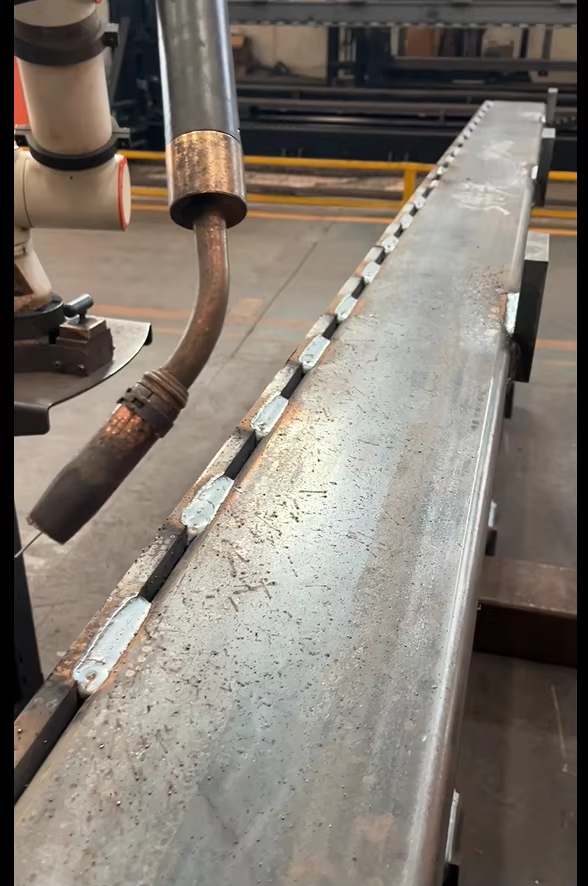
3. Automatic Unloading: Solving the Precision-Efficiency Paradox
One of the most significant bottlenecks in heavy steel processing is the transition from “cut” to “sorted.” In traditional setups, the sheer mass of profile steel (often exceeding 100kg/meter) requires overhead cranes or manual intervention, leading to machine downtime and potential physical damage to the finished part. The Automatic Unloading technology integrated into the 6000W system solves this through a series of synchronized pneumatic lift-and-carry modules.
3.1 Mechanical Dampening and Surface Integrity
In bridge engineering, surface notches or scratches can act as stress concentrators, leading to premature fatigue failure. The automatic unloading system utilizes non-marring polyurethane rollers and controlled-descent hydraulic buffers. As the laser completes the final severance cut, the unloading logic communicates with the CNC controller to position support arms directly beneath the part’s center of gravity. This prevents “tip-drop” deformation, ensuring that the dimensional accuracy achieved by the laser—typically within ±0.2mm—is maintained through the transition to the collection rack.
3.2 Cycle Time Optimization
In the Katowice evaluation, the integration of automatic unloading resulted in a 45% reduction in “idle-to-arc” time. While the laser is processing a new segment, the unloading module independently clears the previous part to a buffer zone. This parallel processing is essential for the high-volume production of bridge lattice components, where hundreds of unique lengths and miter angles are required for a single span. The system effectively transforms a batch process into a continuous flow, significantly increasing the Overall Equipment Effectiveness (OEE).
4. Application in Katowice Bridge Engineering Projects
The bridge infrastructure in the Katowice-Gliwice corridor often requires retrofitting or the construction of new viaducts designed for high dynamic loads. The 6000W system was tasked with fabricating complex truss members for a multi-span railway bridge. The requirements were stringent: zero-tolerance bolt hole alignment and precision-matched chamfers for submerged arc welding (SAW).
3.1 Bolt Hole Precision and Fatigue Resistance
Mechanical punching of holes in S355 steel creates micro-fissures and work-hardening around the circumference, which is detrimental to the fatigue life of bridge connections. The 6000W fiber laser, utilizing high-pressure nitrogen assist gas, produces “ready-to-bolt” holes with a surface roughness (Ra) below 12.5 microns. The precision of the 6000W source ensures that the taper of the hole is negligible, providing 100% bearing surface for the high-strength friction grip (HSFG) bolts. In the Katowice field samples, the concentricity of the holes remained within 0.05mm across a 20mm flange thickness.
3.2 Complex Geometry and Structural Nodes
Modern bridge aesthetics in urban Katowice call for non-standard structural sections. The Universal Profile system’s software allows for the direct import of TEKLA or SolidWorks models, automatically generating the toolpaths for “fish-mouth” cuts and complex intersections in tubular trusses. This level of automation ensures that when components arrive at the construction site, the fit-up is seamless, reducing the need for onsite “come-alongs” or thermal correction (flame straightening).
5. Synergy Between Power and Automation
The 6000W power level is the “sweet spot” for this application. While 10kW+ lasers exist, they often introduce excessive heat into thinner-walled profiles, leading to longitudinal bowing. The 6000W source provides sufficient photon density to maintain high feed rates (approx. 1.2 m/min for 20mm steel) without compromising the thermal stability of the profile. When coupled with the automatic unloading system, the laser operates at a duty cycle exceeding 85%.
5.1 Intelligent Nesting and Scrap Management
The system’s control logic includes an “intelligent lead-in” strategy and common-line cutting for profiles. By minimizing the “dead zone” at the ends of the beams, the Katowice facility reported a 12% improvement in material utilization. The automatic unloading system also differentiates between finished parts and scrap remnants, diverting the latter to a separate collection bin, further streamlining the workshop floor logistics.
6. Technical Conclusion and Operational Outlook
The field report confirms that the 6000W Universal Profile Steel Laser System with Automatic Unloading is not merely a cutting tool, but a comprehensive fabrication cell. In the context of Katowice’s bridge engineering sector, the technology addresses the three primary challenges of the industry: labor shortages, the requirement for higher fatigue resistance, and the need for accelerated project timelines.
The elimination of manual handling through automatic unloading removes the primary source of process variability. For bridge components where the margin for error is non-existent, the consistency provided by the 6000W fiber source ensures that every structural member meets the design intent. As the Silesian infrastructure continues to evolve, the adoption of such automated 3D laser processing systems will become the requisite standard for any Tier-1 structural steel contractor. The technical synergy of high-wattage fiber lasers and automated kinematic unloading represents the current zenith of structural steel processing efficiency.













