Field Technical Report: Implementation of 6000W Universal Profile Laser Systems in Structural Power Infrastructure
1. Site Context and Objective
This report details the operational deployment and performance metrics of a 6000W Universal Profile Steel Laser System with ±45° beveling capabilities within a heavy fabrication facility in Katowice, Poland. The primary objective was the modernization of the “Power Tower Fabrication” workflow—specifically the production of high-voltage transmission lattice towers and substation support structures. Traditionally, these components—comprised of heavy-wall L-profiles, H-beams, and U-channels—required a multi-stage process involving mechanical sawing, hydraulic punching, and manual plasma beveling. The deployment sought to consolidate these operations into a single-pass laser process to achieve sub-millimeter tolerances required for modern energy infrastructure.
2. Technical Specifications of the 6000W Fiber Source
The system utilizes a 6000W continuous wave (CW) fiber laser source. In the context of the Katowice facility, which processes S355 and S460 high-strength structural steels, the 6kW power density represents an optimized equilibrium between cutting speed and edge quality. At this power level, the system achieves high-speed sublimation and fusion cutting of profile thicknesses up to 20mm, which covers 90% of the structural members found in power transmission towers.
The beam parameter product (BPP) of the 6000W source allows for a focused spot size that maintains high energy density even when the laser head is tilted for beveling. This is critical because as the angle of incidence increases, the “apparent thickness” of the material increases (e.g., a 45° cut on a 15mm plate requires the laser to penetrate approximately 21.2mm of material). The 6000W reserve ensures that feed rates remain economically viable without compromising the heat-affected zone (HAZ).
3. Kinematics of the ±45° Bevel Cutting Head
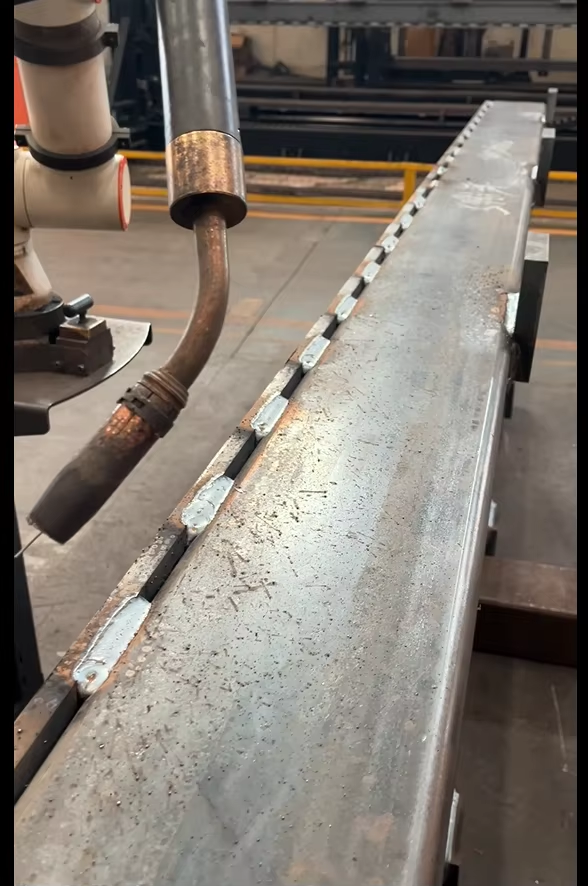
The core technological differentiator in this system is the 5-axis 3D cutting head. Unlike standard 2D laser heads, the universal profile head incorporates two additional rotational axes (A and B), allowing for a ±45° tilt. In power tower fabrication, weld preparation is the most labor-intensive phase. Structural joints require precise V, Y, and K-type bevels to ensure full-penetration welds capable of withstanding extreme aerodynamic loads and ice loading on transmission lines.
The ±45° beveling capability allows for the simultaneous cutting of the profile length and the application of the weld prep geometry. The system’s software dynamically compensates for the focal position relative to the tilted angle, ensuring that the beam’s waist remains at the optimal depth within the kerf. This eliminates the “secondary grinding” phase traditionally required after plasma or oxy-fuel cutting, as the laser-cut edge exhibits a surface roughness (Ra) significantly lower than thermal alternatives, often measuring below 12.5 μm.
4. Universal Profile Processing: H, I, L, and U Geometries
Power towers in the Katowice energy corridor rely heavily on L-shaped angle steel for lattice bracing. Processing these profiles presents a challenge for traditional CNC machines due to material twisting and internal stresses. The Universal Profile Laser System utilizes a four-chuck (or multi-point) clamping architecture that provides high-rigidity support, compensating for the inherent “bow and twist” of hot-rolled profiles.
The “Universal” aspect refers to the system’s ability to transition between different cross-sections without manual retooling. In a single nesting program, the system can process an L-profile bracing member followed by a heavy H-beam flange for a substation base. The laser’s non-contact nature means there is no tool wear—a significant advantage over mechanical drilling and sawing where tool degradation leads to dimensional drift in S460 grade steels.
5. Solving Efficiency Issues in Heavy Steel Processing
Before the integration of the 6000W laser system, the Katowice facility reported a bottleneck in the “Fit-Up and Welding” department. Manual beveling of 15mm angle steel often resulted in angular deviations of ±3°, leading to excessive weld gaps and increased filler metal consumption.
The laser system’s precision (±0.05mm positioning accuracy) solves this through:
- Integrated Hole Cutting: Connection holes for galvanized bolting are cut with the same laser head. This ensures that the hole-to-edge distance is perfectly consistent with the bevel angle, a critical requirement for structural certification under Eurocode 3.
- One-Pass Beveling: By performing the ±45° cut during the initial profile separation, the system reduces the part-handling cycle by 60%. There is no need to transport heavy beams to a separate beveling station.
- Minimal Thermal Distortion: The high speed of the 6000W laser minimizes total heat input. This prevents the “banana effect” (longitudinal bowing) in 12-meter profiles, which is a common failure mode in plasma-cut structural steel.
6. Software Synergy and CAD/CAM Integration
Effective utilization of the ±45° beveling technology is dependent on the synergy between the hardware and the nesting software. In this field application, the system was integrated with Tekla Structures and SolidWorks. The software automatically extracts the bevel requirements from the 3D model and converts them into 5-axis G-code.
A specific feature utilized in the Katowice project is “Automatic Centering.” Hot-rolled profiles often have dimensional variances (flange thickness or web height). The laser system uses a tactile or optical sensing probe to measure the actual dimensions of the loaded profile and shifts the cutting path in real-time to ensure the bevel is perfectly centered. This level of automation reduces the reliance on highly skilled manual operators, a significant factor in the current industrial labor market.
7. Gas Dynamics and Edge Chemistry
For the power tower sector, the choice of assist gas is critical. During this field evaluation, High-Pressure Nitrogen (N2) was used for most 6000W operations to prevent oxidation of the cut edge. This is vital for Katowice-based fabricators who must adhere to strict galvanization standards. An oxidized edge from oxygen-cutting prevents the zinc coating from bonding correctly during the hot-dip galvanizing process, leading to premature corrosion. The N2-cut laser edge is clean and “galvanize-ready,” further reducing the chemical cleaning (pickling) time required in the galvanizing plant.
8. Performance Data and Structural Integrity
Comparative analysis conducted on-site showed that for a standard 200mm x 200mm x 15mm angle steel member, the laser system completed the cut, four bolt holes, and a 45° bevel in 42 seconds. The previous mechanical/manual method required 8.5 minutes of total processing time, including handling.
Furthermore, the fatigue life of laser-cut holes in power towers is superior to punched holes. Punching creates micro-cracks in the cold-worked zone around the hole periphery. The 6000W laser, with its narrow HAZ, preserves the grain structure of the steel, ensuring that the towers can withstand the cyclic loading of wind and vibration over a 50-year service life.
9. Conclusion
The implementation of the 6000W Universal Profile Steel Laser System with ±45° beveling in the Katowice power tower sector represents a fundamental shift in structural steel fabrication. By integrating high-power fiber laser technology with 5-axis kinematics, the facility has effectively eliminated the precision-efficiency trade-off. The system delivers a “Ready-to-Weld” and “Ready-to-Galvanize” part in a single operation, setting a new technical benchmark for the production of energy infrastructure. The synergy of power, precision, and automation ensures that the resulting structures meet the most stringent safety and durability standards required for modern power grids.













