1.0 Technical Overview: The 6000W Fiber Laser in Heavy Structural Environments
In the current industrial landscape of Jakarta’s offshore fabrication sector, the transition from conventional mechanical sawing and drilling to high-power fiber laser profiling represents a significant shift in metallurgical processing. The deployment of a 6000W fiber laser source for heavy-duty I-beam and H-beam profiling is not merely an upgrade in speed, but a fundamental change in the Heat Affected Zone (HAZ) management and structural integrity of offshore components.
The 6000W threshold is critical for the thicknesses encountered in offshore jacket structures and topside modules. At this power density, the beam achieves a high energy concentration capable of sustaining stable vapor capillaries (keyholes) through carbon steel profiles up to 25mm with high-pressure oxygen assistance. For the Jakarta region, where humidity and ambient salt content accelerate oxidation, the precision of the laser cut—measured in microns rather than millimeters—is essential for ensuring that subsequent protective coatings adhere correctly to the cut edges without the micro-cracking often associated with mechanical shearing.
1.1 Beam Parameter Product (BPP) and Kerf Control
The 6000W source utilized in these heavy-duty profilers is engineered for a specific Beam Parameter Product (BPP) that maintains a long Rayleigh range. This is vital when processing I-beams where the distance between the laser head and the lower flange or web varies. High-order mode control ensures that the kerf width remains uniform throughout the depth of the cut, preventing the “tapering” effect that traditionally plagues thick-section thermal cutting. In offshore applications, where T-joints and K-joints must meet stringent AWS D1.1 structural welding codes, the uniformity of the laser-cut edge minimizes the volume of filler metal required during the welding phase.
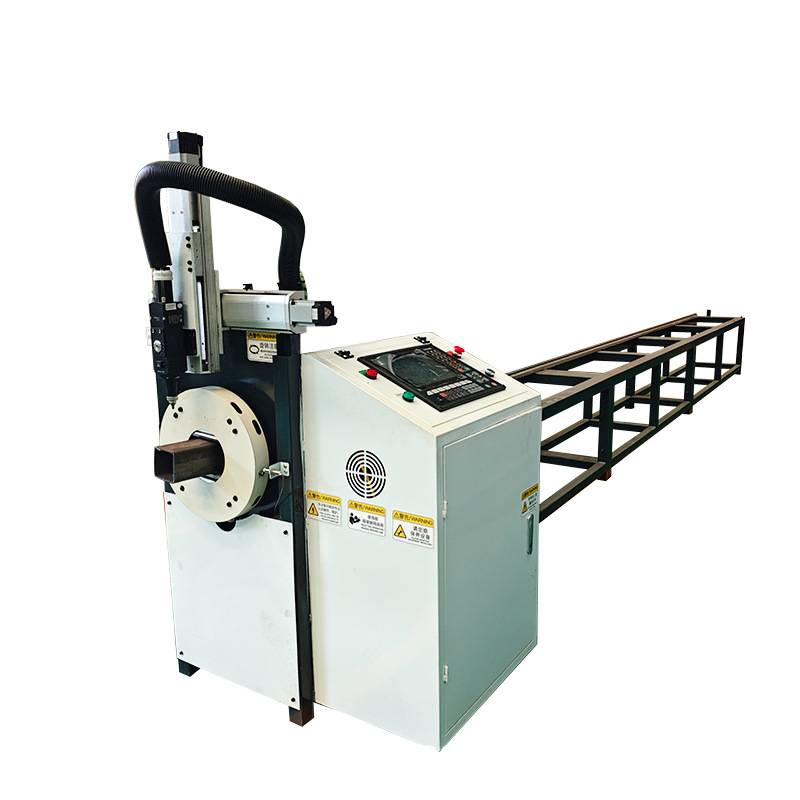
2.0 Zero-Waste Nesting Technology: Mechanical Logic and Yield Optimization
One of the primary inefficiencies in traditional beam processing is the “tailing” or the unusable remnant left in the chuck. In large-scale offshore projects in Jakarta, where specialized high-tensile steel is often imported at high cost, material waste represents a significant financial drain. Zero-Waste Nesting technology addresses this through a synchronized multi-chuck architecture.
2.1 Four-Chuck Synchronous Rotation and Feeding
The system utilizes a four-chuck configuration (typically two fixed and two mobile) that enables “hand-over” material handling. As the laser processes the final section of a beam, the secondary and tertiary chucks maintain grip and rotation, allowing the laser head to cut right up to the edge of the material. This mechanical synchronization ensures that the “dead zone” of the machine is virtually eliminated.
From a programming perspective, the nesting algorithms must account for the mechanical interference zones of the chucks. The software performs dynamic path planning, calculating the optimal sequence to cut holes, notches, and bevels while the material is transitioned between chucks. This results in a material utilization rate exceeding 99%, a critical KPI for high-volume fabrication yards in the Tanjung Priok industrial corridor.
2.2 Impact on Structural Integrity and Precision
Zero-waste nesting is not solely about material saving; it is also about structural stability. By maintaining a multi-point grip on the I-beam throughout the cutting cycle, the system counteracts the internal stress relief that occurs when cutting heavy profiles. When a large web opening is cut into a 12-meter I-beam, the beam tends to “spring” or bow. The four-chuck system provides the necessary rigidity to ensure that the dimensional accuracy of the cut remains within +/- 0.5mm over the entire length of the profile.
3.0 Application in Jakarta’s Offshore Platforms Sector
Jakarta serves as a critical hub for the Indonesian energy sector, specifically for the fabrication of offshore platforms destined for the Java Sea and Natuna blocks. These environments demand structural components that can withstand extreme fatigue cycles and corrosive atmospheres.
3.1 Beveling and Weld Preparation
A 6000W heavy-duty profiler equipped with a 5-axis 3D cutting head allows for the simultaneous cutting and beveling of I-beam flanges. For offshore structures, V, Y, and K-shaped bevels are standard for full-penetration welds. Traditionally, these were performed as secondary operations using manual plasma torches or grinding. The 6000W laser profiler automates this, producing a weld-ready surface with a surface roughness (Ra) significantly lower than plasma cutting. This reduces the risk of hydrogen-induced cracking in the weld root, a common failure mode in maritime steel structures.
3.2 Corrosion Resistance and Edge Quality
In the humid, saline environment of Jakarta, the “edge-rounding” capability of the laser profiler is an underrated technical advantage. High-power laser cutting produces a cleaner edge with less dross (slag) compared to oxy-fuel. This clean edge is critical for the application of high-build epoxy coatings used on offshore platforms. Sharp, irregular edges produced by older methods often lead to premature coating failure and localized pitting corrosion. The precision of the 6000W fiber laser ensures a uniform radius that facilitates superior paint wrap-around.
4.0 Synergy Between Power and Automation
The integration of a 6000W source with automatic structural processing creates a continuous “digital-to-steel” workflow. This synergy is particularly relevant for the Jakarta market, where the shortage of highly skilled manual welders and fitters is a growing concern.
4.1 CAD/CAM Integration and BIM Workflow
The profiler interfaces directly with Building Information Modeling (BIM) software such as Tekla Structures. Complex geometries—including cope cuts, bolt holes, and slot-and-tab alignments—are exported as DSTV or STEP files and processed by the nesting engine. The 6000W laser then executes these designs with zero manual layout required on the shop floor. This eliminates human error in the “marking” phase, ensuring that when components are shipped from Jakarta fabrication yards to offshore installation sites, the fit-up is perfect, eliminating the need for costly “on-deck” modifications.
4.2 Thermal Management in High-Power Cutting
Operating a 6000W laser in a tropical climate like Jakarta requires sophisticated thermal management. The laser source and the cutting head are equipped with high-efficiency chillers using deionized water to maintain a constant Delta-T. Furthermore, the optical path is pressurized with dry, filtered air to prevent the ingress of Jakarta’s high ambient humidity, which could otherwise lead to “thermal lensing” or damage to the protective windows. The automation system monitors these parameters in real-time, adjusting the feed rate if it detects thermal drift in the material.
5.0 Comparative Efficiency: Laser vs. Traditional Methods
To quantify the advantage of the 6000W Zero-Waste Profiler, we must look at the cycle time for a standard 12-meter H-beam requiring 20 bolt holes and four complex bevel cuts.
- Traditional Method: Sawing (15 min) + Drilling (20 min) + Manual Beveling (45 min) + Material Handling (20 min) = 100 minutes total.
- 6000W Laser Profiler: Integrated processing with automatic loading/unloading and zero-waste nesting = 12 minutes total.
The 88% reduction in processing time is accompanied by a significant reduction in floor space requirements, as one laser profiler replaces three separate machine tools.
6.0 Conclusion
The deployment of 6000W Heavy-Duty I-Beam Laser Profilers with Zero-Waste Nesting technology represents the technical pinnacle of structural steel processing for the offshore sector in Jakarta. By solving the dual challenges of material waste and precision weld preparation, this technology enables local fabricators to meet international offshore standards (ISO/API) with unprecedented efficiency. The mechanical rigor of the multi-chuck system combined with the photonic power of the 6000W fiber source ensures that Indonesia’s offshore infrastructure is built on a foundation of superior structural integrity and optimized resource management.













