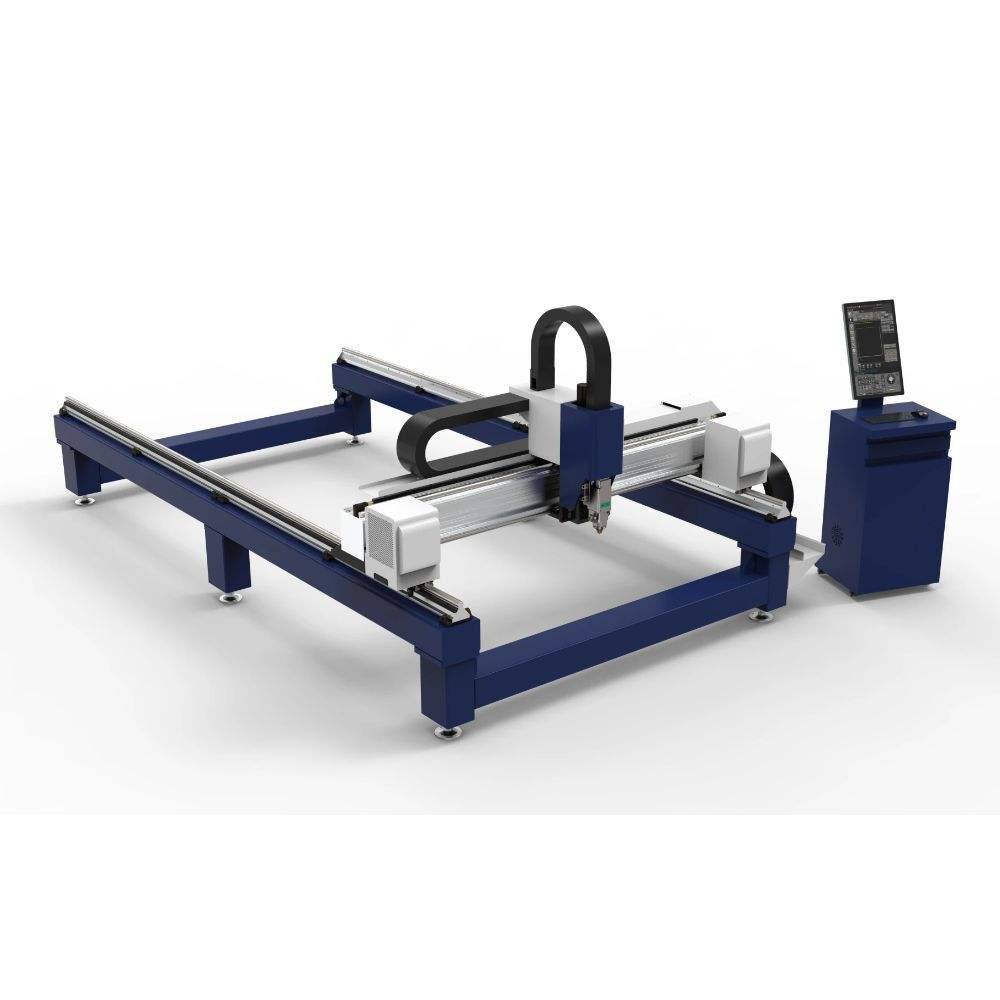
1.0 Technical Overview: The Shift to 6000W Fiber Laser Kinematics in Queretaro’s Industrial Corridor
The industrial landscape of Queretaro, Mexico, has seen a rapid transition toward high-precision structural steel fabrication, driven largely by the expansion of automotive logistics and e-commerce distribution centers. Central to this evolution is the deployment of the 6000W Heavy-Duty I-Beam Laser Profiler. Unlike traditional plasma cutting or mechanical sawing/drilling lines, the 6000W fiber laser source provides a power density capable of achieving narrow kerf widths and minimal heat-affected zones (HAZ) on structural sections including I-beams, H-beams, and heavy-walled rectangular hollow sections (RHS).
In the context of storage racking—specifically high-density AS/RS (Automated Storage and Retrieval Systems)—the structural integrity of the uprights and beams is paramount. The 6000W threshold is critical; it represents the “sweet spot” where cutting speeds for 12mm to 16mm web thicknesses are maximized without compromising the beam quality (M2 factor). This report examines the field performance of these systems, focusing on the synergy between high-wattage photonics and the mechanical automation of unloading heavy structural members.
2.0 Structural Requirements in the Storage Racking Sector
Storage racking systems manufactured in the Queretaro region must adhere to strict seismic and load-bearing standards (such as RMI or Eurocode 3). The components—primarily I-beams used for heavy-duty headers and uprights—require complex hole patterns for bolted connections and precise end-match geometry for moment-resisting frames.
2.1 Dimensional Tolerance and Connection Integrity
Traditional methods often result in hole-positioning deviations of ±2.0mm over a 12-meter span. Laser profiling reduces this to ±0.2mm. In racking, where a single aisle may extend 100 meters, cumulative error is the primary enemy of structural alignment. The 6000W profiler utilizes a 5-axis or 3D cutting head, allowing for chamfering and weld-prep cuts directly on the I-beam flanges and webs in a single pass. This eliminates the need for secondary grinding operations, which are labor-intensive and introduce human error.
3.0 The Engineering of the 6000W Fiber Laser Source
The 6000W fiber laser utilized in these heavy-duty profilers is engineered for high-duty cycle industrial environments. At this power level, the laser delivery system must manage significant thermal loads. The integration of nitrogen (N2) as a cutting gas is common for thinner sections to prevent oxidation, but in the heavy-duty racking sector, high-pressure oxygen (O2) is typically employed for I-beams to leverage the exothermic reaction, increasing penetration depth in thick carbon steel.
3.1 Beam Quality and Focus Dynamics
The optical train of a 6000W system designed for I-beams must include a dynamic focus adjustment. Because I-beams have varying thicknesses between the web and the flange, the CNC must adjust the focal point in real-time (often within milliseconds) as the head transitions across the geometry. A 6000W source provides enough “headroom” to maintain high cutting feed rates even when the beam quality is slightly adjusted to widen the kerf for easier part removal.
4.0 Automatic Unloading: Solving the Bottleneck of Heavy Steel Processing
In heavy-duty profiling, the laser’s cutting speed often outpaces the material handling capacity of the facility. A 12-meter I-beam can weigh upwards of 600kg. Manual unloading using overhead cranes or forklifts introduces significant downtime and safety risks. The “Automatic Unloading” technology integrated into these systems is a specialized mechanical subsystem designed to maintain the flow of the “Continuous-Path” CNC logic.
4.1 Mechanical Synchronization and Actuation
The automatic unloading unit consists of a series of hydraulic lift-and-drag arms synchronized with the laser’s outfeed conveyor. As the laser completes the final cut on a structural member, the CNC triggers a sequence:
1. **Support Engagement:** Hydraulic rollers or V-shaped supports rise to catch the finished beam.
2. **Lateral Displacement:** The unloading arms move the beam laterally away from the cutting centerline onto a buffering table.
3. **Simultaneous Feeding:** The infeed chuck advances the next raw I-beam into the cutting envelope before the previous part has even cleared the buffer zone.
This parallel processing reduces the “cycle-to-cycle” idle time by approximately 70% compared to manual extraction. In a 24/7 production facility in Queretaro, this translates to an additional 4 to 6 metric tons of processed steel per shift.
5.0 Precision Challenges in Heavy-Duty Handling
A significant challenge in profiling heavy I-beams is “material sag” and “twisting” inherent in hot-rolled steel. The automatic unloading system must account for these irregularities.
5.1 Sensor Integration and Feedback Loops
Modern profilers utilize laser displacement sensors to map the beam’s profile before cutting. If the I-beam has a slight camber, the CNC compensates the cutting path. The unloading system must also be “intelligent.” If a part is cut and detaches, sensors confirm the part has cleared the work area. In the storage racking industry, where parts are often long and thin (uprights), the risk of “tip-up” (where a cut part tilts and strikes the laser head) is high. The automatic unloading system employs a “follow-up” support mechanism that stays beneath the beam throughout the entire cutting process, providing constant upward pressure to counteract gravity.
6.0 Synergistic Efficiency: Laser Power + Material Flow
The true value of the 6000W system in Queretaro is found in the synergy between the photonics and the mechanics. High laser power (6000W) allows for faster processing of thick-walled sections, but without automatic unloading, this speed is wasted.
6.1 Throughput Analysis
Consider a standard I-beam header for a racking system requiring 40 bolt holes and two mitered ends.
* **Traditional Method:** Sawing (4 mins) + CNC Drilling (8 mins) + Manual Handling (5 mins) = 17 minutes.
* **6000W Laser with Auto-Unloading:** Total processing time (including loading/unloading) = 3.5 minutes.
The reduction in “touches”—the number of times a human operator or a crane must interact with the steel—is the most significant factor in reducing the cost per ton. In the competitive Queretaro manufacturing sector, where labor costs are rising and precision is non-negotiable, this automation is the baseline for viability.
7.0 Maintenance and Operational Longevity
Operating a 6000W laser on heavy structural steel generates significant particulate matter and slag. The automatic unloading system must be ruggedized to survive this environment.
7.1 Slag Management and Component Protection
The unloading conveyors are typically equipped with scrap collection drawers and high-durability rollers coated in heat-resistant polymers. Furthermore, the 6000W fiber source requires a robust chilling system to maintain the stability of the laser diodes. In the semi-arid climate of Queretaro, dust filtration for the power supply and the cutting head is critical to prevent optical contamination, which can lead to “thermal lensing” and decreased cutting quality.
8.0 Conclusion: The Standard for Modern Structural Fabrication
The 6000W Heavy-Duty I-Beam Laser Profiler with Automatic Unloading represents the pinnacle of current structural steel processing technology. For the storage racking sector in Queretaro, it provides a dual solution: the precision required for complex, high-density racking architectures and the efficiency required to meet high-volume production schedules.
By automating the transition from raw I-beam to finished component, manufacturers eliminate the primary bottleneck in the fabrication shop. The integration of high-power fiber lasers with sophisticated mechanical handling ensures that the structural integrity of the final product is matched by the profitability of the production process. As logistics infrastructure continues to expand globally, the adoption of these automated laser systems will become the defining characteristic of Tier-1 structural fabricators.













