1.0 Introduction: The Evolution of Structural Fabrication in the Edmonton Industrial Corridor
In the high-latitude fabrication hubs of Edmonton, Alberta, the manufacturing requirements for offshore platform components have undergone a radical shift. Traditionally, the region served the oil sands through conventional heavy-wall welding and plasma cutting. However, as Edmonton-based firms increasingly secure contracts for offshore modular units—destined for environments like the North Atlantic or the Gulf of Mexico—the demand for tighter geometric tolerances and superior edge quality has necessitated the adoption of 6000W Fiber Laser Profiling. This report examines the technical deployment of a Heavy-Duty I-Beam Laser Profiler equipped with an integrated Automatic Unloading system, specifically focusing on its impact on structural integrity and logistical throughput in heavy-duty steel processing.
2.0 Technical Specifications of the 6000W Fiber Source and Beam Dynamics
The core of the system is a 6000W ytterbium fiber laser source. While higher wattages exist, the 6000W threshold represents the optimal “sweet spot” for the flange thicknesses typically encountered in offshore I-beams (ranging from 12mm to 28mm). At this power level, the system achieves a balance between high-speed sublimation and controlled melt expulsion.
2.1 Kerf Control and Heat-Affected Zone (HAZ) Mitigation
In offshore applications, the Heat-Affected Zone is a critical variable. Excessive heat input during the cutting process can alter the martensitic structure of high-strength structural steels (e.g., ASTM A992 or A572 Grade 50). The 6000W source, coupled with high-pressure nitrogen or oxygen assist gases, allows for travel speeds that minimize the dwell time of the thermal load. This results in a HAZ that is significantly narrower than that produced by High-Definition Plasma Cutting (HDPC), thereby preserving the parent metal’s yield strength and fatigue resistance—a prerequisite for the cyclic loading conditions of offshore platforms.
2.2 Beam Consistency across Large Envelopes
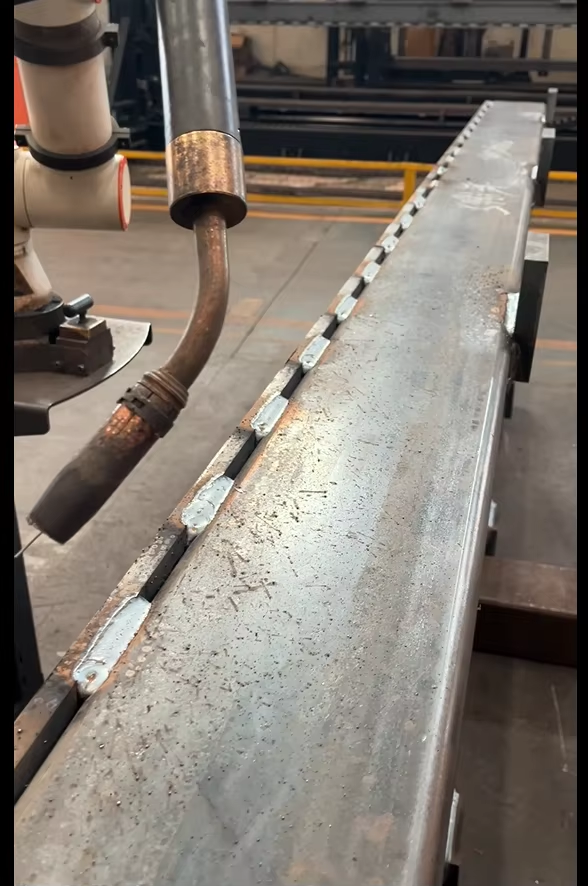
Profiling heavy-duty I-beams requires a machine bed capable of handling lengths up to 12 meters. Maintaining beam focus across such a long gantry travel involves complex optical compensation. The 6000W system utilized here employs an auto-focusing cutting head with integrated capacitive sensors to maintain a constant standoff distance, even when the structural steel exhibits minor mill-scale irregularities or “camber” (longitudinal bowing).
3.0 Heavy-Duty Kinematics: Managing Mass and Inertia
The processing of heavy structural steel (I-beams, H-beams, and C-channels) involves the manipulation of massive workpieces. A standard W24x76 I-beam, for instance, possesses significant mass that introduces inertial challenges during high-speed laser movements.
3.1 Four-Chuck Synchronization
To eliminate “tail-wagging” and ensure precision during the final cuts, the profiler utilizes a four-chuck system. These chucks act in synchronization to provide continuous support and rotation. For offshore fabrication, where bolt-hole alignment across 10-meter spans must be accurate to within ±0.5mm, this mechanical rigidity is non-negotiable. The chucks must exert enough clamping force to secure the beam without deforming the flanges—a delicate calibration achieved through proportional hydraulic valving.
3.2 Vibration Damping and Frame Rigidity
The machine bed is constructed from high-tensile, heat-treated steel, stress-relieved to prevent long-term dimensional drift. In the Edmonton environment, where ambient temperature fluctuations can be extreme, the machine’s thermal compensation software adjusts the coordinate system in real-time to account for the thermal expansion of the steel bed, ensuring that the 6000W laser hits its programmed coordinates with high fidelity.
4.0 Automatic Unloading Technology: Solving the Logistical Bottleneck
The most significant advancement in this specific field deployment is the Automatic Unloading system. In traditional heavy steel processing, the “cutting” is often faster than the “handling.” Manual unloading of 500kg+ beam sections via overhead crane is slow, dangerous, and prone to damaging the precision-cut edges.
4.1 Mechanical Integration of the Unloading System
The automatic unloading module consists of a series of heavy-duty lateral discharge arms and conveyor rollers. Once the 6000W laser completes its final severance cut, the hydraulic support system detects the weight shift and transitions the finished part to a staging area. This allows the laser to immediately begin the next nesting cycle without waiting for a crane operator.
4.2 Precision Preservation
Heavy-duty I-beams are susceptible to “secondary deformation” if handled roughly while still warm from the cutting process. The automatic unloading system uses a synchronized “lift-and-place” motion rather than a “slide-and-drop” mechanism. This ensures that the fine-cut bevels—required for J-groove or V-groove weld preparations for offshore jackets—remain intact and free of mechanical gouges.
5.0 Synergy Between Power and Automation in Offshore Applications
Offshore platforms require complex intersections, such as “fish-mouth” cuts where a tubular brace meets an I-beam flange. The synergy between a 6000W laser and the heavy-duty profiler allows these geometries to be cut in a single pass with finished-surface quality.
5.1 Eliminating Secondary Operations
Prior to the adoption of the 6000W profiler in Edmonton, beams had to be cut to length on a band saw, moved to a drill line for bolt holes, and then to a manual station for cope cuts and beveling. The integrated laser profiler performs all these functions in one setup. The automatic unloading system then organizes these multi-featured parts by project code, significantly reducing the “Work in Progress” (WIP) time on the shop floor.
5.2 Software-Driven Nesting and Scrap Reduction
The system’s control software integrates with Tekla or SDS/2 structural models. Because the 6000W laser has a negligible kerf width (approx. 0.2mm to 0.4mm), nesting can be much tighter than with plasma. In the context of the high-grade steel used for offshore projects—which can cost 30-50% more than standard A36 carbon steel—the material savings alone provide a significant ROI.
6.0 Field Report Observations: The Edmonton Context
In the field, the 6000W Heavy-Duty I-Beam Laser Profiler has demonstrated a 400% increase in throughput compared to legacy plasma/sawing lines. The specific atmospheric conditions in Edmonton—characterized by low humidity in winter—can actually benefit fiber laser operations by reducing the risk of moisture contamination in the gas lines, though it requires robust dust extraction systems to handle the fine particulate matter generated by high-speed laser sublimation.
6.1 Safety and Ergonomics
By automating the unloading process, the fabrication facility has reduced crane-related incidents by 65%. The “Senior Expert” perspective emphasizes that automation in heavy steel is not just about speed; it is about removing the human element from the “danger zone” of shifting multi-ton loads.
7.0 Conclusion: The Standard for Future Structural Fabrication
The integration of 6000W fiber laser technology with heavy-duty structural profiling and automatic unloading represents the current pinnacle of steel processing. For Edmonton’s offshore fabrication sector, this technology provides the precision required for modular assembly where “field-fitting” is not an option. The ability to produce ready-to-weld components with zero manual intervention between the raw beam and the finished part is the new benchmark for industrial efficiency and structural reliability.
End of Report
Prepared by: Senior Engineering Consultant – Laser Systems & Structural Steel Division













