1. Introduction: The Evolution of Structural Steel Fabrication in the HCMC Industrial Corridor
The heavy engineering sector in Ho Chi Minh City (HCMC) and its surrounding industrial hubs (Binh Duong and Dong Nai) has seen a radical shift in fabrication methodologies. Specifically, the mining machinery sector—responsible for the production of heavy-duty crushers, vibrating screens, and subterranean conveyor chassis—demands structural integrity that traditional plasma cutting and mechanical drilling can no longer provide at scale. This report analyzes the deployment of the 6000W Heavy-Duty I-Beam Laser Profiler, focusing on the integration of ±45° bevel cutting technology to meet stringent international mining standards.
2. 6000W Fiber Laser Architecture and Thermal Dynamics
The 6000W fiber laser source represents the optimal power-to-thickness ratio for the structural sections common in mining equipment, typically involving web thicknesses ranging from 10mm to 25mm. At this power density, the beam achieves a high-velocity melt expulsion, minimizing the Heat Affected Zone (HAZ).
2.1. Beam Quality and Kerf Management
Maintaining a constant BPP (Beam Parameter Product) is critical when traversing the complex geometry of an I-beam. The 6000W oscillator, coupled with advanced collimation optics, allows for a stabilized kerf width across the flange and the web. In the HCMC climate, where ambient humidity can affect gas purity, the system utilizes high-pressure nitrogen or oxygen-assisted cutting with dedicated filtration to ensure the cut face remains free of dross, which is essential for subsequent high-fatigue mining applications.
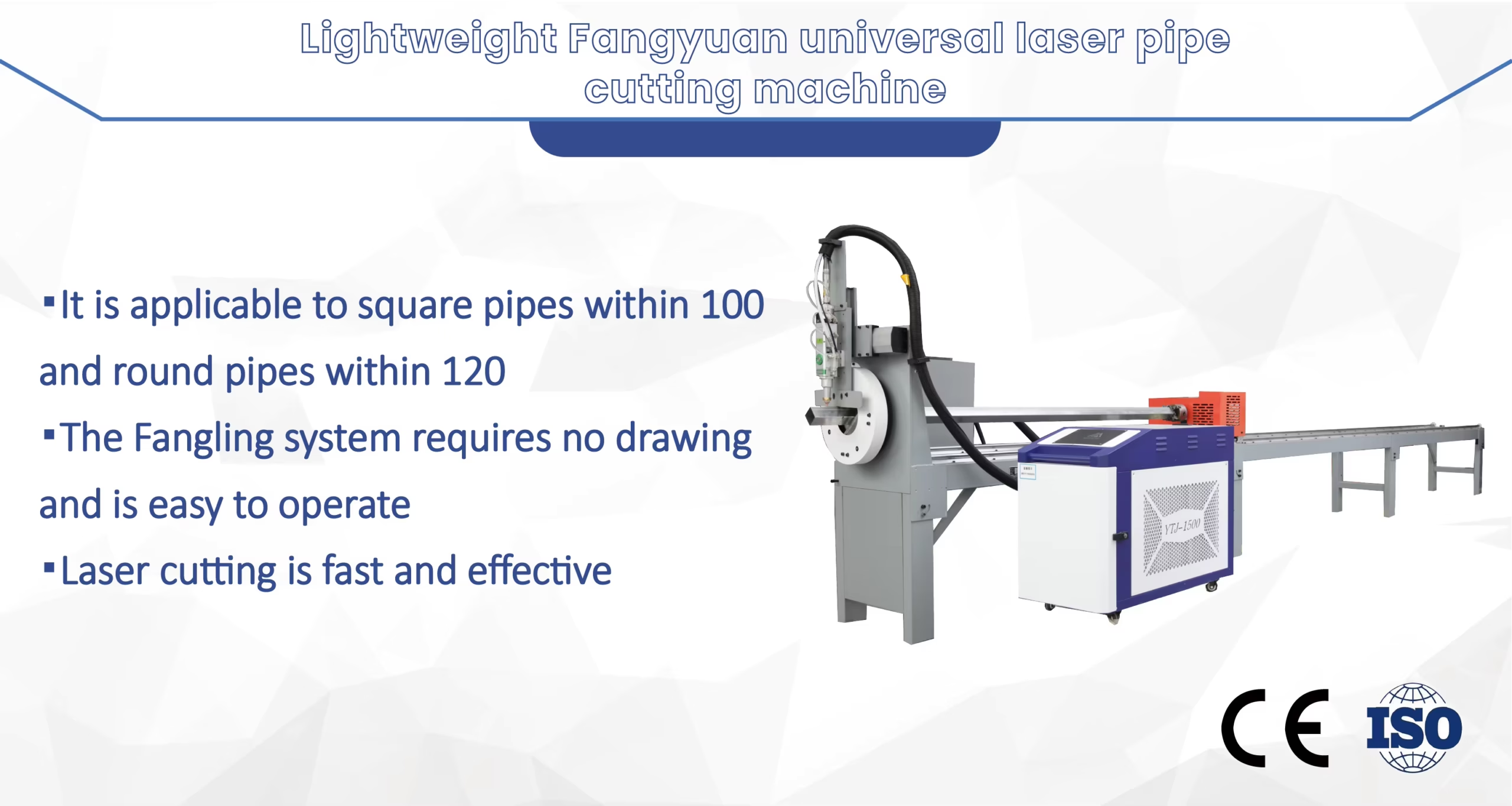
2.2. Power Modulation for Corner Radii
One of the primary challenges in I-beam profiling is the transition from the flange to the web (the fillet). The 6000W system employs real-time power modulation. As the laser head approaches the thicker fillet section, the CNC increases peak power while simultaneously adjusting the feed rate to prevent thermal accumulation, ensuring a uniform cut surface that prevents stress concentrations in the finished mining support structure.
3. Kinematics of ±45° Bevel Cutting in Heavy-Duty Sections
Traditional structural fabrication requires secondary processes—grinding or milling—to create weld preparations (V, Y, or X-type joints). The integration of a 5-axis 3D laser head capable of ±45° beveling transforms the I-beam profiler from a cutting tool into a complete preparation center.
3.1. Five-Axis Interpolation for Complex Geometries
The beveling head utilizes A and B axes to tilt the focal point while maintaining the standoff distance (focal height). In mining machinery, where I-beams often intersect at non-perpendicular angles (e.g., in truss-based conveyor frames), the ability to cut a variable bevel along a contoured path is invaluable. This system calculates the complex intersection math in real-time, ensuring that the miter joints of the I-beams fit with sub-millimeter tolerances.
3.2. Elimination of Secondary Edge Preparation
By achieving a ±45° bevel directly on the laser bed, the “bottleneck” of manual edge preparation is eliminated. For a HCMC-based mining equipment manufacturer, this reduces the floor-to-floor time of a single chassis beam by approximately 65%. Furthermore, the precision of the laser-cut bevel ensures that the subsequent robotic welding cells can maintain a consistent wire-feed speed and penetration depth, reducing the likelihood of weld defects (porosity or lack of fusion) that are catastrophic in mining environments.
4. Application Analysis: Mining Machinery Sector
Mining equipment is subjected to extreme cyclical loading and abrasive environments. The structural components must be fabricated from high-tensile steels (such as S355JR or specialized wear-resistant grades). The 6000W profiler is uniquely suited for these materials.
4.1. Crusher Frame Integrity
In the fabrication of primary jaw crusher frames, I-beams must support immense vibrational loads. The 6000W laser’s ability to cut precise bolt holes and interlocking tabs (tenon-and-mortise style) into heavy I-beams ensures that the assembly is self-aligning. This structural interlocking, impossible with plasma cutting due to the “top-rounding” effect, provides a mechanical backup to the weldments, significantly increasing the frame’s lifespan.
4.2. Conveyor System Scalability
HCMC-based fabricators often produce kilometers of conveyor structures for the regional extraction industry. The heavy-duty profiler’s automated loading and unloading system allows for the processing of 12-meter I-beams with minimal operator intervention. The CNC software optimizes nesting across the beam length, reducing scrap rates in expensive structural steel by up to 15% compared to manual layout methods.
5. Synergy Between Power and Automatic Structural Processing
The “Heavy-Duty” designation of the profiler refers not just to the laser power, but to the mechanical handling of the sections. I-beams are rarely perfectly straight; they exhibit “camber” and “sweep.”
5.1. Sensing and Compensation Algorithms
The 6000W system is equipped with touch-probing or laser-sensing modules that map the actual profile of the beam before cutting. The CNC then “warps” the cutting path to match the physical beam, ensuring that holes and bevels are always centered relative to the actual flange position. In the heavy mining sector, where beams may have deviations of 2-3mm over several meters, this compensation is the difference between a successful assembly and a costly rework.
5.2. Four-Chuck Clamping and Stability
To handle the torque generated by rotating a heavy I-beam for 4-side cutting, a four-chuck system is utilized. This provides maximum rigidity and minimizes “tube whip” during high-speed rotations. The synergy between the 6000W fiber source and this mechanical stability allows for high-precision cutting even at the ends of the beam (zero-tailing technology), which is critical for maximizing material yield in high-volume mining projects.
6. Technical Constraints and Environmental Considerations in HCMC
Operating high-power fiber lasers in the tropical climate of Vietnam presents specific engineering challenges. The 6000W system requires a high-capacity dual-circuit chiller to maintain the resonator and the cutting head at a constant 22-25°C. Any fluctuation can cause focal shift, which would compromise the ±45° bevel accuracy.
Furthermore, the electrical stability in some industrial zones around HCMC requires the integration of high-precision voltage stabilizers. The profiler’s control system must be shielded against the electromagnetic interference (EMI) typical of heavy fabrication shops where high-amperage arc welding is occurring simultaneously.
7. Conclusion: ROI and Structural Impact
The deployment of a 6000W Heavy-Duty I-Beam Laser Profiler with ±45° beveling capability represents a paradigm shift for mining machinery fabrication in South Vietnam. By consolidating cutting, drilling, and beveling into a single automated process, manufacturers achieve:
- Enhanced Precision: Tolerance levels of ±0.1mm, ensuring perfect fit-up for complex mining assemblies.
- Structural Reliability: Minimal HAZ preserves the metallurgical properties of high-tensile steels.
- Economic Efficiency: Significant reduction in labor-intensive secondary processes and material waste.
As the mining sector continues to move toward more complex, modular designs, the ability to perform precision 3D profiling on heavy structural sections becomes not just an advantage, but a technical necessity for maintaining global competitiveness.













