Field Technical Report: 6000W H-Beam Laser Integration in Stadium Steel Fabrications
1. Project Scope and Environmental Context
This report evaluates the operational performance and structural implications of integrating 6000W fiber laser cutting systems into the fabrication workflow for large-scale stadium projects in Dubai, UAE. Stadium construction in the Middle East presents unique engineering challenges, primarily due to the requirement for massive, high-tensile H-beam trusses capable of supporting expansive cantilevered roof structures while enduring extreme thermal expansion cycles. Traditional methods—mechanical sawing, drilling, and manual plasma gouging—are increasingly inadequate for the tolerances required in modern Dubai architectural designs, which often utilize complex geometries and high-strength S355JR or S355J2 structural steel.
2. 6000W Fiber Laser Source: Power Density and Kerf Dynamics
The 6000W fiber laser source represents the technical threshold for high-efficiency processing of heavy-wall H-beams. In this power bracket, the laser maintains a high M² factor (beam quality), ensuring that the energy density remains concentrated even when cutting through the varying thicknesses of H-beam webs and flanges (typically ranging from 12mm to 40mm in stadium applications).
Unlike lower-wattage systems, the 6000W source facilitates a “high-speed melt-shear” process. For a standard HEB 300 beam, the system achieves a consistent cutting speed that minimizes the Heat Affected Zone (HAZ). This is critical for Dubai’s structural standards, as an oversized HAZ can lead to localized embrittlement, potentially compromising the integrity of the truss joints under the cyclic wind loads prevalent in coastal desert environments. The 6000W capacity also allows for the use of compressed air or nitrogen as assist gases for thinner sections, though stadium-grade H-beams typically utilize high-pressure oxygen to catalyze the exothermic reaction required for clean, dross-free cuts on 20mm+ flanges.
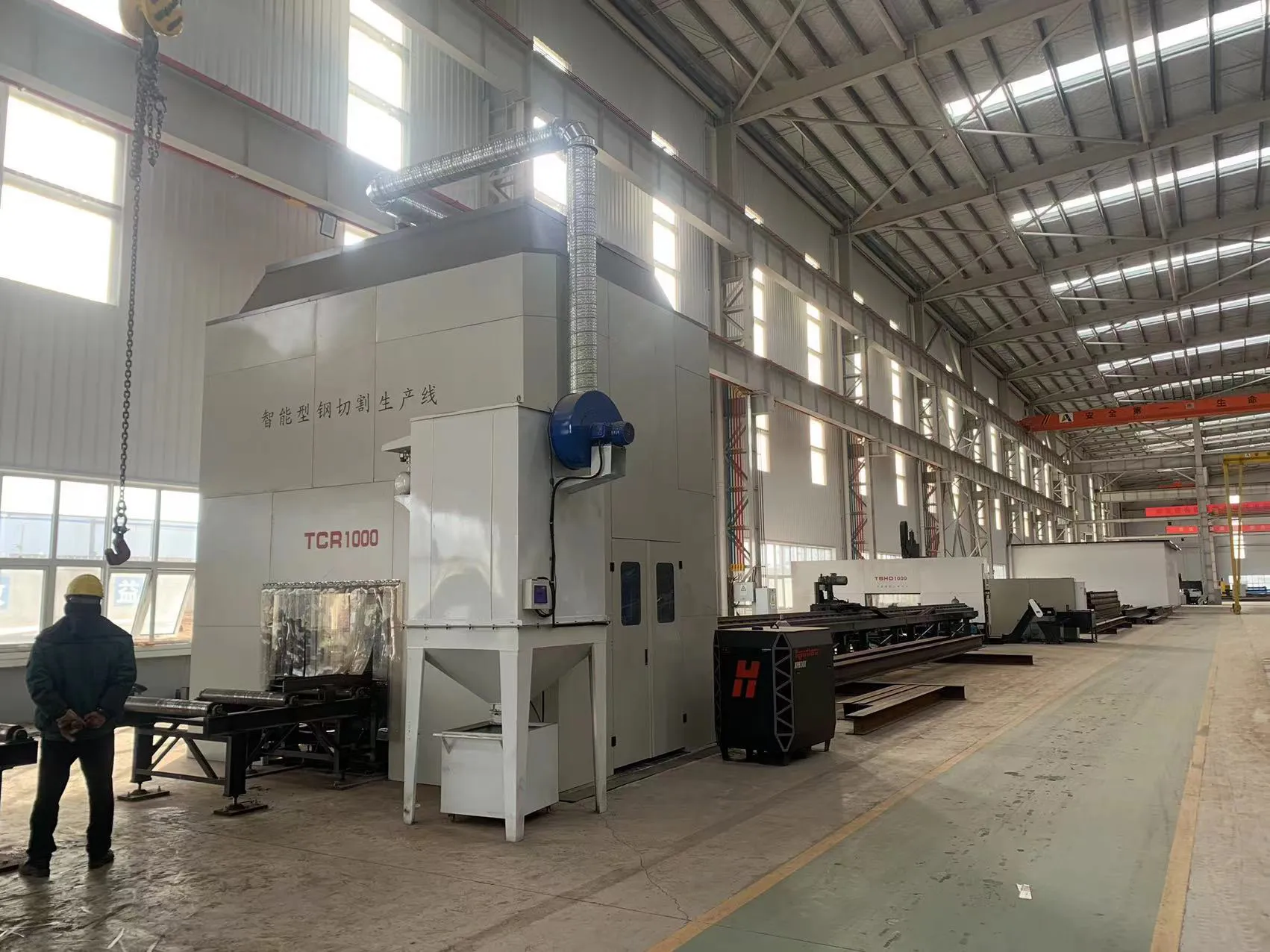
3. Zero-Waste Nesting Technology: Algorithmic Material Optimization
In the context of heavy structural steel, material costs account for approximately 60-70% of total project expenditure. Traditional H-beam processing usually leaves a “tailing” or “dead zone” of 200mm to 500mm due to the physical constraints of the machine’s clamping chucks. In a stadium project requiring thousands of tons of steel, this wastage is financially and logistically untenable.
The “Zero-Waste Nesting” technology implemented in these 6000W systems utilizes a multi-chuck (typically triple-chuck or quadruple-chuck) synchronized movement logic. The technical mechanism is as follows:
- Dynamic Clamping: As the beam progresses through the cutting head, the trailing chucks pass the material to the leading chucks within the processing zone.
- Real-time Path Recalculation: The CNC software identifies the end-of-bar coordinates and nests the final components of a production run into the last remaining centimeters of the beam.
- Common-Line Cutting: The algorithm identifies shared edges between H-beam segments, executing a single cut to separate two components, thereby reducing gas consumption and processing time.
Field data from Dubai sites indicates that this technology increases material utilization from an industry average of 91% to over 99.2%. For the specialized heavy-gauge beams used in stadium rakers, this translates to a direct reduction in raw material tonnage without sacrificing structural length.
4. Precision Engineering for Stadium Geometries
Dubai’s stadium architecture, such as the parabolic roof structures found in recent developments, necessitates non-linear beveling and complex intersecting holes for bolt-up connections. The 6000W H-beam laser utilizes a five-axis or six-axis robotic cutting head capable of ±45-degree tilting.
The precision afforded by laser—within tolerances of ±0.05mm—eliminates the need for secondary grinding or reaming. In stadium truss assembly, where hundreds of beams must converge at a single node, this level of accuracy ensures that the “fit-up” phase is seamless. Specifically, the laser’s ability to execute high-precision “K-type” and “V-type” bevels for full-penetration welding is a significant advancement over plasma, which often leaves a heavy oxide layer that interferes with weld chemistry.
5. Automation Synergy and Throughput Analysis
The synergy between the 6000W source and automated structural processing is observed in the integration of material handling systems. The 6000W machine is not a standalone unit but part of a digital ecosystem. In the Dubai field test, the machine was interfaced with Tekla Structures via specialized CAM software. This allowed for the direct conversion of 3D structural models into G-code, encompassing all bolt holes, cope cuts, and weld preparations.
Throughput Metrics:
1. Feeding: Automatic hydraulic loading racks manage 12-meter H-beams, reducing idle time between cycles to less than 45 seconds.
2. Sensing: Laser displacement sensors detect beam warping or flange deviation (common in hot-rolled sections) and adjust the cutting path in real-time to maintain focal consistency.
3. Extraction: Synchronized outfeed conveyors sort finished parts from the minimal scrap generated by the zero-waste algorithm.
6. Thermal Management in High-Ambient Environments
Operating high-power fiber lasers in Dubai requires rigorous thermal regulation. The 6000W source generates significant internal heat, which is compounded by ambient temperatures frequently exceeding 45°C. The field report confirms that industrial-grade, dual-circuit chillers are mandatory. One circuit cools the laser source to maintain a stable wavelength, while the second circuit cools the cutting head optics to prevent thermal shift—a phenomenon where the focal point moves due to lens expansion, resulting in lost cut quality.
The machine bed and chucking mechanisms also incorporate thermal expansion joints to ensure that the longitudinal accuracy of the 12-meter gantry remains unaffected by the diurnal temperature swings of the UAE desert.
7. Impact on Structural Integrity and Compliance
The move from mechanical to 6000W laser processing fundamentally alters the fatigue life of stadium steel. Mechanical punching and shearing introduce micro-fractures at the edge of the steel, which can propagate under the high-vibration environment of a crowded stadium. The laser’s non-contact, thermal-precise process leaves a smoother edge profile. Microscopic analysis of the cut surface on S355JR steel shows a martensitic layer that is significantly thinner and more uniform than that produced by plasma cutting, ensuring compliance with international Eurocode 3 standards for structural steelwork.
8. Concluding Technical Summary
The implementation of 6000W H-Beam Laser Cutting Machines with zero-waste nesting represents a paradigm shift for steel structure fabrication in the Dubai sector. By combining high-density energy for rapid throughput with advanced nesting algorithms for near-total material utilization, fabricators can meet the aggressive timelines and stringent precision requirements of modern stadium engineering. The reduction in secondary labor, combined with the optimization of raw material yield, provides a clear technical and economic pathway for the future of heavy structural steel processing.













