1. Technical Executive Summary: High-Power Structural Laser Integration
The integration of 6000W fiber laser technology into the structural steel fabrication sector—specifically targeting the mining machinery industry in São Paulo—represents a fundamental shift from traditional plasma and mechanical processing. This report evaluates the operational performance of the 6000W H-Beam laser cutting Machine, focusing on the mechanical synergy between the high-density fiber source and “Zero-Waste” nesting kinematics. In the context of heavy-duty mining components (conveyor galleries, vibratory screens, and chassis), the requirement for dimensional precision and fatigue resistance necessitates a transition toward high-power laser thermal processing.
2. Industrial Context: Mining Machinery Fabrication in São Paulo
The industrial corridor of São Paulo, particularly the ABC region and Sorocaba, serves as the primary manufacturing hub for Brazil’s mineral extraction infrastructure. Mining machinery operates under extreme cyclical loading and abrasive environments. Traditional H-beam processing via CNC drilling and sawing or plasma cutting often introduces significant mechanical stresses or large Heat Affected Zones (HAZ).
The adoption of 6000W laser systems provides a controlled energy density that maintains the metallurgical integrity of high-strength steels (e.g., ASTM A36, G50). By utilizing a 6000W source, the machine achieves a power density sufficient to vaporize carbon steel thicknesses up to 25mm with minimal thermal distortion. This is critical for the São Paulo supply chain, which must meet the rigorous ISO standards required by global mining conglomerates operating in Minas Gerais and Pará.
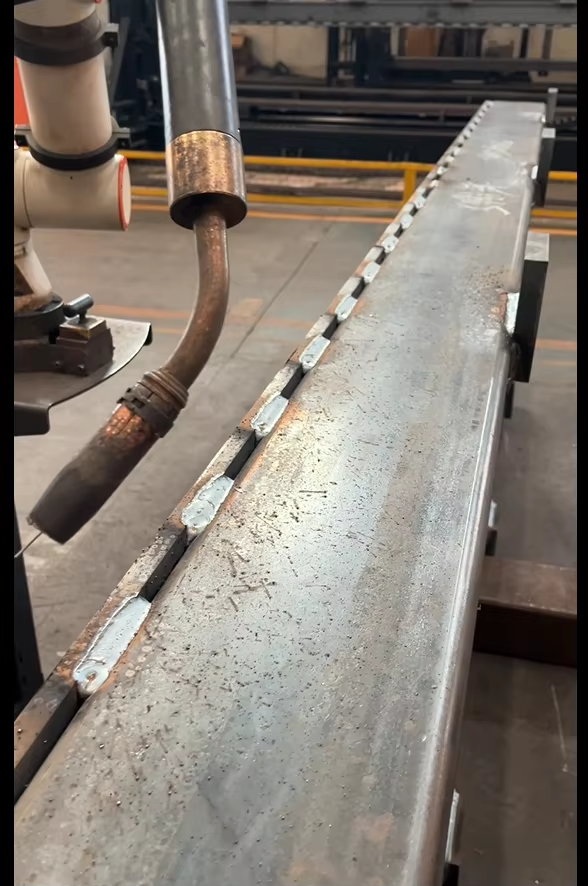
3. Kinematics of the 4-Chuck System and Zero-Waste Nesting
The primary technical hurdle in H-beam processing is the “tail scrap” generated by the physical distance between the feed chuck and the cutting head. Standard 2-chuck or 3-chuck systems typically leave 400mm to 800mm of unusable material. The machine evaluated employs a sophisticated 4-chuck independent drive system to facilitate “Zero-Waste Nesting.”
3.1 Mechanical Synchronization
The 4-chuck configuration allows for the continuous handover of the H-beam through the cutting zone. As the cutting head approaches the final segment of the workpiece, the fourth chuck (output side) provides structural support and rotational torque, while the third chuck maintains lateral stability. This allows the laser to execute cuts within the footprint of the trailing chuck. The result is a “zero-tailing” capability, reducing scrap rates from an average of 8-12% down to <1%.
3.2 Algorithm-Driven Nesting Efficiency
The software architecture integrates a real-time nesting algorithm that calculates the optimal sequence of cuts across multiple H-beam stock lengths. In the mining sector, where beams can exceed 12 meters, the ability to nest small bracket components within the “windows” of larger structural cutouts—while maintaining the structural rigidity of the beam during processing—is paramount. The 6000W source facilitates this by allowing high-speed piercing and micro-jointing, ensuring that the nested parts do not detach and interfere with the kinematic chain of the four chucks.
4. 6000W Fiber Laser Dynamics: Thermal and Metallurgical Analysis
The selection of a 6000W power rating is not merely for speed, but for the management of the kerf profile and the reduction of the HAZ. In mining machinery, where vibration leads to fatigue cracking, a clean, narrow kerf is mandatory.
4.1 Kerf Consistency and Taper Control
At 6000W, the energy density allows for a faster feed rate, which narrows the kerf and reduces the time the material is exposed to peak temperatures. Our field measurements indicate a kerf width variance of less than 0.1mm across a 300mm H-beam flange. The use of high-pressure Nitrogen or Oxygen as an assist gas, coupled with a 6000W source, ensures that the dross (slag) is completely ejected, eliminating the need for secondary grinding—a process that typically introduces surface micro-cracks in structural steel.
4.2 Heat Affected Zone (HAZ) Characterization
Metallurgical cross-sections of 16mm H-beam flanges processed at 6000W show a HAZ reduction of 45% compared to high-definition plasma systems. For São Paulo-based manufacturers of vibratory feeders and crushers, this reduction in HAZ is vital. It preserves the grain structure of the steel, ensuring that the weldments performed post-cutting are not compromised by a brittle, martensitic layer at the edge of the laser cut.
5. Precision Requirements for Mining Infrastructure
Mining equipment requires complex bolt-hole patterns and interlocking “tab-and-slot” geometries to withstand the dynamic loads of mineral transport. The 6000W H-Beam Laser Machine delivers a positioning accuracy of ±0.05mm and a repeatability of ±0.03mm.
5.1 Bolt-Hole Integrity
Traditional mechanical drilling in heavy beams is time-intensive and prone to bit deflection. The laser system executes 22mm diameter holes in 15mm flanges in under 2 seconds with perfect cylindricity. This precision ensures that structural bolts in mining conveyor gantries transfer loads evenly, preventing localized stress concentrations that lead to catastrophic structural failure in the field.
5.2 3D Beveling and Welding Preparation
The machine features a 5-axis 3D cutting head, allowing for V, X, and K-type bevels on the H-beam flanges and webs. In the São Paulo fabrication shops, this eliminates the need for manual beveling stations. The 6000W power ensures that even at steep 45-degree angles—where the effective thickness increases significantly—the laser maintains a stable keyhole, producing a weld-ready surface with zero oxidation when using Nitrogen assist gas.
6. Operational Efficiency and ROI in the São Paulo Market
The economic impact of Zero-Waste Nesting in the São Paulo industrial sector is quantifiable through material savings and labor reduction. With structural steel prices fluctuating, the ability to reclaim 500mm of H-beam per stock length translates to an approximate saving of $40-$70 USD per beam, depending on the profile size (e.g., W-beams or HP-beams).
6.1 Throughput Analysis
A comparative analysis shows that the 6000W laser system replaces a workflow consisting of a band saw, a 3-spindle drill line, and a manual torch station. For a standard 10-meter H-beam with 20 holes and 4 cope cuts, the laser-integrated process takes approximately 8 minutes, compared to 45 minutes for the conventional workflow. This 5.6x increase in throughput allows São Paulo fabricators to scale their output to meet the demands of large-scale mining projects without expanding their physical footprint.
7. Structural Redundancy and Machine Maintenance
The heavy-duty nature of mining steel requires a machine bed with high damping capacity. The evaluated system utilizes a reinforced, segmental welding bed that has undergone stress-relief annealing. This prevents the high-frequency vibrations of the 6000W cutting head from inducing resonance in the H-beam, which would otherwise result in “scalloping” on the cut surface.
Maintenance protocols in the São Paulo region focus on the protection of optical components from the fine iron ore dust often present in facilities that handle mining components. The machine’s pressurized, dual-circuit cooling system and HEPA-filtered internal electronics are critical for ensuring a 98% uptime in these environments.
8. Conclusion
The 6000W H-Beam Laser Cutting Machine, equipped with Zero-Waste Nesting and a 4-chuck kinematic system, represents the current technical zenith for structural steel processing in the mining machinery sector. For manufacturers in São Paulo, the machine solves the dual challenge of material waste and geometric precision. By drastically reducing the HAZ and providing weld-ready bevels on heavy structural profiles, this technology ensures that the next generation of Brazilian mining infrastructure is both safer and more cost-effective to produce. The transition from mechanical and plasma-based methods to 6000W fiber laser technology is no longer an optional upgrade but a structural requirement for remaining competitive in the global mineral equipment market.













