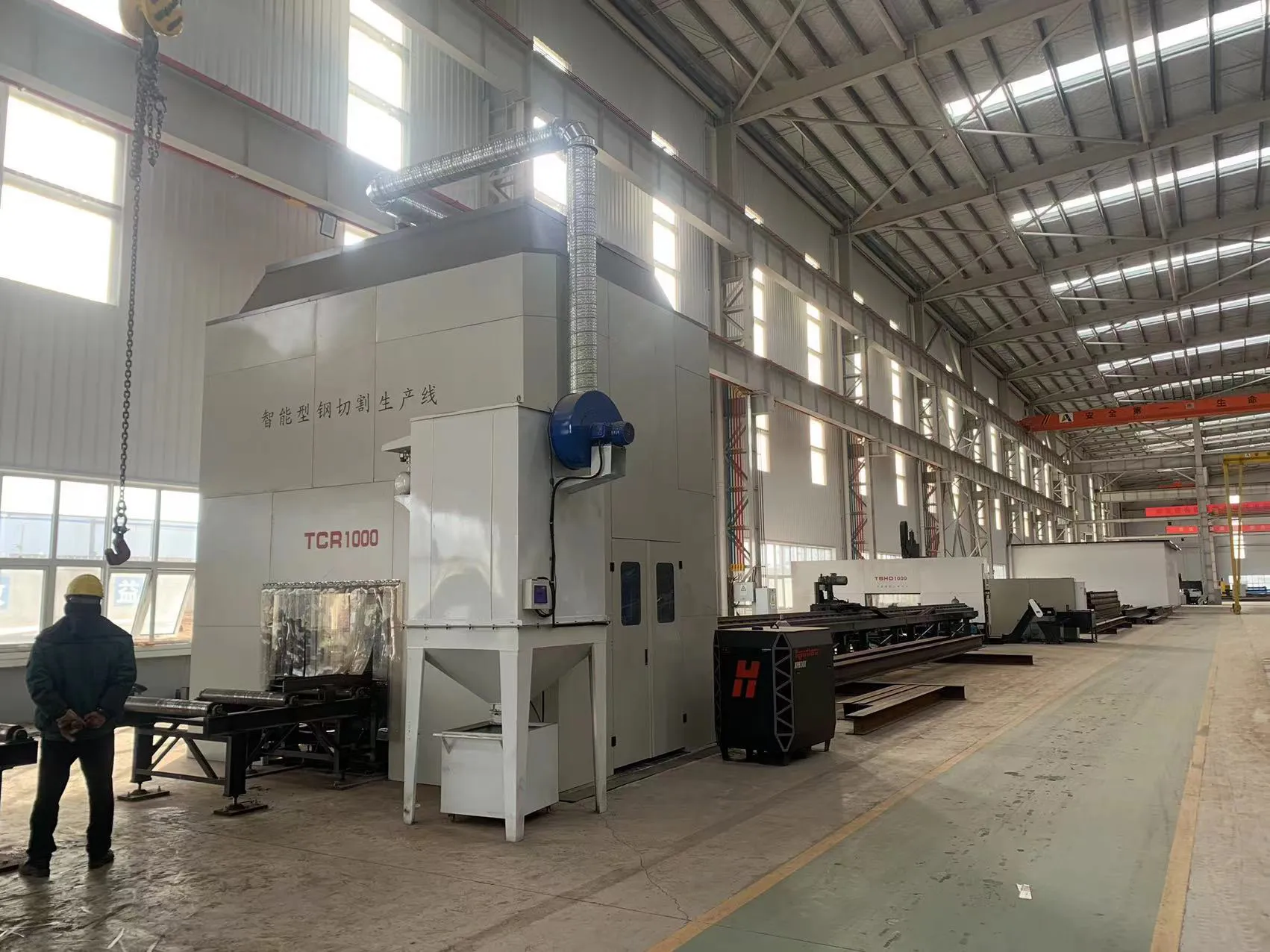
The Industrial Evolution of Casablanca: Embracing Fiber Laser Technology
Casablanca has long been the beating heart of Morocco’s economy, a city where traditional trade meets the high-tech demands of the 21st century. As the city expands and modernizes, the construction industry is moving away from labor-intensive, on-site methods toward “Modular Construction.” This shift requires a level of precision that traditional mechanical tools simply cannot provide. Enter the 6000W Fiber Laser—a tool that has redefined what is possible in steel fabrication.
In the context of Casablanca’s strategic position as a gateway to Africa, the adoption of a 6000W H-Beam laser cutting Machine is not just an upgrade; it is a competitive necessity. The ability to process heavy structural steel with the speed of light allows local fabricators to meet international standards (such as Eurocodes) required for large-scale infrastructure projects. The 6kW power rating is the “sweet spot” for structural steel, offering enough “punch” to penetrate thick H-beam flanges while maintaining the high speeds necessary for thin-wall hollow sections used in modular frames.
The Powerhouse: Why 6000W is the Standard for H-Beams
When we discuss 6000W (6kW) in the fiber laser world, we are talking about a massive leap in photon density. For H-beams—which are characterized by varying thicknesses between the web and the flange—power management is critical. A 6kW source allows for clean, dross-free cuts on carbon steel up to 20mm or 25mm, covering the vast majority of structural requirements for modular buildings.
The efficiency of a fiber laser over older CO2 or plasma systems is staggering. Fiber lasers convert electricity to light with roughly 35-40% efficiency, compared to the 10% of CO2. In the industrial zones of Casablanca, where energy costs and sustainability are increasingly prioritized, the 6000W fiber system provides a lower cost-per-part ratio. Furthermore, the beam quality of a fiber laser remains consistent over long distances, which is essential when the cutting head must travel the length of a 12-meter H-beam.
The Infinite Rotation 3D Head: Engineering Without Limits
The true “secret sauce” of this machine is the Infinite Rotation 3D Head. Traditional laser heads are often limited by internal cabling that prevents them from rotating more than 360 or 720 degrees before needing to “unwind.” In a complex H-beam cut—where you might be cutting a circular opening, a miter cut, and a weld preparation bevel all in one sequence—this unwinding time is wasted time.
The “Infinite Rotation” capability uses advanced slip-ring technology or specialized fiber delivery systems that allow the head to spin indefinitely. This is paired with a 3D tilt mechanism (often up to 45 degrees or more).
Why does this matter for modular construction?
1. **Weld Preparations:** Instead of a flat cut that requires a secondary grinding team to create a bevel for welding, the 3D head cuts the bevel (K, Y, or X-shaped joints) directly into the H-beam.
2. **Complex Intersections:** Modular frames often require beams to meet at awkward angles to maximize space or create architectural features. The 3D head can follow the contour of the H-beam’s “root” (the curved area where the web meets the flange) with surgical precision.
3. **Accuracy:** Because the beam and the flange are cut in a single setup, the dimensional accuracy is maintained within ±0.05mm.
Modular Construction: The Perfect Use Case
Modular construction relies on the “Manufacturing and Assembly” (DfMA) philosophy. Components are built in a factory in Casablanca and then shipped to the site to be bolted together. If an H-beam is off by even 2mm, the entire modular stack—which might be 10 stories high—will suffer from cumulative error.
The 6000W H-Beam laser eliminates this risk. By using the machine’s 3D head to cut bolt holes, notches, and slots in one pass, the machine ensures that every beam is a perfect clone of the digital CAD model. In Casablanca’s hot climate, where steel can expand and contract, having precision-engineered joints that “lock” together reduces the reliance on heavy welding, which can introduce thermal distortion.
Furthermore, modular construction often utilizes “smart” joints—interlocking tabs and slots that allow beams to be self-jigging. A 3D laser head is the only tool capable of cutting these complex geometries into heavy H-beams efficiently.
Integration with the Casablanca Supply Chain
Casablanca’s proximity to major ports means that raw steel H-beams arrive in bulk. A 6000W laser integrated with an automated loading and unloading system creates a seamless “Steel Service Center.” Raw beams go in one end; fully processed, labeled, and ready-to-assemble modular components come out the other.
This automation is vital for the Moroccan workforce. It shifts the labor requirement from dangerous, manual torch-cutting to high-skill CNC programming and machine oversight. As Casablanca positions itself as a tech-forward city, the presence of such machinery attracts international investment and proves that local firms can compete with European and Asian fabricators in terms of quality and lead times.
The Technical Edge: Software and Nesting
A machine of this caliber is only as good as the software driving it. For H-beam processing, specialized 3D nesting software is used to minimize waste. The software “unwraps” the 3D H-beam into a 2D path for the laser head while accounting for the thickness of the material at every angle.
In Casablanca’s modular projects, where cost-efficiency is key, the ability to nest multiple small parts within the “web” of a large H-beam or to optimize cuts to reduce “drop” (scrap) can save thousands of dollars per project. The 6000W laser’s software also allows for the “Common Cut” technique, where two parts share a single cut line, further increasing speed and reducing gas consumption (Oxygen or Nitrogen).
Environmental Impact and Future Outlook
The move toward 6000W fiber lasers in Casablanca also aligns with global “Green Building” initiatives. Fiber lasers do not use toxic gases to generate the beam, and they produce significantly less waste than traditional mechanical shearing or punching. The precision of the 3D head means fewer mistakes, which means less steel ends up in the scrap heap.
As we look toward the future, the integration of AI with these 6000W machines will allow for real-time monitoring of the cut quality. If the laser detects a variation in the steel’s composition (common in recycled structural steel), it can automatically adjust the frequency and power of the 6kW beam to maintain a perfect cut.
Conclusion: A New Era for Moroccan Steel
The introduction of the 6000W H-Beam Laser Cutting Machine with Infinite Rotation 3D Head is a watershed moment for Casablanca’s industrial sector. By solving the two greatest challenges of modular construction—precision and speed—this technology enables a new era of architectural possibility.
Fabricators in Casablanca are no longer just “cutting steel”; they are “manufacturing architecture.” With 6000 Watts of power and the infinite freedom of a 3D head, the only limit to what can be built is the imagination of the engineers. As the city continues to rise, it will be built on a foundation of laser-cut precision, proving that Morocco is not just participating in the global modular revolution, but leading it.