The Industrial Evolution of Rayong: A Hub for Green Energy
Rayong has long been the backbone of Thailand’s heavy industry, housing the lion’s share of the Eastern Economic Corridor (EEC). Historically dominated by automotive and petrochemical sectors, the region is now pivoting toward the “Green Economy.” As Thailand aims for carbon neutrality, the demand for wind energy infrastructure has surged. Wind turbine towers, which stand as monolithic guardians of renewable power, require immense structural precision.
The introduction of the 6000W H-Beam laser cutting Machine into Rayong’s fabrication shops is not merely an incremental upgrade; it is a strategic necessity. Wind towers rely on internal H-beam structures for platforms, ladders, and nacelle supports. These components must withstand extreme fatigue and environmental stress. In this high-stakes environment, the traditional methods of manual sawing, drilling, and plasma cutting are no longer sufficient to meet the rigorous standards of global energy developers.
Understanding the 6000W Fiber Laser Advantage
In the realm of fiber lasers, 6000W (6kW) represents the “sweet spot” for structural steel fabrication. While 10kW or 20kW machines exist, the 6kW variant offers the most balanced return on investment for the thicknesses typically associated with H-beam flanges and webs used in tower internals.
A 6000W laser source provides a high energy density that can vaporize carbon steel in milliseconds. For H-beams—which are characterized by varying thicknesses between the central web and the outer flanges—the 6kW power level ensures clean, dross-free cuts at high speeds. Unlike plasma cutting, which creates a significant heat-affected zone (HAZ) that can embrittle the steel, the fiber laser’s concentrated beam minimizes thermal distortion. This is critical for wind turbine components, where the crystalline structure of the steel must remain intact to prevent stress fractures over a 25-year lifespan.
The Geometry of Precision: ±45° Bevel Cutting
The most significant technological leap in these machines is the ±45° bevel cutting head. In traditional H-beam processing, cutting the beam to length is only the first step. To prepare the beam for high-strength welding, the edges must be beveled—a process that usually involves manual oxy-fuel torches or dedicated milling machines.
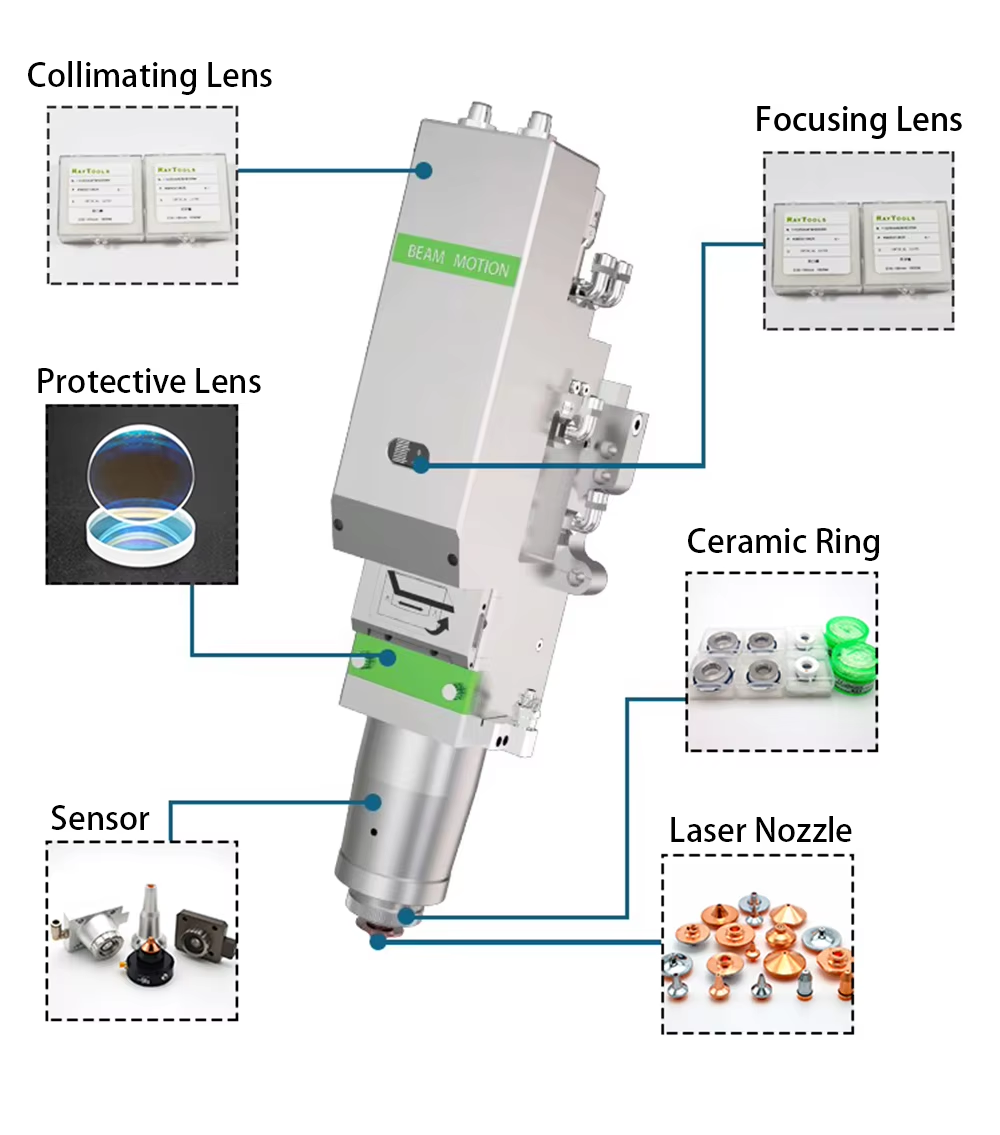
The 5-axis 3D laser head changes this paradigm. It can tilt and rotate around the H-beam, executing complex V, X, K, and Y-shaped bevels in a single pass.
1. **V-Bevels:** Essential for butt joints where deep weld penetration is required.
2. **Accuracy:** With a ±45° range, the laser can create precise angles that allow for a perfect fit-up, reducing the amount of filler wire needed during the welding process.
3. **Complex Notching:** For wind tower internal supports, beams often need to be notched to wrap around curved interior walls. The beveling head allows for these “saddle cuts” to be executed with a beveled edge, ensuring the weld seam is consistent along the entire circumference.
Streamlining Wind Turbine Tower Fabrication
Wind turbine towers are essentially giant tapered tubes, but their internal complexity is often overlooked. Every tower contains a series of internal “floors” and structural reinforcements. These are built using heavy H-beams and I-beams that must be bolted or welded to the tower’s inner shell.
When a manufacturer in Rayong utilizes a 6000W laser with beveling, they consolidate multiple workstations into one. A single machine handles:
– **Cutting to Length:** Precise to within 0.1mm.
– **Hole Drilling:** Laser-cut holes for bolting are perfectly circular and require no reaming, unlike plasma-cut holes which are often tapered.
– **Marking:** The laser can etch part numbers and welding lines directly onto the beam, facilitating faster assembly.
– **Beveling:** Preparing the weld preparation zones instantly.
For wind tower components, this level of integration reduces the production cycle of a single internal kit from days to hours.
Material Challenges: Handling S355 and Beyond
Wind energy infrastructure typically utilizes high-strength low-alloy (HSLA) steels, such as S355. These materials are chosen for their balance of strength and weldability. However, they can be sensitive to the intense heat of traditional cutting methods.
The 6000W fiber laser, using oxygen or nitrogen as an assist gas, maintains the integrity of the S355 steel. In Rayong’s humid coastal environment, the laser’s ability to produce a smooth, oxide-free surface (when using nitrogen) is particularly valuable. It prevents the immediate onset of flash rust on the cut edge, ensuring that the subsequent welding and coating processes—vital for corrosion resistance in offshore wind farms—are of the highest quality.
The “Smart” Factory: Integration with Industry 4.0
The deployment of these machines in Rayong is often accompanied by advanced CAD/CAM software tailored for structural steel (such as Tekla or specialized nesting suites). This allows for a “digital twin” workflow. A 3D model of the wind tower is designed, and the H-beam specifications are sent directly to the laser cutter.
The machine’s sensors monitor the beam’s positioning in real-time. Since H-beams are rarely perfectly straight from the mill (often having slight bows or twists), the laser’s “touch-sensing” or vision systems map the actual geometry of the workpiece. The 6000W laser then adjusts its path and focal point to compensate for these imperfections, ensuring the ±45° bevel remains consistent along the entire length of the beam.
Economic and Environmental Impact in Thailand
The transition to 6000W H-beam laser cutting provides a dual benefit to the Rayong industrial sector: economic competitiveness and environmental sustainability.
**1. Reduced Energy Consumption:** While 6000W sounds like a lot of power, fiber lasers are remarkably efficient, converting over 35% of electrical input into laser light. Compared to CO2 lasers or high-definition plasma systems, the energy-per-cut is significantly lower.
**2. Waste Minimization:** The precision of laser nesting means that more parts can be squeezed out of a single H-beam, reducing scrap metal. In the wind industry, where steel prices fluctuate, a 5% increase in material utilization can equate to millions of Baht in annual savings.
**3. Labor Efficiency:** By automating the beveling and hole-cutting processes, companies can reallocate their skilled labor to more complex assembly tasks, addressing the skilled labor shortages often cited in the EEC.
Maintenance and Longevity in Tropical Climates
Operating a high-power laser in Rayong presents specific challenges, notably heat and humidity. Modern 6000W machines are designed with “Rayong-proof” features. The laser source is typically housed in an air-conditioned, dust-proof cabinet to prevent the degradation of optical components.
Furthermore, because fiber lasers deliver the beam through a flexible fiber optic cable rather than a series of mirrors (as seen in older CO2 technology), there is no risk of beam misalignment due to thermal expansion of the machine frame. This ensures that even in a non-climate-controlled factory in the middle of a Thai summer, the ±45° bevel remains accurate shift after shift.
Conclusion: Powering the Future of ASEAN Wind Energy
As the wind energy sector in Southeast Asia matures, the pressure on the supply chain to deliver faster, cheaper, and more reliable components will only increase. The 6000W H-beam laser cutting machine with ±45° beveling is the answer to this pressure.
In the workshops of Rayong, this technology is doing more than just cutting steel; it is building the foundation of a sustainable future. By bridging the gap between heavy structural fabrication and high-precision aerospace-grade tolerances, fiber laser technology ensures that the wind towers of tomorrow are stronger, more efficient, and ready to withstand the elements for decades to come. For the Thai fabricator, investing in this technology is not just an equipment purchase—it is a commitment to being at the forefront of the global energy transition.