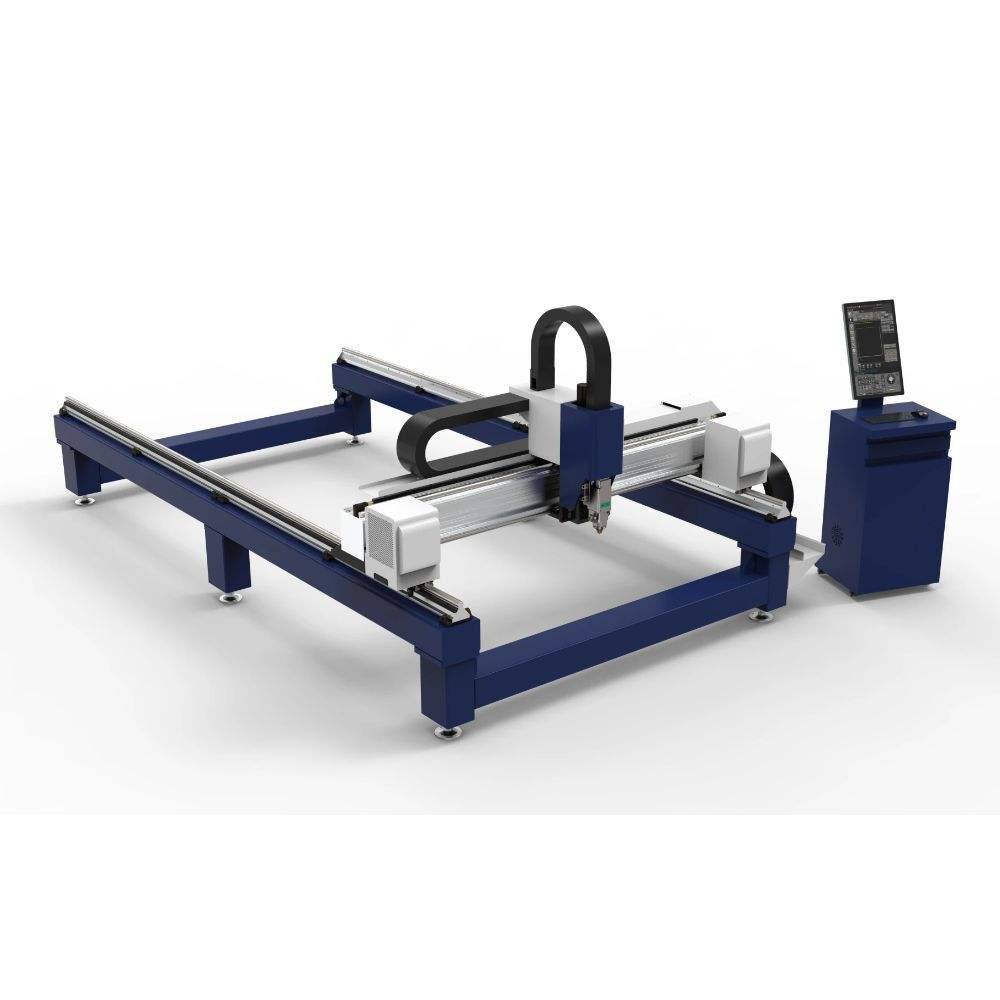
Technical Field Evaluation: 6000W CNC Structural Laser Integration in Pune’s Modular Sector
1. Operational Context: The Shift in Pune’s Structural Engineering Landscape
Pune has emerged as a critical hub for modular construction and heavy engineering in India, driven by the rapid expansion of industrial corridors in Chakan, Talegaon, and Pimpri-Chinchwad. The transition from traditional on-site fabrication to off-site modular assembly demands a level of dimensional precision that conventional plasma cutting and mechanical drilling cannot sustain. This field report evaluates the implementation of a 6000W CNC Beam and Channel Laser Cutter equipped with an Infinite Rotation 3D Head, specifically focusing on its impact on the fabrication of H-beams, I-beams, C-channels, and L-angles.
In modular construction, where steel frames are pre-assembled into volumetric units, the tolerance for error is virtually zero. A deviation of 2mm on a primary structural member can lead to catastrophic misalignment during site installation. The 6000W fiber laser source provides the necessary power density to penetrate thick-walled structural sections while maintaining the narrowest possible kerf width, ensuring that the “Lego-like” fitment required for modular units is achieved consistently.
2. The Physics of 6000W Fiber Integration in Heavy Structural Profiles
The choice of a 6000W fiber laser source is strategic for the Pune modular sector. While 3000W sources are sufficient for thin-walled tubes, the heavy-duty profiles—often exceeding 12mm to 16mm in flange thickness—require the higher photon density of a 6000W resonator.
The fiber laser operates at a wavelength of approximately 1.06 microns, which is more readily absorbed by carbon steel compared to CO2 lasers. In the context of beam processing, this power level allows for high-speed nitrogen cutting on thinner sections and high-quality oxygen cutting on heavy structural members. The synergy between the 6000W source and advanced CNC control allows for “Fine Cut” modes, which minimize the Heat Affected Zone (HAZ). By limiting the HAZ, we preserve the metallurgical integrity of the structural steel—a critical requirement for seismic-resistant modular builds in Maharashtra’s varying topographies.
3. Infinite Rotation 3D Head: Kinematics and Geometric Accuracy
The centerpiece of this technology is the Infinite Rotation 3D Head. Traditional 3D laser heads often utilize a “twist” mechanism that is limited to ±360 degrees, requiring a “rewind” cycle that interrupts the cutting process and creates lead-in/lead-out artifacts on the steel surface.
A. Mechanical Advantages of Infinite Rotation:
The infinite rotation capability utilizes slip-ring technology or advanced fiber-routing geometries that allow the cutting head to rotate continuously. This is paramount when processing complex geometries like H-beams where the head must navigate the web-to-flange transition without stopping. This continuous motion eliminates dwell time, significantly reducing the risk of over-burn at the corners—a common failure point in conventional CNC beam processing.
B. Beveling and Weld Preparation:
In modular construction, structural joints often require V, X, or K-type bevels for full penetration welds. The 3D head’s ability to tilt up to ±45 degrees (or more depending on the specific kinematic model) while rotating infinitely allows for the simultaneous cutting and beveling of beam ends. This eliminates the need for secondary grinding or manual beveling, which are labor-intensive and prone to human error.
4. Solving Precision and Efficiency Issues in Heavy Steel
Heavy steel processing in the Pune region has historically relied on a “Saw-Drill-Manual Bevel” workflow. This legacy process introduces cumulative error. The CNC Beam Laser consolidates these three steps into a single automated cycle.
I. Internal Hole Precision:
Bolted connections are the backbone of modular steel frames. The 6000W laser achieves hole diameters with a tolerance of ±0.1mm, far exceeding the ±0.5mm to ±1.0mm typically seen with mechanical drilling or plasma. This precision ensures that high-strength friction grip (HSFG) bolts can be inserted without reaming on-site, drastically accelerating the assembly of modular segments.
II. Complex Intersections:
Modular frames often involve “bird-beak” cuts or complex saddle notches where one beam meets another at an oblique angle. The Infinite Rotation 3D Head uses 5-axis or 6-axis interpolation to execute these profiles in a single pass. The software calculates the compensation for the beam’s flange thickness, ensuring the fit-up is tight enough for automated welding robots to take over without manual gap filling.
5. Automation Synergy and Throughput in Modular Construction
The efficiency of the 6000W system is not solely dependent on the cutting speed, but on the automation of the entire structural workflow. In Pune’s high-volume manufacturing environments, the integration of automatic loading and unloading systems with the laser cutter creates a “Lights-Out” manufacturing potential.
A. Material Handling and Chuck Precision:
The system utilizes large-scale pneumatic or hydraulic chucks designed to handle structural sections up to 12 meters in length. These chucks provide the necessary torque to rotate heavy H-beams with millimetric precision. The synchronization between the chuck (X/U axis) and the 3D head (A/B/C/Z axes) is managed by high-speed CNC controllers (such as CypCut or specialized structural equivalents), which interpret TEKLA or Revit BIM data directly.
B. Nesting and Material Utilization:
Software algorithms specifically designed for beam processing allow for the nesting of different project components on a single 12-meter length of raw stock. By optimizing the sequence of cuts and utilizing “Common Line Cutting,” the system reduces scrap rates by up to 15% compared to manual layout methods. Given the fluctuating prices of structural steel in the Indian market, this material saving provides a significant competitive advantage to Pune-based fabricators.
6. Field Observations on Pune’s Industrial Environment
Operating high-power fiber lasers in the Pune region presents specific environmental challenges that the 6000W system is designed to mitigate.
I. Thermal Management:
The ambient temperatures in Pune can fluctuate significantly. The 6000W system requires a high-capacity dual-circuit chiller. One circuit cools the laser source, while the other cools the 3D cutting head and optics. Maintaining a constant temperature is vital for preventing thermal drift, which can affect the focal point and, consequently, the cut quality.
II. Power Stability:
While Pune’s industrial zones have improved infrastructure, voltage fluctuations can still occur. The integration of high-grade voltage stabilizers and UPS systems for the CNC controller is mandatory. The 6000W fiber source is generally more resilient to power fluctuations than older CO2 technology, but the precision electronics of the Infinite Rotation head require a “clean” signal to maintain the integrity of the 5-axis interpolation.
7. Conclusion: The Strategic Value of 3D Laser Integration
The implementation of a 6000W CNC Beam and Channel Laser Cutter with Infinite Rotation 3D Head technology represents a paradigm shift for the modular construction industry in Pune. By solving the inherent inaccuracies of heavy steel processing, the system allows fabricators to move from “construction” toward “manufacturing.”
The technical synergy of high power (6000W), infinite kinematic freedom (3D Head), and automated structural handling eliminates the bottlenecks associated with secondary processing. As modular units become more complex and tolerances tighter, this technology is no longer an optional upgrade but a fundamental requirement for any Tier-1 structural steel provider aiming to dominate the infrastructure and residential modular markets. The data confirms that cycle times for a standard H-beam (cutting to length, holing, and beveling) are reduced by approximately 70% compared to traditional methods, while assembly precision is improved by an order of magnitude.













