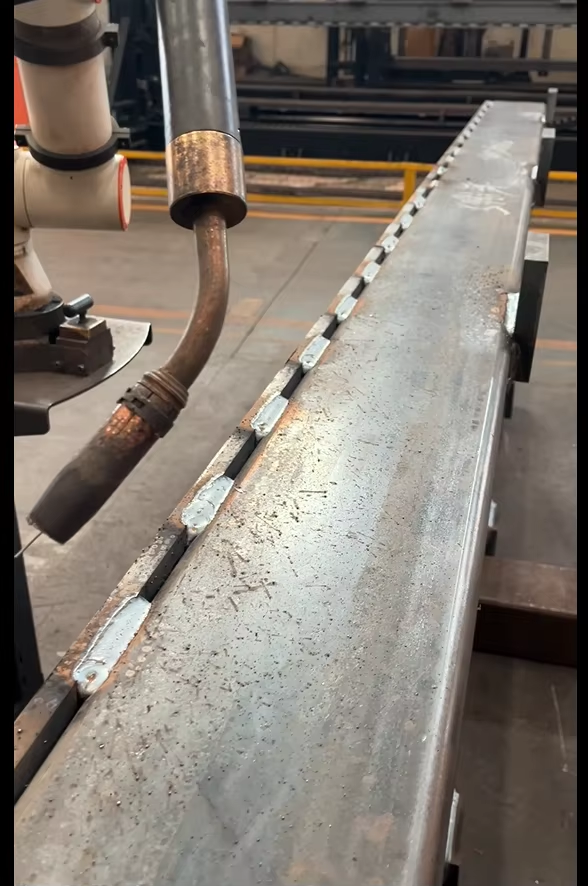
The Dawn of High-Power Fiber Lasers in Queretaro’s Industrial Corridor
Queretaro has long been recognized as the heart of Mexico’s aerospace and automotive sectors. However, a new frontier is emerging: heavy-duty structural fabrication for the energy sector. The deployment of a 6000W CNC Beam and Channel Laser Cutter represents a significant investment in local manufacturing infrastructure. Unlike traditional plasma or mechanical sawing methods, the 6000W fiber laser offers a concentrated energy density that allows for clean, burr-free cuts on thick-walled structural steel.
For companies supporting the offshore platforms in the Gulf of Mexico, the proximity of Queretaro offers a strategic logistical advantage. By processing beams and channels in a controlled, high-tech environment inland and transporting them to coastal shipyards, firms can ensure that the structural components of a rig—from the jacket legs to the topside modules—are engineered to sub-millimeter tolerances.
Technical Superiority: The 6000W Advantage
At the core of this machine is a 6000W fiber laser source. In the world of laser physics, power equates to both speed and the ability to penetrate thickness. A 6000W source is the “sweet spot” for structural steel. It provides enough energy to cut through carbon steel channels up to 25mm or 30mm thick while maintaining a narrow kerf width.
One of the primary advantages of fiber laser technology over CO2 or plasma is the wavelength. At approximately 1.06 microns, the fiber laser beam is absorbed more efficiently by metals. This results in a smaller Heat Affected Zone (HAZ). In offshore engineering, minimizing the HAZ is critical. Excessive heat can alter the metallurgical properties of the steel, making it brittle and prone to stress-corrosion cracking in saltwater environments. The 6000W fiber laser preserves the integrity of the base metal, ensuring that the beams retain their designed load-bearing characteristics.
3D Geometry and Multi-Axis Precision
Cutting a flat sheet is relatively simple; cutting a 12-meter H-beam is an entirely different engineering challenge. The CNC Beam and Channel Laser Cutter utilizes a multi-axis head (often 5-axis or 6-axis) that allows the laser nozzle to rotate around the profile. This 3D capability is essential for “coping”—the process of removing material from the ends of beams so they can be joined together.
In offshore platform construction, complex “K-joints” and “T-joints” are common. Traditional methods involve manual marking, torch cutting, and hours of grinding to achieve the correct bevel for welding. The 6000W CNC laser automates this entire process. It can execute complex bevel cuts (up to 45 degrees) directly into the program. This means that when the beam arrives at the assembly site, it fits perfectly against the mating surface, requiring zero manual adjustment. The precision of the CNC interface ensures that even the bolt holes for secondary structures are aligned with robotic accuracy.
The Efficiency of Automatic Unloading Systems
One of the most significant bottlenecks in heavy fabrication is material handling. A standard 12-meter structural beam can weigh several tons. Manually moving these pieces off a cutting bed requires overhead cranes, multiple operators, and significant downtime.
The integration of an automatic unloading system changes the ROI (Return on Investment) calculation for Queretaro-based shops. As the laser completes its final cut, a series of synchronized hydraulic or pneumatic lifters and conveyor rollers take the finished part and move it to a staging area. Simultaneously, the next raw beam is loaded into the chuck.
This continuous workflow is vital for large-scale offshore projects that operate on tight “First Oil” deadlines. Automatic unloading not only increases throughput by 30-40% but also drastically improves workplace safety. By minimizing the need for manual intervention with heavy suspended loads, fabricators reduce the risk of industrial accidents—a key metric for international energy companies when auditing their suppliers.
Engineering for the Abyss: Meeting Offshore Standards
Offshore platforms are among the most stressed structures on earth. They must withstand constant wave action, hurricane-force winds, and the corrosive power of the ocean. Therefore, the structural members—the beams and channels processed by the laser—must meet stringent international standards such as AWS (American Welding Society) D1.1 and API (American Petroleum Institute) RP 2A.
The 6000W CNC laser facilitates compliance with these standards through its “pre-weld” preparation capabilities. Because the laser can cut precise bevels and “J-grooves,” it ensures deep weld penetration, which is mandatory for structural integrity. Furthermore, the CNC system logs every cut, providing a digital trail of fabrication. In the event of a structural audit, the fabricator in Queretaro can prove that every notch and hole was executed exactly to the naval architect’s specifications.
The Strategic Role of Queretaro in the Energy Supply Chain
Choosing Queretaro as the hub for this technology is a calculated move. The region’s stable climate is ideal for maintaining the delicate optics of a high-power laser. More importantly, the industrial ecosystem in Queretaro provides a pool of highly skilled CNC programmers and laser technicians who can maximize the machine’s potential.
The logistics of Mexico’s highway infrastructure allow for the rapid transport of processed beams from Queretaro to the ports of Tampico, Altamira, and Veracruz. This creates a “hub-and-spoke” manufacturing model. The high-precision, high-tech work is done in the Queretaro “hub,” and the final assembly and load-out occur at the coastal “spokes.” This specialization allows Mexican fabricators to compete with international shipyards in Singapore or Korea, offering high-quality structural components at a more competitive price point due to reduced labor and shipping costs.
Future-Proofing Mexican Fabrication
As we look toward the future of energy, including offshore wind and deep-water oil exploration, the demand for complex structural steel will only grow. The 6000W CNC Beam and Channel Laser Cutter is not just a tool; it is a statement of intent. It signals that Mexico is moving away from basic “maquiladora” assembly and into high-value, high-complexity engineering.
The integration of software—where CAD (Computer-Aided Design) files are sent directly from an engineer’s desk in Houston or Mexico City to the laser in Queretaro—minimizes the “human error” factor. This “Industry 4.0” approach ensures that the beams and channels produced today will stand the test of time in some of the world’s most demanding environments.
Conclusion
The installation of 6000W CNC Beam and Channel Laser Cutters with automatic unloading in Queretaro is a game-changer for the offshore platform industry. By marrying the power of fiber laser technology with the efficiency of automated logistics, Queretaro is positioning itself as a global leader in structural fabrication. For the offshore sector, this means safer platforms, faster construction cycles, and the assurance that every beam and channel is cut to the highest possible standard of excellence. As these machines continue to hum in the industrial parks of the Bajio region, they are not just cutting steel—they are carving out Mexico’s future in the global energy landscape.