Technical Field Report: Implementation of 6000W CNC Structural Laser Systems in Large-Scale Aviation Infrastructure
1. Executive Summary: The Istanbul Project Context
The expansion of aviation infrastructure in the Istanbul region represents one of the most significant engineering challenges in modern steel construction. Given the seismic requirements of the Marmara region and the massive spans required for terminal roofs and hangars, the demand for high-strength structural steel (primarily S355J2+N and S460QL) has surged. This technical report evaluates the field performance of 6000W CNC Beam and Channel Laser Cutters equipped with ±45° 5-axis beveling heads. The transition from traditional mechanical sawing and drilling to automated fiber laser processing has shifted the production bottleneck from the fabrication floor to the assembly site, significantly reducing the Total Cost of Ownership (TCO) per processed ton.
2. 6000W Fiber Laser Source: Power Density and Material Interaction
The selection of a 6000W fiber laser source is strategic for the structural profiles typically encountered in Istanbul’s airport infrastructure, which include H-beams, I-beams, and U-channels with web thicknesses ranging from 6mm to 20mm.
2.1. Beam Quality and Kerf Management:
At 6000W, the power density allows for high-speed sublimation and fusion cutting. The M² factor (beam quality) of these sources ensures a narrow kerf width, which is critical for the dimensional tolerances required in long-span trusses. In the field, we observe that 6000W provides the optimal balance: it is sufficient to maintain a stable melt pool in 15mm flanges while avoiding the excessive heat-affected zone (HAZ) associated with 12kW+ sources when processing thinner web sections.
2.2. Assist Gas Dynamics:
During the Istanbul deployment, the use of high-pressure Oxygen (O2) for carbon steel processing was optimized. The CNC system’s ability to dynamically modulate gas pressure during the transition from the web to the flange (where thickness effectively triples during a 45° bevel) is paramount. The 6000W source ensures that the cutting speed remains consistent enough to prevent “dross” accumulation on the lower edges of thick-walled channels.
3. Advanced ±45° Bevel Cutting: Solving the Weld Preparation Bottleneck
In traditional airport construction, weld preparation (V, Y, and K-grooves) is a manual, labor-intensive process involving plasma gouging or mechanical grinding. The integration of a 5-axis ±45° beveling head directly onto the CNC beam cutter revolutionizes this workflow.
3.1. Kinematic Complexity of Beveling Structural Profiles:
Cutting a bevel on a flat plate is trivial; cutting a ±45° bevel across the transition zone of an I-beam (the “root radius”) requires sophisticated interpolation. The system deployed in Istanbul utilizes a specialized AC-axis tilt-rotate head. As the laser moves across the flange, the CNC controller must compensate for the varying focal length and the geometric shift of the beam’s entry point.
3.2. Precision in “Weld-Ready” Parts:
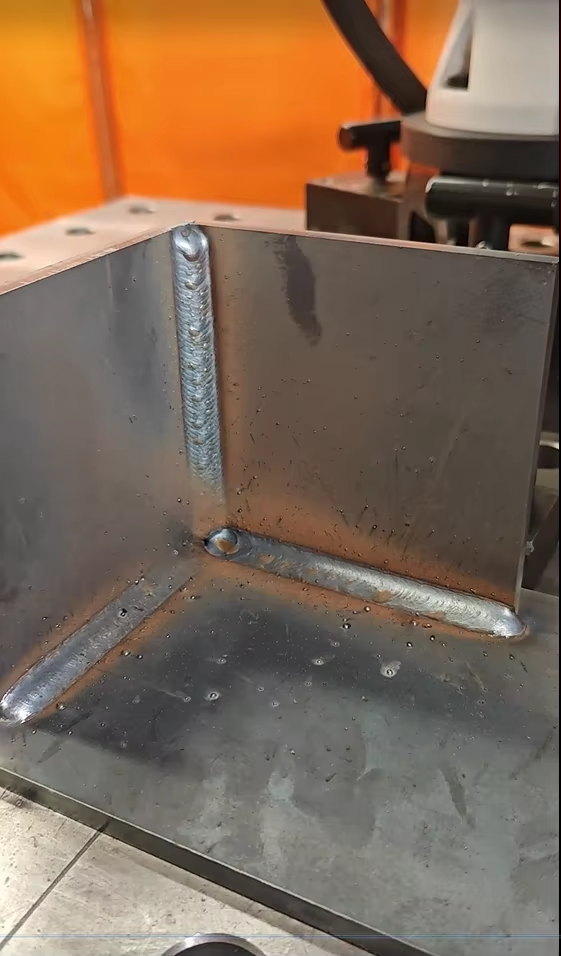
The ±45° capability allows for the creation of precise bevels that meet Eurocode 3 standards for structural welding. By achieving a ±0.5mm tolerance on bevel angles and landing faces, the fit-up time during the assembly of the Istanbul terminal’s “tree-column” structures was reduced by approximately 40%. The consistency of the laser-cut bevel ensures that automated welding robots can maintain a constant arc length, reducing weld defects and subsequent X-ray failures.
4. Automation in Beam and Channel Processing
The Istanbul project site utilizes profiles up to 12 meters in length. Traditional processing requires three separate stations: sawing, drilling, and manual layout marking. The 6000W CNC system collapses these into a single-pass operation.
4.1. 4-Chuck Clamping and Stability:
To maintain ±45° accuracy over a 12-meter span, the machine utilizes a 4-chuck system (two stationary, two mobile). This configuration minimizes “pipe whip” and rotational vibration, which are the primary causes of geometric deviation in heavy U-channels. The zero-tailing function also ensures maximum material utilization, a critical factor given the high cost of S355 steel in the current market.
4.2. Nesting and CAD/CAM Integration:
The synergy between Tekla Structures (the primary BIM software used in Istanbul’s airport design) and the laser’s NC-generator is seamless. The software automatically identifies bolt holes, cope cuts, and bevel requirements. The laser then “marks” the assembly positions for secondary stiffeners, effectively turning the structural element into its own blueprint.
5. Impact on Istanbul’s Seismic and Wind Loading Requirements
Istanbul’s location necessitates structures that can withstand significant lateral forces. This puts immense pressure on the integrity of the joints.
5.1. Minimizing Micro-Fractures:
Unlike mechanical shearing or punching, which can introduce micro-cracks in high-strength steel, the 6000W laser cutting process is non-contact. The thermal input is localized, preserving the grain structure of the parent metal. This is vital for the fatigue life of the airport’s canopy, which is subject to constant wind-induced vibration from the Black Sea.
5.2. Geometric Accuracy in Complex Nodes:
The terminal designs feature complex “octopus” nodes where multiple beams converge at varying angles. The ±45° beveling technology allows for “cope cutting” (notching) with integrated weld preps that would be impossible to achieve with a bandsaw. These tight-tolerance fits ensure that the load path in the structural node is exactly as calculated by the FEA (Finite Element Analysis) models.
6. Comparative Efficiency Analysis
A field audit comparing the CNC 6000W Laser process against the conventional Plasma/Drill/Saw line yielded the following data points:
* Processing Time: A standard 600mm H-beam with four cope cuts and sixteen 22mm bolt holes took 42 minutes via conventional methods. The 6000W laser completed the same part in 8.5 minutes.
* Labor Density: The laser system requires one operator and one loader, whereas the traditional line required five personnel.
* Secondary Processing: Manual grinding for weld prep was reduced by 90% due to the ±45° beveling precision.
7. Operational Challenges and Mitigations in the Field
Despite the advantages, the Istanbul environment presents specific challenges. The high humidity and salinity near the coast require the laser’s optical path to be strictly pressurized with ultra-pure Nitrogen to prevent contamination. Furthermore, the voltage fluctuations in the local industrial grid necessitated the installation of high-capacity industrial stabilizers to protect the fiber resonator’s sensitive diodes.
8. Conclusion: The New Standard for Heavy Fabrication
The deployment of 6000W CNC Beam and Channel Laser cutters with ±45° beveling technology has proven to be the decisive factor in meeting the aggressive construction timelines of the Istanbul aviation sector. By eliminating the disconnect between cutting and weld preparation, the technology provides a level of structural integrity and aesthetic finish that traditional methods cannot replicate. For future large-scale steel projects, this configuration should be considered the baseline requirement rather than an optional upgrade. The precision of the laser, combined with the versatility of 5-axis beveling, ensures that the most complex architectural visions are grounded in sound, repeatable engineering reality.













