The Strategic Imperative of Fiber Lasers in Riyadh’s Industrial Landscape
As Saudi Arabia accelerates its transition toward a diversified energy portfolio, the National Renewable Energy Program (NREP) has set ambitious targets for wind energy capacity. Riyadh, serving as the industrial and logistical heart of the Kingdom, is the logical epicenter for the specialized manufacturing required to build these massive structures. The wind turbine tower—a monumental feat of structural engineering—demands materials that can withstand cyclical loading and extreme temperature fluctuations.
Traditional methods of fabricating these towers involved labor-intensive plasma cutting or oxy-fuel processes, followed by hours of manual grinding to achieve the necessary weld prep angles. The introduction of the 6000W Fiber Laser 3D Structural Steel Processing Center fundamentally changes this equation. Fiber lasers offer superior absorption rates in carbon steel, and at 6000W, the system provides the “sweet spot” of power—balancing high-speed processing of medium-to-thick plates (12mm to 25mm) with the refined beam quality needed for intricate 3D geometries.
The Mechanics of Power: Why 6000W is the Industry Benchmark
In the realm of structural steel, power is the primary driver of throughput. A 6000W fiber laser source provides a power density that allows for “high-speed melt-shearing.” When processing the heavy-wall sections of a wind turbine tower, the laser must not only cut through the material but do so while maintaining a minimal Heat Affected Zone (HAZ).
For Riyadh’s manufacturers, the 6kW output ensures that the structural integrity of the steel is preserved. High-wattage fiber lasers operate at a wavelength of approximately 1.07 microns, which is more readily absorbed by steel than the 10.6 microns of legacy CO2 lasers. This leads to faster cutting speeds and a narrower kerf. In wind tower production, where kilometers of steel are cut annually, the efficiency gains of a 6kW system over a 3kW or 4kW system translate into thousands of saved man-hours and significantly lower electricity consumption per meter of cut.
The Breakthrough of Infinite Rotation 3D Technology
The most critical component of this processing center is the 3D head with infinite rotation capabilities. Traditional 3D cutting heads are often limited by “cable wrap,” where the internal gas lines and electrical cables restrict the head to a 360-degree or 540-degree turn before it must “unwind.” In the context of large-scale structural steel and wind tower sections—which are often circular or elliptical—this unwinding causes a pause in the cut, creating a “lead-in/lead-out” mark that can become a point of structural weakness or a weld defect.
The Infinite Rotation 3D Head utilizes advanced slip-ring technology and specialized optical pathways to allow the head to rotate indefinitely around the C-axis. When combined with a tilting A-axis (often +/- 45 to 60 degrees), the machine can perform complex beveling ($V, Y, X,$ or $K$ joints) in a single continuous pass. For wind turbine towers, which require precise beveling to ensure deep-penetration welds, this technology ensures that the seam is perfectly prepared without the mechanical inconsistencies associated with stopping and starting the laser.
Precision Beveling for Wind Turbine Tower Integrity
Wind turbine towers are essentially tapered tubes subjected to immense torque and environmental stress. The welding of these sections is the most critical phase of assembly. A 6000W 3D laser system allows for “Weld-Ready” parts straight off the machine.
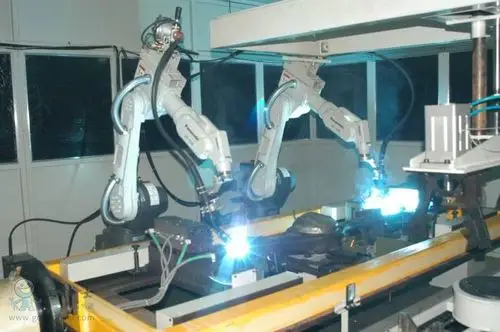
By utilizing the 3D head’s ability to tilt, the system can cut the necessary weld prep angles directly into the curved surface of the tower sections. This eliminates the need for secondary beveling processes. In Riyadh’s high-output manufacturing facilities, the ability to move a plate or a pre-rolled section into the laser center and have it emerge with perfect $V$-grooves or complex contours means that the subsequent robotic welding stations can operate at peak efficiency with zero-gap fit-up. This precision is vital for the longevity of the tower, as even a minor misalignment in the weld can lead to fatigue failure over the tower’s 25-year lifespan.
Processing Structural Steel: Beyond the Tower
While wind towers are a primary focus, the 6000W 3D Processing Center is a versatile asset for Riyadh’s broader construction sector. The “Structural Steel” aspect of the center refers to its ability to handle H-beams, I-beams, channels, and heavy-wall square tubing.
The infinite rotation head allows for the cutting of “fish-mouth” joints, bolt holes, and complex notches in structural members that form the internal platforms and ladders of the wind tower. Beyond renewables, this technology is being used to build the skeletons of Riyadh’s new mega-projects, such as the New Murabba and the expanding metro infrastructure. The ability to process 3D geometries means that architects and engineers can design more complex, lighter, and stronger steel structures, knowing that the laser can execute the geometry with sub-millimeter accuracy.
Environmental Adaptation: Operating Fiber Lasers in Riyadh
Operating high-precision fiber lasers in the Riyadh climate presents unique challenges, primarily related to heat and airborne particulates. A 6000W laser generates significant internal heat, and the ambient temperatures in Riyadh can exceed 45°C.
Modern processing centers designed for this region feature dual-circuit industrial chillers with oversized heat exchangers. One circuit cools the fiber laser source, while the other cools the 3D cutting head and optics. Furthermore, the 3D head is pressurized with “clean dry air” (CDA) or nitrogen to prevent the ingress of desert dust into the sensitive optical path. The “Infinite Rotation” mechanism is also hermetically sealed to ensure that the mechanical gears and slip rings remain lubricated and free of contaminants, ensuring 24/7 operation in the industrial zones of Sudair or Modon.
Economic Impact and the Future of Manufacturing in KSA
The investment in 6000W 3D laser technology represents a shift from “labor-intensive” to “knowledge-intensive” manufacturing. For a facility in Riyadh, the ROI (Return on Investment) is driven by three factors:
1. **Material Savings:** The precision of the fiber laser reduces scrap rates. The nesting software optimized for 3D paths ensures that every square centimeter of high-grade structural steel is utilized.
2. **Labor Reallocation:** Instead of a team of ten workers performing manual grinding and plasma cutting, a single technician and a loader can manage the entire laser center.
3. **Speed to Market:** The ability to go from a CAD drawing to a finished, beveled structural component in minutes rather than days allows Saudi manufacturers to compete on a global scale.
As Riyadh continues to grow as a technological beacon, the 6000W 3D Structural Steel Processing Center stands as a testament to the Kingdom’s industrial maturity. It is not merely a cutting machine; it is a sophisticated robotic cell that bridges the gap between raw steel and the clean energy of the future. By mastering the infinite rotation of the laser head, Saudi engineers are quite literally carving the path for the wind energy revolution in the Middle East, ensuring that every tower standing against the desert winds is a masterpiece of precision and power.