The Dawn of High-Power Photonics in Riyadh’s Industrial Landscape
The industrial landscape of Riyadh is undergoing a radical transformation, driven by the ambitious mandates of Saudi Vision 2030. At the heart of this revolution is the adoption of ultra-high-power fiber laser technology. The introduction of a 30kW fiber laser system specifically designed for universal profile steel—including H-beams, I-beams, channels, and heavy-wall tubes—represents a shift from “conventional” manufacturing to “smart” heavy industry. For the railway sector, where structural integrity and dimensional precision are non-negotiable, the 30kW threshold is a game-changer.
Historically, the fabrication of heavy rail profiles relied on plasma cutting or mechanical sawing and drilling. While effective, these methods often necessitated secondary processes such as grinding, deburring, and manual layout marking. A 30kW fiber laser eliminates these bottlenecks. By harnessing a concentrated beam of light with extreme power density, the system can slice through thick-gauge structural steel at speeds that plasma cannot match, all while maintaining a heat-affected zone (HAZ) so narrow that the structural properties of the steel remain intact. In the arid and demanding climate of Riyadh, where thermal expansion can complicate large-scale assembly, the precision of laser-cut components ensures a perfect fit-up every time.
30kW Power Dynamics: Redefining Thickness and Speed
As a fiber laser expert, it is essential to understand why 30kW is the “sweet spot” for modern railway infrastructure. In the past, 6kW to 12kW lasers were the standard, but they struggled with the massive cross-sections required for bridge supports and railway chassis. The 30kW source provides the “overkill” necessary for high-speed nitrogen cutting, which leaves a bright, oxide-free surface ready for immediate welding. This is critical for railway applications where weld quality is scrutinized by X-ray and ultrasonic testing.
The 30kW power level allows for the efficient processing of carbon steel up to 50mm or even 80mm in thickness, but its true value lies in its “flying cut” capabilities on 10mm to 25mm profiles. In the context of Riyadh’s infrastructure projects, this means that the hundreds of kilometers of steel required for catenary supports, station frameworks, and track fasteners can be produced in a fraction of the time. The increased power also allows for faster piercing—reducing the “dwell time” on thick materials and preventing the buildup of heat that can lead to material warping.
Universal Profile Processing: The Multi-Axis Advantage
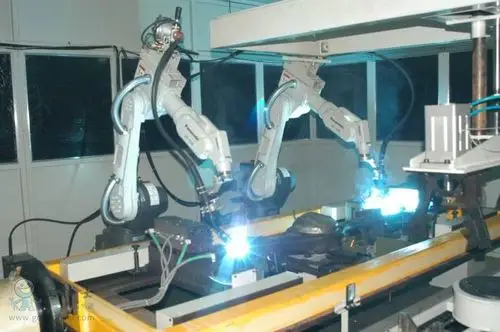
Railway infrastructure is rarely composed of flat plates alone. It relies on complex structural shapes. The “Universal Profile” designation of this system refers to its ability to handle 3D geometries. Unlike a standard flatbed laser, this system is equipped with a sophisticated 5-axis or 6-axis cutting head and a rotary chuck system that can accommodate heavy beams and oversized pipes.
For a project like the Riyadh Metro or the expansion of the North-South Railway, this system can take a standard 12-meter I-beam and perform complex bevel cuts, bolt-hole drilling, and miter joints in a single continuous process. The CNC integration allows for the nesting of different parts within a single profile, maximizing material utilization. In an era where steel prices fluctuate globally, the ability to reduce scrap by even 5% through intelligent laser nesting translates to millions of Riyals in savings over the course of a major infrastructure project.
The Critical Role of Automatic Unloading in Riyadh’s High-Output Facilities
A 30kW laser is so fast that manual loading and unloading become the primary bottleneck. In the high-temperature environment of a Riyadh fabrication plant, manual labor is not only a bottleneck but a safety concern when handling heavy, heat-treated steel. The integration of an automatic unloading system is what transforms a “machine” into a “production cell.”
The automatic unloading system uses a series of synchronized conveyors, hydraulic lifts, and robotic arms to move finished profiles away from the cutting zone. As the laser completes a cut, the system intelligently supports the piece to prevent it from dropping and damaging the precision edges. For the railway industry, where components can be several meters long and weigh hundreds of kilograms, this automation is essential. It allows the laser to maintain a high “beam-on” time—often exceeding 85%—whereas a manual system might see the laser idle for half the shift while workers struggle to clear the bed.
Engineering for the Riyadh Environment: Cooling and Filtration
Operating a 30kW fiber laser in Riyadh presents unique engineering challenges, specifically regarding ambient temperature and airborne dust. Fiber lasers are sensitive to heat; the laser diodes and the optical path must be kept within a strict temperature range to prevent “thermal lensing” or diode degradation. This system requires an industrial-grade, dual-circuit chiller specifically rated for the Middle Eastern climate, utilizing high-efficiency refrigerants and oversized condensers.
Furthermore, the cutting of structural steel—especially with 30kW of power—generates a significant volume of metallic dust and fumes. The filtration system must be top-tier, utilizing HEPA filters and high-volume extraction to ensure that the internal optics of the laser remain pristine. In Riyadh’s dusty environment, the machine’s cabinet must be pressurized with filtered air to prevent “Sand/Dust Ingress,” which is a common cause of failure for sensitive electronic components in the region. As an expert, I emphasize that the longevity of the 30kW system in Saudi Arabia depends entirely on the robustness of its environmental protection suites.
Impact on Railway Infrastructure and Local Content
The deployment of this technology in Riyadh is a direct boost to “Local Content” requirements. Instead of importing pre-fabricated steel segments from Europe or East Asia, Saudi contractors can now fabricate complex railway components locally. This reduces lead times from months to days and allows for “just-in-time” delivery to construction sites across the Kingdom.
For railway infrastructure, the laser’s ability to perform high-precision “etching” is an underrated benefit. Every beam and profile can be laser-marked with QR codes, part numbers, and assembly instructions. This creates a digital twin of the infrastructure, where every piece of steel in a bridge or station can be traced back to its material batch and the exact date it was cut. This level of traceability is vital for the long-term maintenance and safety of the Saudi railway network.
Conclusion: The Future of Saudi Manufacturing
The 30kW Fiber Laser Universal Profile Steel System is more than just a cutting tool; it is a statement of industrial intent. By locating this capacity in Riyadh, the heart of the Kingdom’s logistical hub, Saudi Arabia is positioning itself as a leader in advanced manufacturing. The synergy of high-power photonics, 3D profile machining, and automated unloading creates a manufacturing powerhouse capable of meeting the grueling demands of railway construction.
As we look toward the future of Saudi Vision 2030, the ability to process heavy steel with surgical precision will be the foundation upon which the Kingdom’s cities and transit systems are built. The 30kW fiber laser has moved from the laboratory to the front lines of Riyadh’s industrial expansion, proving that the future of infrastructure is fast, automated, and powered by light.













