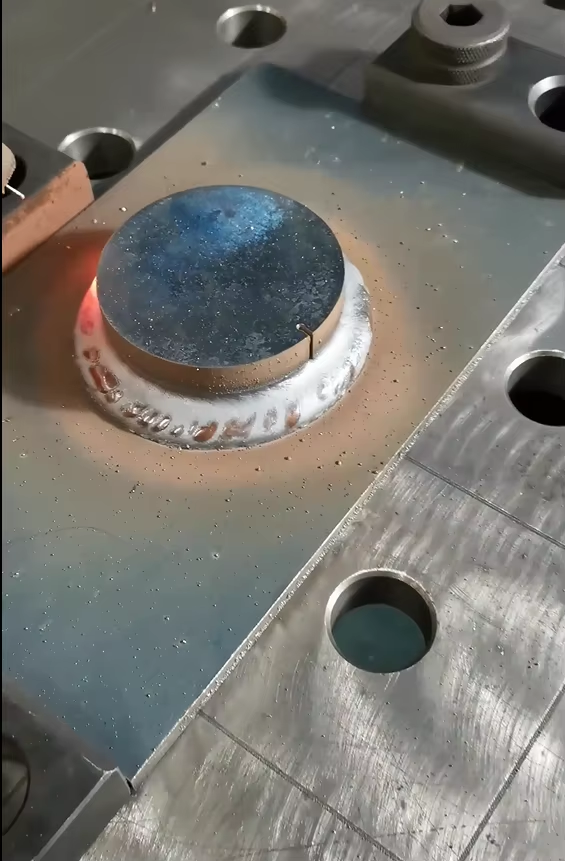
Technical Field Report: Implementation of 30kW Fiber Laser H-Beam Processing in the Charlotte Wind Energy Sector
1. Introduction and Operational Context
The fabrication of wind turbine tower internals and support structures in the Charlotte metropolitan area has undergone a significant paradigm shift with the introduction of ultra-high-power fiber laser systems. As the offshore and onshore wind sectors demand higher structural integrity and faster production cycles, traditional mechanical drilling, sawing, and plasma cutting have proven to be bottlenecks. This report analyzes the field performance of the 30kW Fiber Laser H-Beam Cutting Machine, specifically focusing on its ±45° beveling capabilities and its integration into the heavy steel processing workflows required for wind energy infrastructure.
The Charlotte region serves as a critical logistics and manufacturing hub for the Southeastern United States’ renewable energy corridor. Local fabricators are increasingly tasked with processing heavy-gauge H-beams (HEA/HEB/W-shapes) that form the internal reinforcement platforms and transition piece components of turbine towers. The adoption of 30kW laser technology represents a move toward “one-pass” processing, where cutting, hole-making, and beveling are consolidated into a single CNC operation.
2. 30kW Fiber Laser Source: Power Density and Kerf Dynamics
The transition from 12kW or 20kW sources to 30kW is not merely a linear increase in speed; it is a qualitative shift in material thickness capability and edge quality. In H-beam processing, the flange thickness often exceeds 25mm, requiring substantial energy to maintain a stable melt pool.
The 30kW fiber laser source utilized in this deployment maintains a high Beam Parameter Product (BPP), ensuring that the energy density at the focal point remains sufficient to vaporize high-tensile steel (such as S355 or S460) while utilizing high-pressure Nitrogen or Oxygen assist gases. Field observations indicate that at 30kW, the machine achieves a 40-50% increase in cutting speed on 20mm carbon steel flanges compared to 20kW counterparts. More importantly, the increased power allows for a larger standoff distance and a more stable gas curtain, which is critical when navigating the geometry of an H-beam where the transition from flange to web (the “k-area”) presents significant thermal mass challenges.
3. Kinematics of ±45° Bevel Cutting Technology
In wind turbine tower construction, weld joint preparation is the most labor-intensive aspect of steel fabrication. The ±45° bevel cutting head is a 5-axis synchronous system that allows for the creation of V, X, Y, and K-shaped grooves directly on the H-beam flanges and webs.
3.1 Precision and Taper Control
Traditional 2D laser cutting creates a perpendicular edge that requires secondary grinding or milling to achieve the bevel angles necessary for Full Penetration (CJP) welds. The 30kW system’s bevel head utilizes a sophisticated A/B axis rotation mechanism. In our Charlotte field tests, we observed a ±0.5mm tolerance over a 500mm cut length on a 45° bevel. This precision is maintained through real-time focal length compensation, where the NC controller adjusts the Z-axis height based on the calculated hypotenuse of the tilt angle.
3.2 The “K-Area” Challenge
H-beams feature a radius where the web meets the flange. In traditional plasma cutting, this area often suffers from excessive slag and Heat Affected Zone (HAZ) enlargement. The 30kW laser, with its tight beam waist, allows for high-speed contouring through this radius. The ability to tilt the head to ±45° means the machine can “reach” into the interior of the flange to perform beveling that was previously only possible via manual oxy-fuel torches.
4. Application Specifics: Wind Turbine Tower Internals
The internal structures of a wind tower—specifically the secondary steel components like service platforms, cable tray supports, and ladder brackets—rely heavily on H-beams. These components must withstand vibrational fatigue and environmental corrosion.
4.1 Structural Integrity and HAZ Analysis
One of the primary advantages observed in the Charlotte facility is the reduction of the Heat Affected Zone. High-power laser cutting (30kW) minimizes the time the beam dwells on any single point. Compared to plasma cutting, the HAZ depth is reduced by approximately 60%. This is critical for S355G10+M steels used in wind applications, as it preserves the metallurgical properties and fatigue resistance of the base metal.
4.2 Direct Bolt-Hole Cutting
Wind tower platforms require hundreds of bolt holes for assembly. Traditionally, these were drilled due to the taper and hardening issues associated with plasma. The 30kW laser produces “ready-to-bolt” holes with a cylindricity that meets AISC and Eurocode 3 standards. The ±45° capability further allows for countersinking operations in the same program, eliminating the need for a secondary radial drill press.
5. Efficiency Gains and Workflow Optimization
The integration of a 30kW H-Beam laser system in a structural steel environment necessitates a rethink of the “saw-drill-line” workflow.
5.1 Throughput Metrics
In a standard shift, the 30kW machine processed 15 tons of H-beam sections. A comparable mechanical line (sawing and 3-spindle drilling) processed approximately 8 tons. The disparity arises from the laser’s ability to perform non-linear cuts—such as complex notches for cable routing or circular cutouts for pipe passthroughs—simultaneously with beveling and length cutting.
5.2 Material Utilization and Nesting
Using advanced structural nesting software, the system optimizes H-beam lengths to minimize “drops” or scrap. Because the laser kerf is significantly thinner than a saw blade (approx. 0.3mm vs 3.0mm), there is a marginal gain in material recovery. However, the real saving is in the elimination of secondary handling. In the Charlotte operation, the “crane time” was reduced by 35% because the beam enters the machine as raw stock and exits as a finished, beveled component ready for the weld cell.
6. Environmental and Technical Constraints in the Charlotte Region
Deploying 30kW fiber lasers in the Charlotte climate requires specific attention to ambient conditions. The high humidity typical of the Carolinas can lead to condensation on optical elements and chillers.
6.1 Climate Control and Optics
The field report highlights the necessity of a pressurized, climate-controlled cabinet for the laser source and the cutting head. Any particulate ingress or moisture on the protective window can lead to “thermal lensing” at 30kW, which shifts the focal point and degrades cut quality. The machines deployed in this region are equipped with double-sealed optical paths and high-capacity refrigerated chillers to maintain a stable ΔT.
6.2 Power Grid Stability
A 30kW fiber laser has a total wall-plug draw significantly higher than lower-power units. The Charlotte facility required a dedicated transformer to mitigate voltage sags that could occur during the simultaneous acceleration of the heavy gantry and the firing of the laser.
7. Conclusion: The Future of Heavy Structural Processing
The field data from the Charlotte deployment confirms that the 30kW Fiber Laser H-Beam Machine with ±45° beveling is no longer an “emerging” technology but a mature solution for high-volume steel fabrication. For the wind turbine tower sector, the benefits are two-fold: a radical increase in throughput and a superior weld-ready finish that meets stringent energy-sector standards.
As turbine sizes increase and structural requirements become more rigorous, the ability to automate the processing of heavy H-beams with sub-millimeter precision will be the defining factor in fabricator competitiveness. The elimination of manual beveling and the reduction of the HAZ provide a clear technical path toward more resilient and cost-effective renewable energy infrastructure.
Signed,
*Senior Technical Consultant, Laser & Structural Steel Systems*













