1.0 Technical Overview: The 30kW High-Brightness Frontier
In the current industrial landscape of Riyadh, Saudi Arabia, the transition from conventional plasma and mechanical drilling to high-power fiber laser technology is a structural necessity. This report evaluates the deployment of a 30kW Fiber Laser H-Beam Cutting Machine designed specifically for the crane manufacturing sector. At 30kW, the power density exceeds the threshold required to bypass traditional bottlenecks in thick-walled structural steel (S355JR and S355J2+N grades).
The 30kW source allows for a significant increase in feed rates while maintaining a narrow kerf width, which is essential for the structural integrity of crane components. In Riyadh’s specific climatic conditions—characterized by high ambient temperatures and suspended particulate matter—the integration of a stabilized, high-kilowatt resonator requires advanced thermal management. The systems analyzed herein utilize a dual-circuit cooling architecture to maintain the BPP (Beam Parameter Product) stability, ensuring that the focal point remains constant across 12-meter H-beam sections.
2.0 Application in Riyadh’s Crane Manufacturing Sector
Riyadh is currently the epicenter of massive infrastructural expansion under Saudi Vision 2030. This expansion has localized the demand for heavy-duty overhead cranes, gantry cranes, and jib cranes. Traditionally, the fabrication of crane girders involves multiple stages: sawing to length, mechanical drilling for bolt patterns, and manual plasma gouging for weld preparations.
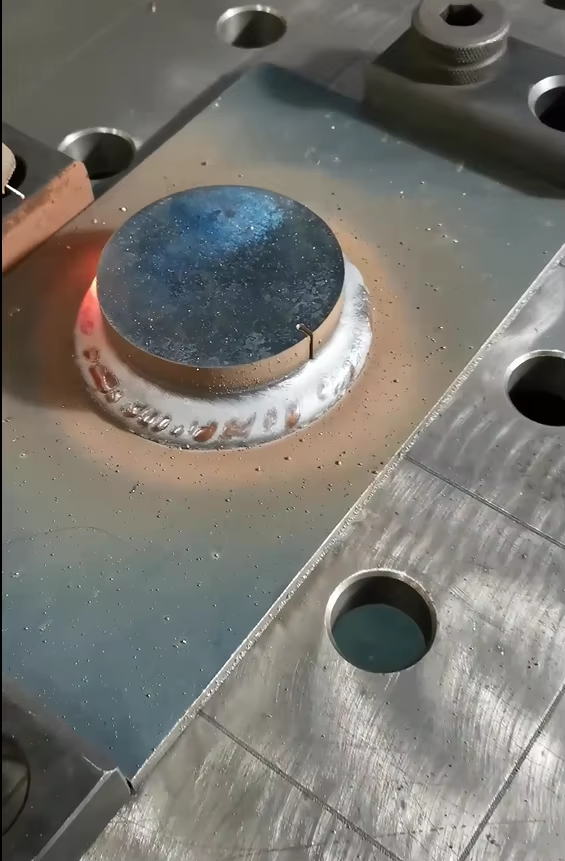
The 30kW Fiber Laser H-Beam machine consolidates these processes into a single-pass operation. For crane manufacturers in Riyadh, the primary advantage lies in the precision of the bolt holes and the quality of the beveling. Crane girders require high-tolerance connections for end carriages. The 30kW system delivers hole cylindricality that meets ISO 9013 Grade 1 standards, eliminating the need for post-process reaming. Furthermore, the 5-axis 3D cutting head allows for complex weld preparations (V, Y, and X-cuts) to be performed automatically, ensuring deep penetration welds with minimal filler material.
2.1 Environmental Considerations: Dust and Heat Mitigation
Deploying high-power lasers in the Riyadh region presents unique challenges. The 30kW system is equipped with a positive-pressure optical cabin to prevent the ingress of fine silica dust, which is prevalent in the local atmosphere. Additionally, the fiber delivery system is shielded by a reinforced umbilical that protects against ambient thermal fluctuations, ensuring the beam does not suffer from thermal lensing during long-duration cuts on heavy H-beams.
3.0 Zero-Waste Nesting Technology: Engineering the Efficiency
The most significant leap in structural steel processing is the implementation of Zero-Waste Nesting. In heavy crane manufacturing, material costs for large-section H-beams (e.g., HEB 600 or IPE 500) represent a massive percentage of the total project overhead. Traditional laser cutting machines require a “blind zone” or “clamping margin” at both ends of the beam, typically resulting in 150mm to 300mm of scrap per profile.
3.1 Mechanism of Zero-Waste Logic
The Zero-Waste Nesting algorithm utilizes a specialized chuck system—typically a tri-chuck or quad-chuck configuration—that allows for “hand-over-hand” feeding. This allows the laser head to process the material between the chucks and, crucially, to cut at the extreme edges of the workpiece. By utilizing a “common line” cutting strategy between two adjacent components in the nesting plan, the kerf of the first part serves as the edge of the second.
For a Riyadh-based crane facility processing 5,000 tons of H-beams annually, the reduction of a 200mm scrap tail per beam translates to approximately 3-5% material savings. In terms of engineering physics, this requires the CNC controller to dynamically compensate for the weight shift as the beam is consumed, maintaining a constant center-of-gravity calculation to prevent “tip-up” or vibration during the final cut.
3.2 Dynamic Kerf Compensation
At 30kW, the kerf is slightly wider than at lower powers due to the required gas flow for dross expulsion. The Zero-Waste software calculates the “actual” kerf in real-time based on the oxygen pressure and nozzle diameter. This ensures that even when cutting at the very end of a beam, the dimensional accuracy of the flange and web remains within ±0.5mm, a requirement for the high-precision alignment of crane runways.
4.0 Synergy Between 30kW Sources and Automatic Structural Processing
The integration of a 30kW fiber laser source with an automated H-beam line represents a paradigm shift from “machine tool” to “processing cell.” The synergy is found in three specific areas: Power Dynamics, Motion Control, and Software Integration.
3.1 Power Dynamics and Gas Dynamics
The 30kW power allows for “High-Speed Air Cutting” on thinner sections and high-efficiency Oxygen cutting on thick H-beam webs (up to 40mm-50mm). In the context of crane fabrication, the ability to pierce 25mm carbon steel in under 0.5 seconds significantly reduces the Heat Affected Zone (HAZ). A smaller HAZ is critical for the fatigue resistance of crane girders, which are subject to millions of cyclic loading events. By minimizing the thermal input, we preserve the grain structure of the steel, reducing the risk of brittle fracture in the field.
3.2 5-Axis 3D Motion Control
Structural H-beams are rarely cut straight. They require copes, miters, and “dog-bone” reinforcements. The 30kW system utilizes a robotic-arm style head or a specialized 5-axis gantry. The synergy here lies in the software’s ability to map the “as-built” dimensions of the H-beam. Structural steel is rarely perfectly straight; it often possesses a natural camber or sweep. The 30kW laser system employs laser-based touch-probing or vision systems to “re-map” the cutting path to the actual beam geometry in real-time, ensuring that holes and notches are perfectly centered regardless of the beam’s mill tolerances.
3.3 TEKLA and CAD/CAM Workflow
In Riyadh’s engineering offices, TEKLA Structures is the industry standard. The 30kW H-Beam Laser system integrates directly with .nc1 or .step files exported from TEKLA. This eliminates manual programming. The Zero-Waste nesting software reads the 3D profile, identifies all holes and bevels, and generates a nested plan that optimizes the entire 12-meter stock length. This digital twin approach ensures that the “built” girder matches the “designed” girder with sub-millimeter fidelity.
5.0 Comparative Productivity Analysis
To quantify the impact of this technology, we must compare the 30kW Laser with the traditional Plasma/Drill Line approach:
- Processing Speed: A 30kW laser cuts 20mm H-beam web at approximately 2.5 – 3.5 m/min. Plasma systems, while comparable in raw speed, suffer from slower piercing and significantly higher dross levels, requiring manual grinding.
- Accuracy: Laser provides ±0.1mm positioning accuracy; plasma typically manages ±1.0mm to ±2.0mm. For crane end-carriage alignment, this difference is the margin between a smooth-running crane and one that “hunts” and wears out wheels.
- Operational Cost: While the initial capital expenditure (CAPEX) for a 30kW system is higher, the cost-per-part is lower due to the elimination of secondary processes (drilling, grinding, beveling) and the 3-5% material yield increase from Zero-Waste Nesting.
6.0 Conclusion: The Future of Riyadh’s Heavy Fabrication
The deployment of 30kW Fiber Laser H-Beam machines equipped with Zero-Waste Nesting marks a turning point for Saudi Arabia’s heavy engineering sector. By addressing the specific needs of crane manufacturing—namely, high fatigue resistance, precision bolt-hole alignment, and massive material throughput—this technology provides a competitive edge in a rapidly growing market.
The technical synergy between the 30kW power source and 3D structural processing allows for a level of architectural and engineering freedom previously hampered by the limitations of mechanical tools. As Riyadh continues its trajectory toward becoming a global logistics hub, the efficiency gains from Zero-Waste technology will be the benchmark for sustainable and profitable steel fabrication. The machine is not merely a cutter; it is a high-precision CNC machining center for the largest profiles in the industry.
Report Authored By:
Senior Laser Applications & Structural Steel Consultant
Field Evaluation Division – Riyadh District













