The Dawn of Ultra-High Power: Why 30kW Matters
For years, the fiber laser industry hovered in the 6kW to 12kW range, which was sufficient for sheet metal but struggled with the thick-walled structural members required for heavy-duty industrial racking. The leap to 30kW changes the fundamental physics of the cutting process. As an expert in fiber optics, I see this not just as an increase in “heat,” but as a massive leap in energy density and processing speed.
At 30kW, the laser beam maintains a stable “keyhole” in thick structural steel, allowing for high-speed fusion cutting. In Dubai’s competitive fabrication market, speed is the primary currency. A 30kW source can process 20mm carbon steel channels at speeds that would make a 10kW machine stall. Furthermore, the higher power allows for the use of compressed air or nitrogen cutting on thicker sections, which leaves a clean, oxide-free edge. This is crucial for storage racking, where components often require immediate welding or powder coating without the labor-intensive step of edge grinding.
Precision Engineering for Beams and Channels
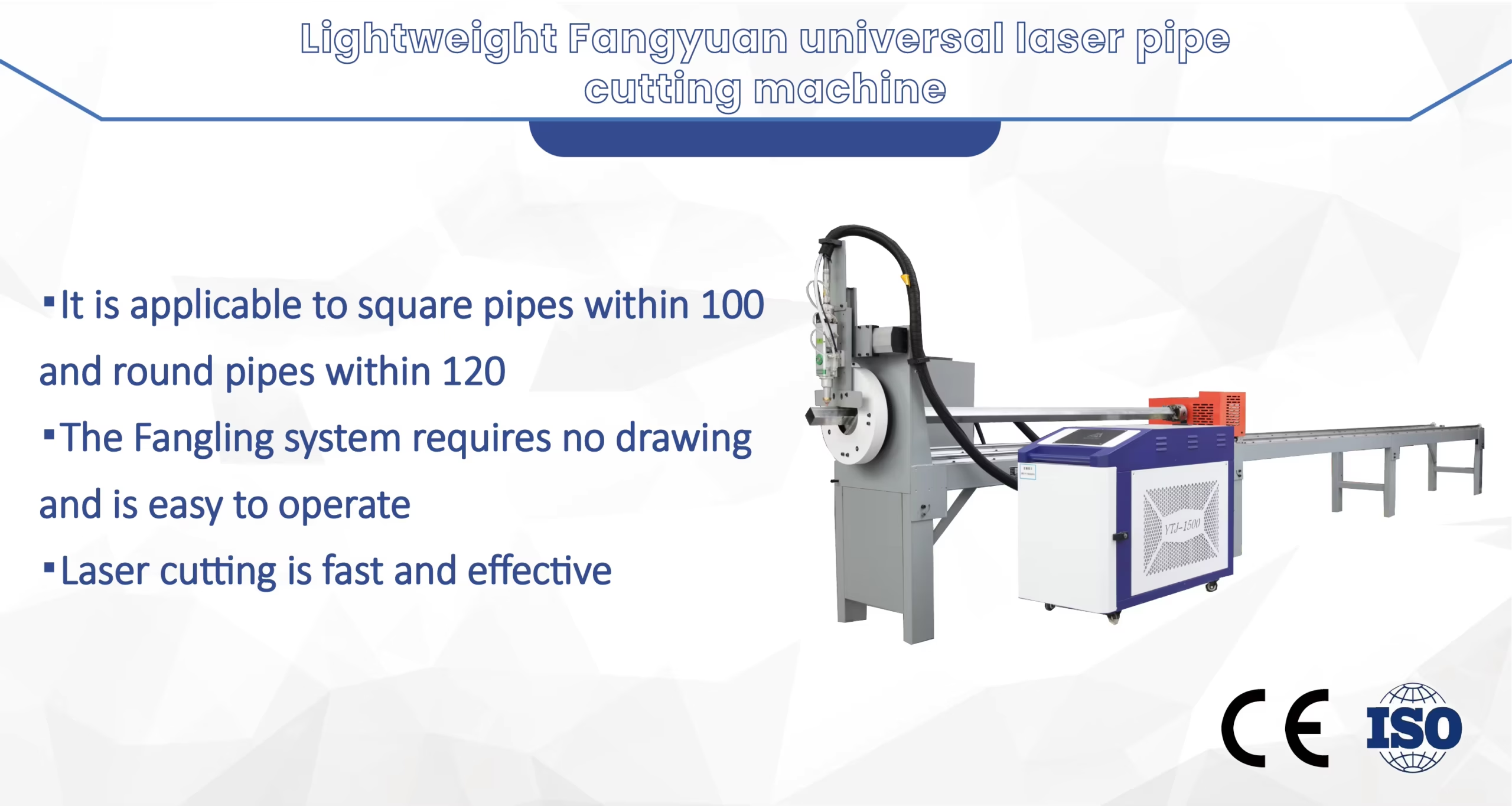
Standard sheet lasers are two-dimensional; however, structural steel for racking involves complex 3D geometries. The 30kW Beam and Channel Laser utilize a sophisticated multi-chuck system—often a four-chuck configuration—to rotate and move long structural members through the cutting zone.
The 5-axis 3D cutting head is the “brain” of the operation. It allows for beveling and miter cuts on I-beams and H-beams, which are essential for creating the interlocking joints found in sophisticated racking systems. In Dubai’s logistics hubs, where high-bay warehouses are the norm, the racking must withstand immense vertical loads. The precision of a 30kW laser ensures that bolt holes are perfectly concentric and that interlocking tabs fit with zero tolerance, enhancing the structural integrity of the entire warehouse installation.
The “Zero-Waste” Revolution in Nesting Technology
In the high-volume world of storage racking, material cost is the largest variable. When processing 12-meter beams, traditional laser cutters often leave “tailings”—unused segments at the end of the beam that the chucks cannot hold. For a 30kW machine specialized in zero-waste nesting, this is a problem of the past.
Advanced CNC software uses “common-line cutting” and “intelligent jumping” to nest parts so closely that the exit cut of one component serves as the entry cut for the next. The four-chuck system allows the machine to pass the beam between chucks mid-cut, enabling the laser to process the material right up to the very edge. In Dubai, where raw steel prices are subject to global shipping fluctuations, moving from 10% waste to less than 1% waste provides a massive competitive advantage. Over a year of high-volume production, these savings can effectively pay for the machine’s maintenance and a significant portion of its operational costs.
Optimizing Storage Racking Fabrication in the UAE
Dubai is a global logistics nexus, housing some of the world’s largest distribution centers. The demand for storage racking—ranging from standard pallet racks to complex Automated Storage and Retrieval Systems (AS/RS)—is insatiable.
The 30kW laser simplifies the production flow of these systems. Historically, a C-channel rack upright would move from a saw (to cut to length) to a drill press (for bolt holes) to a milling machine (for notch-outs). The 30kW Fiber Laser combines these three steps into one continuous process. It can “drill” hundreds of holes in minutes, notch out sections for cross-beams, and cut the profile to length in a single program. This reduction in “work-in-progress” (WIP) is vital for Dubai-based manufacturers who need to meet tight project deadlines for Jebel Ali Free Zone (JAFZA) developments.
Engineering for the Dubai Climate: Thermal Management
As a fiber laser expert, I must emphasize that a 30kW system in Dubai faces environmental challenges that machines in Europe or North America do not. The extreme ambient heat and humidity can wreak havoc on laser resonators and sensitive optics.
To combat this, these machines are equipped with industrial-grade, dual-circuit water chillers and climate-controlled electrical cabinets. The fiber source itself is hermetically sealed to prevent dust ingress—a common issue in the desert environment. Furthermore, the 30kW power level generates significant internal heat. Advanced “pierce monitoring” and “active cooling” at the cutting head prevent the nozzle from overheating during long runs on thick H-beams. When deploying these systems in the UAE, we prioritize high-flow ventilation and specialized filtration to handle the voluminous dust generated by high-power vaporization of thick steel.
The Synergy of Software and Photonics
The hardware is only half the story. The “Zero-Waste” promise relies heavily on the integration of CAD/CAM software tailored for structural shapes. This software can import 3D models of entire racking assemblies and automatically unfold them into the cutting instructions for the beam.
In Dubai’s fast-paced construction sector, design changes are frequent. The agility of CNC laser cutting means that a manufacturer can update a hole pattern across a thousand channels with a few clicks, rather than re-tooling a physical punch or drill jig. This digital workflow, combined with the raw power of a 30kW source, allows for “Just-In-Time” manufacturing of customized racking solutions that meet specific seismic or load-bearing requirements of the GCC region.
ROI and Long-Term Value for Metal Service Centers
Investing in a 30kW beam and channel laser is a significant capital expenditure, but the Return on Investment (ROI) is driven by three factors: throughput, versatility, and material yield.
1. **Throughput:** One 30kW laser can often replace three lower-powered machines or five manual processing lines.
2. **Versatility:** The ability to switch from thin-walled box sections to heavy I-beams in minutes allows a shop to take on diverse projects.
3. **Zero-Waste:** As mentioned, the reduction in scrap metal directly bolsters the bottom line.
For Dubai’s metal service centers, this technology represents a shift from being a “supplier” to being a “high-tech partner.” They are no longer just selling steel; they are selling precision-engineered components that are ready for immediate assembly at the job site.
Conclusion: The Future of UAE Structural Fabrication
The 30kW Fiber Laser CNC Beam and Channel Cutter is more than just a tool; it is a catalyst for industrial maturity in the UAE. By embracing zero-waste nesting and ultra-high-power photonics, Dubai-based manufacturers are setting new global benchmarks for efficiency in the storage racking sector.
As we look toward increasingly automated “Smart Factories” in the region, the integration of these high-power lasers with robotic loading and unloading systems will be the next step. For now, the 30kW laser remains the gold standard, providing the perfect balance of raw power, surgical precision, and economic sustainability. In the land of architectural marvels and logistical giants, the ability to shape the very bones of industry with light is a testament to the future of fabrication.