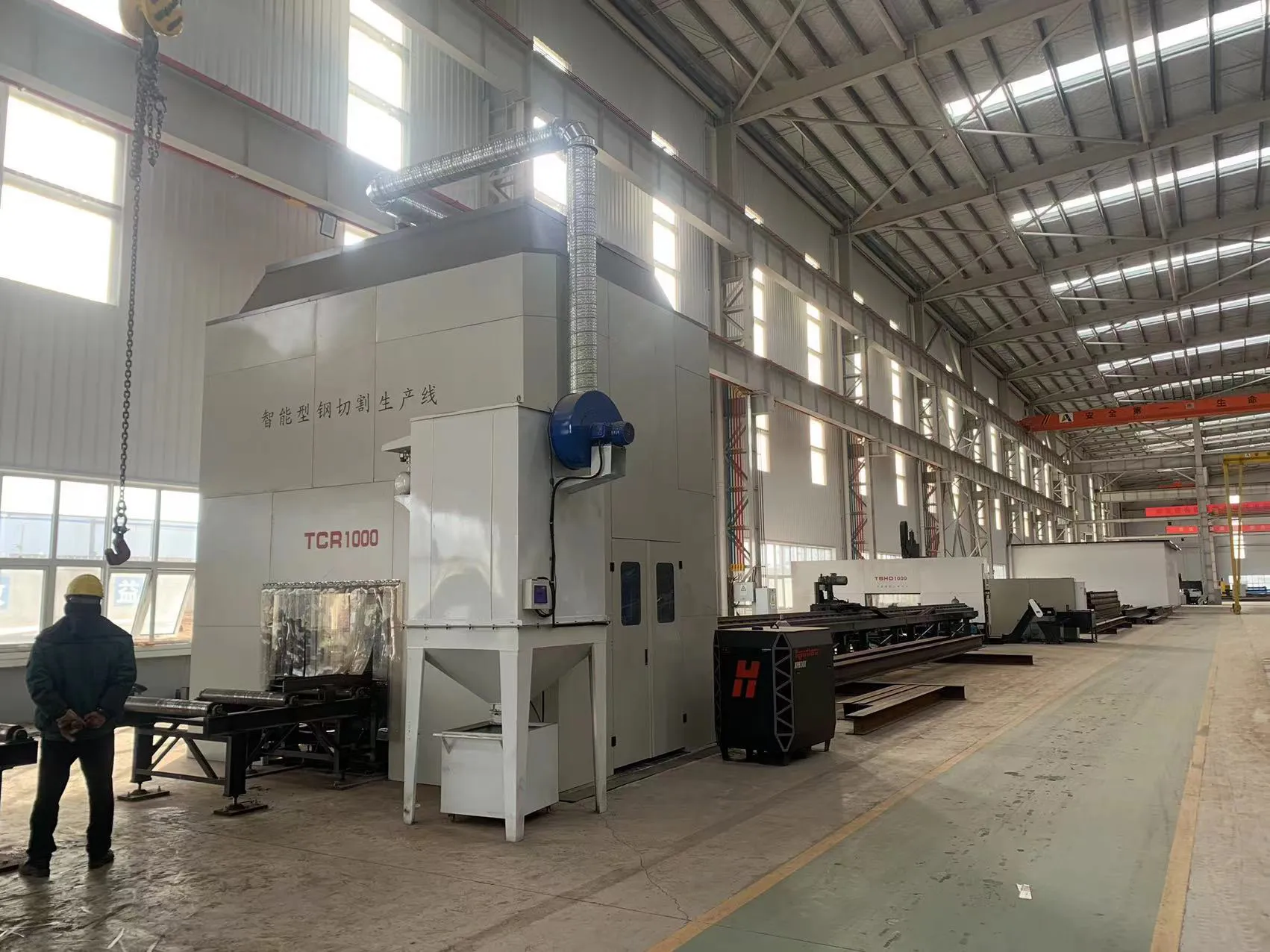
Field Technical Report: Implementation of 30kW 3D Structural Steel Processing in Houston Maritime Manufacturing
1. Executive Summary and Site Context
This report details the technical deployment and operational performance of a 30kW 3D Fiber Laser Structural Steel Processing Center within the Houston ship-building corridor. The facility focuses on the fabrication of offshore supply vessels (OSVs) and modular marine structures. Historically, this sector has relied on plasma arc cutting (PAC) and oxy-fuel processes. The transition to a 30kW fiber laser source equipped with a 5-axis ±45° beveling head represents a significant shift in thermal cutting dynamics, primarily aimed at eliminating secondary machining for weld preparation and increasing the volumetric throughput of heavy-section H-beams, I-beams, and bulb flats.
2. 30kW Fiber Laser Source: Physics and Thermal Dynamics
The core of the system is a 30kW ytterbium fiber laser source. At this power density, the interaction between the 1.07μm wavelength beam and structural carbon steel (ASTM A131/A36) undergoes a transition from traditional melt-and-blow dynamics to high-speed sublimation and shear-stress-driven melt expulsion.
2.1. Power Density and Kerf Morphology
With a 30kW output, the power density at the focal spot exceeds several megawatts per square millimeter. This allows for the maintenance of a stable keyhole even in sections exceeding 30mm. In the Houston maritime context, where thick-walled structural members are standard, the 30kW source ensures that the “drag line” of the cut remains nearly vertical at higher feed rates, reducing the angular deviation typically seen in lower-power systems.
2.2. Heat-Affected Zone (HAZ) Characterization
A critical requirement for American Bureau of Shipping (ABS) certified structures is the minimization of the HAZ. The high-speed processing capability of the 30kW source reduces the residence time of the thermal load on the base material. Field cross-sections indicate a HAZ reduction of 65% compared to high-definition plasma, significantly lowering the risk of hydrogen-induced cracking and grain coarsening in high-tensile naval steels.
3. ±45° Bevel Cutting Kinematics and Weld Preparation
The integration of a 3D 5-axis torch head allows for ±45° beveling, a prerequisite for V, Y, X, and K-type weld preparations required by AWS D1.1 structural welding codes.
3.1. Compound Angle Precision
In structural steel processing, specifically for tubular junctions and interlaced H-beam architectures, the laser head must maintain a constant standoff distance (Focal Position) while executing complex spatial interpolations. The system utilizes real-time capacitive sensing adapted for angled surfaces. Testing confirms that at a 45° tilt, the beam path length through the material increases by a factor of 1.414; the 30kW reserve ensures that cutting speeds on a 20mm plate at a 45° bevel (effective 28.2mm) remain above 2.5m/min, maintaining productivity.
3.2. Elimination of Secondary Operations
Traditional Houston shipyard workflows involve primary cutting followed by manual grinding or mechanical beveling to achieve weld-ready edges. The ±45° 3D laser head produces a surface roughness (Rz) within the 30-50μm range on beveled edges. This eliminates the need for post-cut dressing, allowing for immediate fit-up and robotic welding integration.
4. Structural Processing Center Architecture
The “Processing Center” designation refers to the integration of the laser source with a multi-axis material handling system capable of managing 12-meter structural profiles.
4.1. 3D Spatial Path Calibration
Unlike flat-bed lasers, the 3D processing center must account for the inherent geometric deviations in hot-rolled structural steel (camber and sweep). The Houston field unit employs a laser scanning pre-pass to map the actual profile of the H-beam. The CNC controller then offsets the 5-axis cutting path in real-time to ensure that the bevel geometry remains consistent relative to the beam’s centerline, rather than the theoretical CAD model.
4.2. Workpiece Stabilization and Chuck Dynamics
To handle the momentum of heavy structural members, the system utilizes a synchronized four-chuck rotation system. This minimizes vibration during the high-acceleration phases of the 30kW cutting head. In Houston’s high-humidity environment, the pneumatic and mechanical components are treated for corrosion resistance to prevent micro-stuttering in the drive train, which would otherwise manifest as striations on the cut surface.
5. Synergy Between High Power and Automation
The 30kW source is not merely a tool for thickness; it is an enabler for “Flying Cut” logic in 3D space.
5.1. Throughput Metrics
In a comparative analysis of a standard web-and-flange penetration for an offshore bulkhead stiffener:
– **Oxy-fuel:** 12 minutes (including pre-heat and manual beveling).
– **Plasma:** 4 minutes (including slag removal).
– **30kW 3D Laser:** 45 seconds (weld-ready finish).
5.2. Gas Dynamics and Nozzle Technology
At 30kW, nozzle cooling becomes paramount. The system utilizes high-pressure nitrogen or oxygen-assisted cutting with chilled nozzles. The gas flow is optimized via aerodynamic simulation to ensure that the molten metal is ejected cleanly from the bottom of the kerf, even during extreme 45° maneuvers where the gas column tends to lose laminarity.
6. Engineering Challenges in the Houston Sector
Operating high-power fiber lasers in the Gulf Coast region presents specific environmental challenges that were addressed during the field commissioning.
6.1. Ambient Humidity and Optical Integrity
The high dew point in Houston necessitates a pressurized, desiccated environment for the entire beam path and the laser source cabinet. The 30kW power level is highly sensitive to any particulate or moisture contamination on the protective windows. The field unit utilizes a dual-circuit chiller system with ±0.1°C stability to prevent condensation on the optics while managing the massive heat load generated by the laser diodes.
6.2. Power Grid Stability
The 30kW laser, coupled with the motion control systems, demands a significant and stable kVA input. The facility was retrofitted with dedicated transformers and active power filtering to mitigate voltage sags that can occur in heavy industrial zones, ensuring that the laser’s beam profile (M2 factor) remains stable during prolonged heavy-section piercing.
7. Conclusion
The deployment of the 30kW Fiber Laser 3D Structural Steel Processing Center in Houston marks a definitive shift in maritime fabrication. By combining the raw energy of a 30kW source with the geometric flexibility of a ±45° 5-axis head, the facility has achieved a 400% increase in component-ready throughput. The precision of the laser-cut bevels ensures superior weld penetration and structural integrity, meeting the most stringent offshore standards while drastically reducing the labor-intensive secondary processing traditionally associated with heavy steel construction. Future iterations will focus on the integration of real-time melt-pool monitoring to further automate quality assurance in the 3D cutting path.













