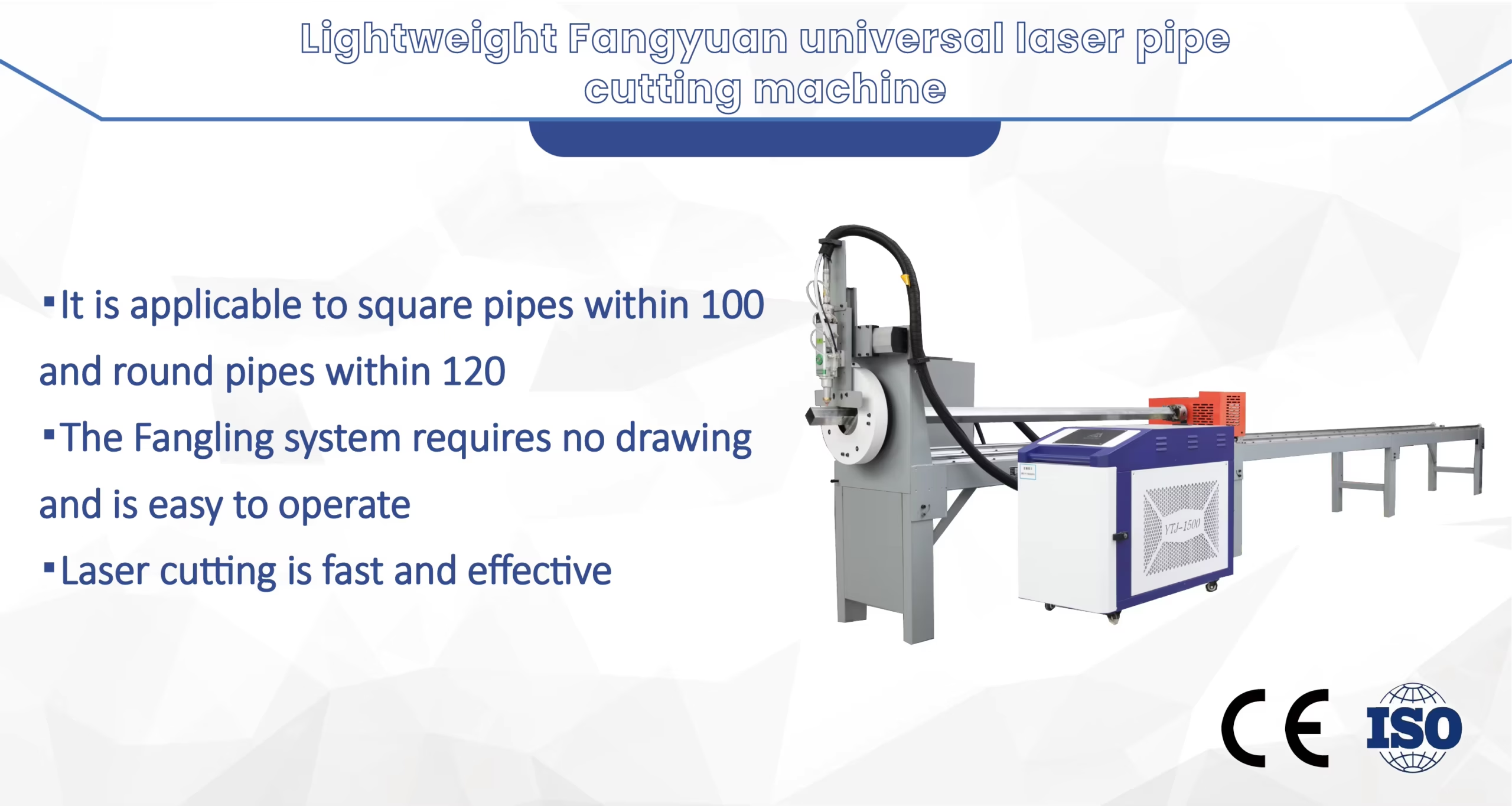
Technical Field Assessment: 20kW 3D Universal Profile Laser Integration in Sao Paulo Rail Infrastructure
1. Introduction and Scope of Infrastructure Deployment
The modernization of the Sao Paulo railway network—encompassing both the CPTM (Companhia Paulista de Trens Metropolitanos) upgrades and the expansion of the Metro lines—has necessitated a paradigm shift in structural steel fabrication. Traditional methods, including mechanical sawing, manual plasma gouging, and radial drilling, have proven insufficient to meet the stringent tolerances and volume requirements of the current expansion phase. This report evaluates the field performance of the 20kW Universal Profile Steel Laser System equipped with an Infinite Rotation 3D Head, specifically as it pertains to the fabrication of heavy-duty structural members such as H-beams, I-sections, and specialized U-channels used in rail overpasses and catenary support systems.
In the industrial clusters of the ABC region and Guarulhos, where primary fabrication occurs, the integration of 20kW fiber sources has transitioned from a high-cost luxury to a technical necessity. The primary objective is the mitigation of secondary processing stages (grinding, re-drilling, and manual beveling) to accelerate the project lifecycle of Sao Paulo’s transit arteries.
2. The 20kW Fiber Laser Resonator: Power Density and Kerf Dynamics
The core of the system is the 20kW ytterbium-doped fiber laser source. In the context of railway infrastructure, we are dealing with high-tensile carbon steels (typically ASTM A36 or A572 Grade 50) with thicknesses frequently exceeding 20mm in the web and 30mm in the flanges of structural H-beams.
At a 20kW power rating, the energy density at the focal point allows for “vaporization cutting” speeds that were previously unattainable with 6kW or 10kW systems. The Beam Parameter Product (BPP) of modern 20kW resonators is optimized to maintain a narrow kerf even at high power, which is critical for the structural integrity of rail components.
Key Technical Observations:
- Thermal Input: The high-speed throughput of the 20kW source minimizes the Heat Affected Zone (HAZ). This is vital for Sao Paulo’s rail bridges, where fatigue resistance is paramount. A smaller HAZ reduces the risk of martensitic grain transformation, which can lead to brittle fractures under the cyclical loading of heavy freight and passenger trains.
- Gas Dynamics: Field testing indicates that high-pressure nitrogen cutting at 20kW yields an oxide-free surface on 15mm profiles, eliminating the need for post-cut pickling or grinding before welding. For 25mm+ sections, oxygen-assisted cutting is utilized with a sophisticated nozzle sensor system to maintain a constant standoff distance despite the irregular geometry of profile steel.
3. Infinite Rotation 3D Head: Overcoming Geometric Constraints
The “Infinite Rotation” technology represents the most significant mechanical advancement in the system. Traditional 5-axis laser heads are limited by cable winding, necessitating “unwind” cycles that interrupt the cutting path. In profile steel processing—where a single cut might involve traversing the flange, the radius, and the web—these interruptions introduce “dwell marks” and thermal accumulation points.
Technical Advantages in Rail Fabrication:
The Infinite Rotation 3D Head utilizes a sophisticated slip-ring or high-torque direct-drive mechanism that allows the cutting head to rotate continuously beyond 360 degrees. In Sao Paulo’s rail projects, this is particularly relevant for:
- Complex Beveling (A, V, X, and K joints): For heavy structural welds, a precise bevel is required. The 3D head can execute a ±45° tilt while rotating around the profile, ensuring a constant bevel angle even across the transition from the web to the flange.
- Bolt Hole Precision: Railway sleepers and support pillars require high-tolerance bolt holes (ISO 9013 Class 1 or 2). The infinite rotation allows the head to maintain a perfectly perpendicular orientation or a specific countersink angle without stopping, ensuring circularity tolerances within ±0.1mm.
- Coping and Notching: When intersecting large I-beams at non-orthogonal angles (common in curved rail sections in the Serra do Mar passages), the 3D head maneuvers through the internal radii of the profile without mechanical interference.
4. Application Specifics: Sao Paulo Railway Infrastructure
The specific environmental and structural demands of Sao Paulo’s rail geography—ranging from high humidity to the need for rapid seismic-resistant assembly—place unique pressures on steel fabrication.
Structural Support for Catenary Systems:
The electrification of the rail lines requires thousands of overhead line equipment (OLE) supports. These involve complex apertures in H-beams for cantilever attachments. The 20kW system automates the cutting of these apertures with a finish quality that prevents stress risers.
Bridge Girders and Truss Nodes:
In the construction of the Metrô Line 17 (Ouro) monorail and conventional heavy rail links, the nodal connections where multiple profiles converge require extreme precision. The 20kW laser, guided by the 3D head, allows for “tab-and-slot” design architecture in heavy steel. This enables pre-assembly in the shop with high-fidelity fit-ups, significantly reducing the welding time and man-hours required at the construction site in downtown Sao Paulo.
5. Synergy Between Power and Automation
The 20kW Universal Profile system is not merely a cutting tool; it is a robotic cell. The synergy between the high-power source and the automatic structural processing software (integrating directly with BIM and TEKLA structures) allows for a “raw material in, finished component out” workflow.
Material Handling and Throughput:
In the field, we have observed that the bottleneck in rail fabrication is often not the cutting speed but the material handling. The Universal Profile system solves this via:
- Automatic Loading: Using hydraulic lifters and conveyor systems capable of handling 12-meter profiles weighing several tons.
- Mechanical Clamping and Centering: Profiles are rarely perfectly straight. The system uses laser touch-probing to map the actual deformation of the beam in real-time, adjusting the 3D cutting path to compensate for “camber” or “sweep” in the steel. This ensures that every cut is relative to the beam’s actual geometry, not an idealized CAD model.
- Nesting Efficiency: Advanced nesting algorithms for profiles reduce scrap rates by up to 15% compared to manual sawing. Given the current price of structural steel in the Brazilian market, this provides a direct ROI.
6. Precision and Quality Assurance Standards
For the Sao Paulo railway authorities, compliance with NBR (Normas Brasileiras) and international AWS (American Welding Society) standards is non-negotiable. The 20kW 3D system meets these through:
- Surface Roughness: Achieving Rz values within the limits for high-strength friction grip (HSFG) bolted joints.
- Perpendicularity: The 3D head compensates for beam thickness variations, ensuring that bolt holes are perfectly aligned across both flanges of a 400mm deep beam.
- Reduced Slag Adhesion: The high-frequency modulation of the 20kW fiber source, combined with the 3D head’s ability to maintain optimal gas flow vectors, results in dross-free cuts, even on the underside of thick flanges.
7. Conclusion: The Strategic Impact on Sao Paulo’s Logistics
The deployment of the 20kW Universal Profile Steel Laser System with Infinite Rotation 3D Head marks a technological milestone for Brazilian infrastructure. By solving the precision and efficiency issues inherent in heavy steel processing, the system allows for the rapid expansion of the Sao Paulo rail network while maintaining the highest levels of structural integrity.
The elimination of manual layout, the reduction in weld-prep time via 3D beveling, and the sheer throughput of a 20kW source create a streamlined fabrication pipeline. As Sao Paulo continues to densify its transit systems, this high-power laser integration will remain the cornerstone of its structural steel strategy, ensuring that the rail infrastructure is both robust and economically viable for the next century of operation.













