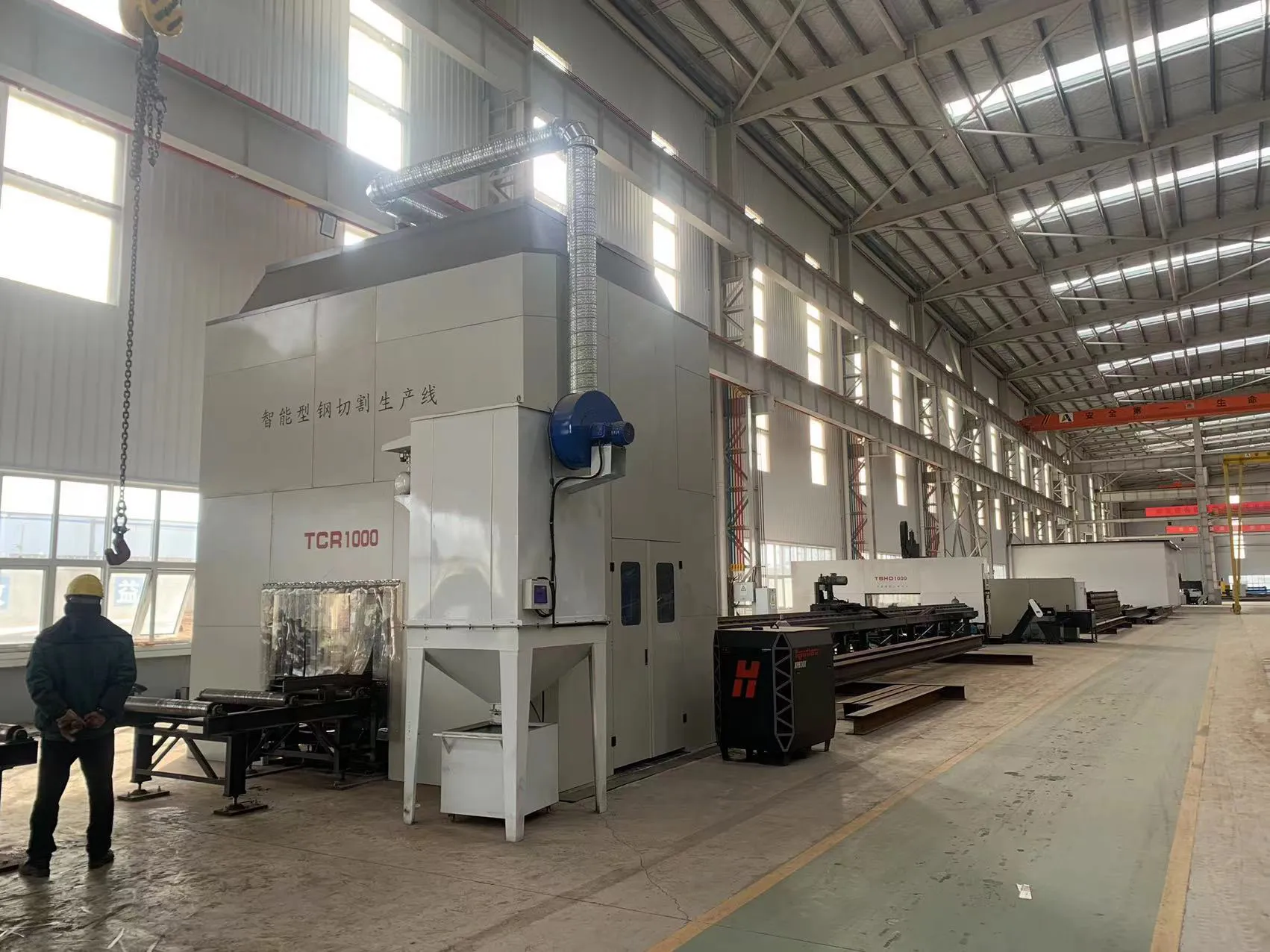
Field Report: Deployment of 20kW Heavy-Duty I-Beam Laser Profiler in Wind Turbine Tower Fabrication
1. Project Overview and Site Dynamics
This technical report evaluates the operational integration of a 20kW Heavy-Duty I-Beam Laser Profiler, equipped with an Infinite Rotation 3D Head, within the Charlotte, North Carolina industrial corridor. Charlotte has emerged as a critical hub for renewable energy infrastructure, specifically the manufacturing of wind turbine tower components. The structural demands of these towers—characterized by extreme height-to-weight ratios and the necessity for high-fatigue-resistance welds—require a shift from traditional plasma cutting to high-density fiber laser processing.
The deployment focuses on the fabrication of internal structural reinforcements, flange attachments, and heavy-duty I-beam supports that constitute the skeleton of wind turbine nacelle bases and tower internal platforms. The primary objective is the mitigation of thermal distortion while achieving AWS-compliant bevel angles for high-integrity welding.
2. The Kinematics of the Infinite Rotation 3D Head
The core technological differentiator in this deployment is the Infinite Rotation 3D Head. Traditional 5-axis laser heads are limited by cable management systems, necessitating a “reset” or “unwinding” motion after reaching a rotational limit (typically ±360 or ±540 degrees). In the context of complex I-beam profiling—where the laser must navigate web-to-flange transitions and circular bolt-hole patterns on slanted surfaces—these resets introduce significant cycle time latencies and potential start-stop defects in the cut path.
The Infinite Rotation assembly utilizes a high-torque slip-ring and integrated cooling manifold that allows the B and C axes to rotate without mechanical limits. This allows for:
- Continuous Beveling: Seamless transition from V-groove to K-groove geometries along the longitudinal axis of an I-beam without interrupting the laser beam.
- Complex Saddle Cuts: Precision interfacing of structural tubing with I-beam webs, critical for the cross-bracing required in turbine tower internals.
- Reduced Heat Affected Zone (HAZ): By maintaining constant feed rates without the deceleration associated with axis resetting, the thermal input remains uniform, preserving the metallurgical integrity of the S355 or A572 Grade 50 steel commonly used in these applications.
3. 20kW Fiber Laser Integration: Thermal and Kinetic Analysis
The transition to a 20kW fiber laser source represents a 300% increase in power density compared to standard 6kW systems previously used in the Charlotte sector. At 20kW, the laser achieves a “keyhole” welding-mode equivalent in cutting, where the photon density is sufficient to vaporize thick-walled steel instantaneously.
Material Penetration and Feed Rates:
For heavy-duty I-beams with flange thicknesses exceeding 25mm, the 20kW source maintains a feed rate that is approximately 4 to 5 times faster than oxygen-fuel or plasma cutting. In the wind turbine sector, where tower base flanges can reach 50mm, the 20kW source facilitates high-pressure nitrogen or air-assist cutting. This eliminates the oxidation layer associated with oxygen cutting, thereby removing the need for secondary grinding prior to welding—a major bottleneck in wind tower production lines.
Kerf Management:
With the increased power, kerf width control becomes critical. The 20kW system utilizes dynamic focal positioning to adjust the beam waist relative to the material depth. This ensures that the kerf remains narrow and the sidewalls remain perpendicular (or at the precisely programmed bevel angle), which is essential for the tight tolerances required in turbine tower assembly.
4. Structural Processing Automation and Beam Deformation Compensation
Heavy-duty I-beams, particularly those exceeding 12 meters in length, are rarely perfectly straight. In the Charlotte facility, the I-beam profiler utilizes an integrated 3D laser scanning system to map the actual geometry of the workpiece prior to the first cut.
Touch-Probe and Laser Scanning Synergy:
The system performs a multi-point scan of the I-beam’s web and flanges. The CNC controller then maps the programmed 3D cut paths onto the actual deformed shape of the steel. This “Best Fit” algorithm ensures that bolt holes for flange connections are aligned within ±0.5mm over a 12-meter span, a requirement for the structural bolts used in wind turbine tower segments which must withstand massive aerodynamic loads.
Workpiece Handling:
The “Heavy-Duty” designation refers to the reinforced bed and chuck system capable of handling profiles weighing up to 1200 kg/m. The synchronization between the chucks (Rotation Axis) and the bridge (Longitudinal Axis) is governed by high-resolution absolute encoders to prevent slippage during high-acceleration maneuvers of the 20kW head.
5. Precision Beveling for Wind Turbine Tower Integrity
Wind turbine towers are subject to cyclical loading and vibration. Consequently, the weld prep quality on the internal structural beams is non-negotiable. The Infinite Rotation 3D Head allows for “variable beveling,” where the angle of the cut changes dynamically along the path to accommodate the changing geometry of the tower’s conical sections.
Technical Advantages in Weld Prep:
- Consistency of Root Face: The system maintains a consistent root face (land) of 1mm to 2mm with a precision of ±0.1mm, facilitating automated robotic welding of the tower segments.
- Multi-Pass Efficiency: By producing clean K-cuts and Y-cuts in a single pass, the profiler reduces the total volume of filler metal required, directly lowering the cost of consumables and reducing the risk of weld inclusions.
- Complex Intersections: In the fabrication of the “door frame” reinforcements for tower bases—where the stress concentration is highest—the 3D head cuts complex elliptical bevels into thick-walled plate or I-beams with surgical precision, ensuring a flush fit-up.
6. Operational Impact on the Charlotte Manufacturing Sector
The deployment of this technology in Charlotte addresses several regional challenges. The local labor market has seen a shortage of Tier-1 manual welders and fitters. By automating the most complex aspect of structural steel fabrication—the beveling and fitting of heavy profiles—the 20kW profiler allows manufacturers to reallocate human capital to final assembly and quality assurance.
Furthermore, the reduction in secondary processing (grinding, de-burring, and re-shaping) has led to a documented 40% reduction in “dock-to-stock” cycle times for turbine tower internal components. The energy efficiency of the 20kW fiber source, compared to CO2 lasers or high-def plasma, also aligns with the “green” mandates of the wind energy companies being serviced.
7. Expert Conclusion
The integration of 20kW fiber laser power with Infinite Rotation 3D Head technology represents the current technical zenith for heavy-duty structural steel processing. In the specialized field of wind turbine tower fabrication, the ability to maintain continuous, high-speed, high-precision cuts on massive I-beams is no longer a luxury but a requirement for global competitiveness.
The Charlotte deployment confirms that the synergy between high-wattage sources and advanced 5-axis kinematics effectively solves the historical conflict between “heavy-duty processing” and “high-precision engineering.” For future iterations, the focus should remain on the further integration of AI-driven predictive maintenance for the 3D head’s optical components, ensuring maximum uptime in high-throughput environments.
End of Report.
Author: Senior Laser Systems & Structural Steel Consultant
Date: October 2023
Location: Charlotte, NC Facility













