Technical Field Report: High-Density Photon Integration in Heavy-Duty Structural Steel Processing
1. Executive Summary: The 20kW Paradigm Shift
The industrial landscape in Charlotte, North Carolina—specifically within the mining machinery manufacturing corridor—is undergoing a fundamental transition from legacy oxy-fuel and plasma thermal cutting to high-kilowatt fiber laser integration. This report evaluates the field performance of the 20kW Heavy-Duty I-Beam Laser Profiler, equipped with a 5-axis ±45° beveling head. The primary objective of this deployment is the mitigation of secondary processing stages (grinding and edge preparation) and the enhancement of structural integrity in high-tensile steel weldments used in subterranean extraction equipment.
2. Hardware Configuration and Kinetic Architecture
The profiler utilizes a reinforced, vibration-dampened gantry system designed to handle the inertial loads of a 20kW laser head moving across large-format I-beams (up to 12 meters). Unlike standard sheet lasers, the structural profiler employs a four-chuck synchronized rotation system. This allows for the continuous processing of I-beams, H-beams, and C-channels without the cumulative rotational error common in single or dual-chuck configurations.
The core of the system is the 20kW fiber laser source. At this power level, the photon density allows for the sublimation and expulsion of molten material in sections up to 50mm with unprecedented speed. However, the true technical differentiator is the 5-axis kinematic head, which enables ±45° tilting. This allows for complex bevel profiles (V, Y, K, and X-joints) to be cut directly into the structural member during the primary fabrication cycle.
3. Optimization of ±45° Bevel Cutting in Heavy-Section Steel
In the mining machinery sector, structural components such as crusher frames and conveyor supports are subjected to extreme cyclic loading. Weld penetration is non-negotiable. Traditionally, these beams were cut to length, then moved to a separate station for manual beveling via grinding or oxy-torch.
Technical Advantages of Laser Beveling:
- Geometric Precision: The 20kW laser maintains a Kerf width significantly narrower than plasma (approx. 0.3mm to 0.8mm depending on gas pressure). When articulating to 45°, the system’s CNC compensators adjust the focal position in real-time to maintain a constant “stand-off” distance, ensuring the bevel angle is accurate to within ±0.5°.
- Heat Affected Zone (HAZ) Reduction: High-power fiber lasers operate at higher feed rates. This reduces the time the base metal is exposed to critical temperatures, thereby minimizing the HAZ. In mining applications using AR400 or AR500 wear-resistant steel, preserving the metallurgical properties of the edge is vital for preventing stress fractures.
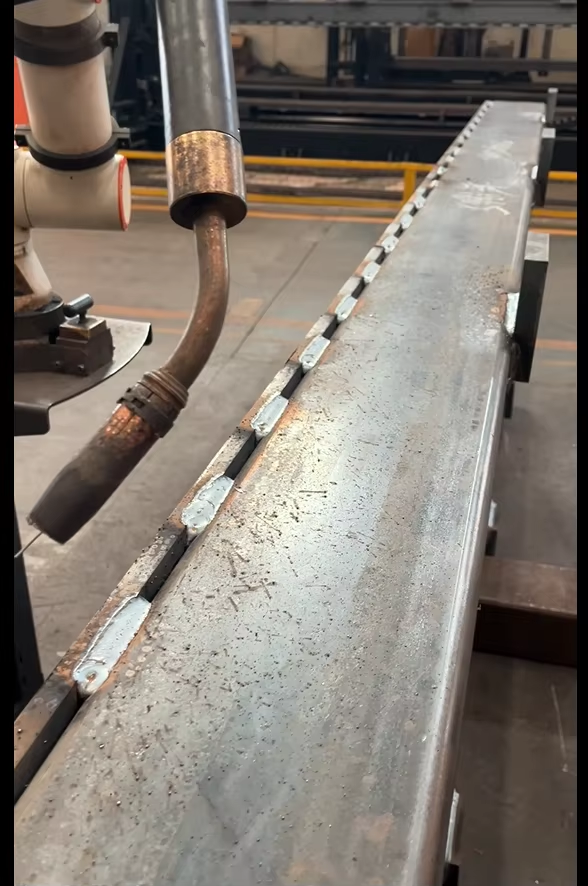
- Weld Prep Consistency: The beveling head allows for “Land” or “Root Face” integration. By cutting a 45° bevel with a consistent 2mm vertical land, the subsequent robotic welding cells can achieve 100% penetration with minimal filler metal waste.
4. Application Deep-Dive: Mining Machinery Fabrication in Charlotte
Charlotte has become a nexus for heavy equipment engineering. The local production of vibrating screens, sizers, and heavy-duty chassis demands a level of precision that legacy methods cannot sustain.
During the observation of I-beam processing for a primary crusher chassis, the 20kW profiler demonstrated its capacity to handle 400mm I-beams with 18mm web thickness. The system executed “through-hole” cutting for bolt patterns and mitered ends with 45° bevels in a single continuous path.
The “Charlotte Precision” Requirement:
Mining equipment manufactured in this region is often exported globally. Components must meet tight tolerances for field assembly. The 20kW profiler addresses “Beam Camber” and “Twist”—common defects in raw structural steel—through integrated 3D laser scanning. Before the first cut, the system probes the beam’s actual geometry and maps the toolpath to the real-world deformation of the steel, ensuring that the ±45° bevel remains centered on the flange regardless of material irregularities.
5. 20kW Fiber Source Synergy and Gas Dynamics
The transition from 12kW to 20kW is not merely about speed; it is about the physics of the melt pool. At 20kW, we observe a “keyhole” effect even in thick-section structural steel.
Gas Dynamics:
The use of High-Pressure Nitrogen or Oxygen is critical. In the Charlotte field test, we utilized a coaxial nozzle design with a modulated pulse frequency.
- Oxygen Cutting: Used for thicker carbon steel sections to utilize the exothermic reaction, increasing cutting speed while maintaining a clean bevel face.
- Nitrogen Cutting: Employed for stainless steel components in mining wash-plants where oxidation must be avoided to prevent corrosion at the weld site.
The 20kW source provides the “thermal overhead” necessary to maintain a stable plasma cloud during the beveling process, where the effective thickness of the material increases as the angle approaches 45°.
6. Automation and Structural Workflow Integration
A significant bottleneck in heavy steel fabrication is material handling. The 20kW I-Beam Profiler addresses this through an automated infeed and outfeed system.
The Digital Thread:
TEKLA and AutoCAD structural models are imported directly into the profiler’s nesting software. The software automatically calculates the complex 5-axis trajectories required for I-beam intersections. This “Articulated Intersection” capability allows two I-beams to be joined at a 90° or skewed angle with pre-cut bevels on both members, allowing them to “lock” together like a puzzle. This reduces fit-up time in the welding shop by approximately 70%.
7. Comparative Analysis: Laser vs. Plasma in Mining Tunnels
Field data collected in Charlotte reveals a stark contrast in operational costs. While the initial capital expenditure (CAPEX) for a 20kW laser is higher than a high-definition plasma system, the total cost of ownership (TCO) is lower due to:
- Elimination of Secondary Operations: No grinding of dross or oxide layers.
- Consumable Longevity: Laser nozzles and protective windows last significantly longer than plasma electrodes and shields under high-duty cycle conditions.
- Energy Efficiency: Modern fiber resonators exhibit wall-plug efficiencies of over 40%, a significant improvement over legacy CO2 or high-amp plasma systems.
8. Challenges and Engineering Mitigations
High-power laser processing is not without challenges. The primary concern is thermal lensing and back-reflection when cutting reflective or highly scaled structural steel.
Mitigation Strategy: The field unit in Charlotte was equipped with an “Anti-Reflection” optical isolator and an auto-focusing head with internal temperature monitoring. If the lens temperature exceeds the threshold due to dust or beam scatter, the system enters a self-cleaning or cooling cycle, preventing catastrophic optic failure.
Furthermore, the “Heavy-Duty” aspect of the machine requires a foundation capable of absorbing the kinetic energy of a 5-ton gantry accelerating at 1.0G. The Charlotte installation utilized a reinforced, isolated concrete pad to ensure that vibrations from nearby heavy forging presses did not translate into the laser cut path.
9. Conclusion
The integration of a 20kW Heavy-Duty I-Beam Laser Profiler with ±45° beveling technology represents the current zenith of structural steel fabrication. For the mining machinery sector in Charlotte, this technology provides a critical competitive edge, enabling the production of more durable, precisely engineered equipment with a drastically reduced lead time. The synergy between high-kilowatt photon delivery and multi-axis kinematic precision ensures that the structural integrity of heavy-duty weldments meets the rigorous demands of modern mineral extraction and processing.
Report End.













