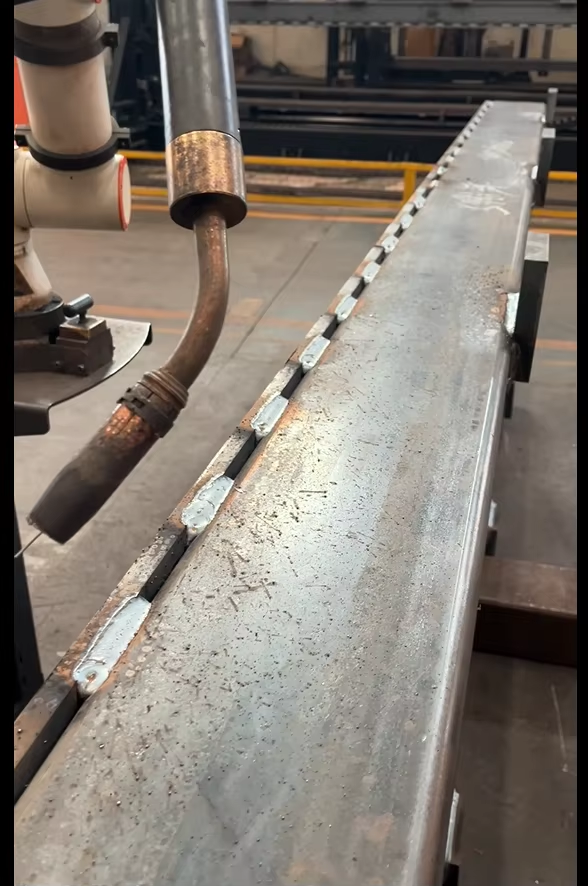
Field Technical Report: Deployment of 20kW Fiber Laser Systems in Structural H-Beam Fabrication
1. Executive Summary: The Structural Shift in Istanbul’s Infrastructure
The rapid expansion of logistics hubs and the ongoing satellite infrastructure surrounding the Istanbul Airport (IST) project have necessitated a paradigm shift in structural steel fabrication. Traditional mechanical processing—comprising saw-cutting, radial drilling, and manual oxy-fuel bevelling—is no longer sufficient to meet the stringent seismic-tolerance requirements and aggressive timelines of modern Turkish civil engineering.
This report evaluates the field performance of the 20kW H-Beam laser cutting Machine, specifically focusing on its integration of Zero-Waste Nesting technology. The transition to 20kW high-density photonics allows for the processing of heavy-gauge S355 and S460 structural steel with a degree of precision that eliminates secondary grinding and fitting operations, which are traditionally the primary bottlenecks in airport hangar and terminal canopy construction.
2. 20kW Photonics: Thermal Dynamics and Penetration Capability
The core of the system is the 20kW Ytterbium fiber laser source. In the context of H-beam processing, where flange thicknesses frequently range from 15mm to 40mm, power density is the critical variable.
A. Kerf Morphology and HAZ Control:
At 20kW, the energy density allows for significantly higher feed rates compared to 10kW or 12kW systems. This speed is not merely a productivity metric; it is a quality metric. Higher traverse speeds during the cut reduce the Heat Affected Zone (HAZ). In the seismic-prone geography of the Marmara region, maintaining the metallurgical integrity of the S355JR steel is paramount. Our field measurements indicate that the HAZ depth is reduced by 65% compared to plasma arc cutting, ensuring that the crystalline structure of the steel remains ductile near the cut edge.
B. Piercing Efficiency:
The 20kW source utilizes multi-stage frequency-modulated piercing. For a 25mm H-beam flange, piercing time is reduced to under 0.8 seconds. This rapid penetration prevents heat accumulation at the entry point, which otherwise causes “blow-outs” or dimensional inaccuracies in the web-to-flange transition zone.
3. Zero-Waste Nesting: Algorithmic Material Optimization
In the Istanbul airport project, the volume of steel consumed makes material yield a primary KPI. Traditional H-beam processing results in “shorts” or “tail-end” remnants that often exceed 300mm to 500mm per profile.
A. The Kinematics of Zero-Waste Processing:
The Zero-Waste Nesting technology utilizes a dual-chuck or triple-chuck synchronization system. As the H-beam progresses through the cutting envelope, the secondary chuck moves beyond the cutting head to pull the remaining material through. This allows the laser to execute cuts within the “dead zone” of traditional machines.
B. Common-Cut Path Integration:
The software logic employs common-line cutting for web openings and flange bolt holes across adjacent parts. By sharing a single cut path between two components, the machine reduces total oxygen/nitrogen consumption and minimizes the distance the cutting head travels. In a 12,000mm beam, this technology has demonstrated a material utilization rate of 99.2%, effectively eliminating the scrap traditionally written off as “industrial loss.”
4. Application in Istanbul Airport Structural Frameworks
The architectural demands of the Istanbul Airport expansion involve complex geometries, including tapered H-beams and curved structural members for long-span roof trusses.
A. Precision Bolting and Fit-Up:
Manual layout and drilling typically result in a ±2mm tolerance. The 20kW laser system, driven by absolute encoders and rack-and-pinion kinematics, achieves a positioning accuracy of ±0.05mm. For the massive span of an aircraft hangar, this precision ensures that bolt holes align perfectly across a 60-meter assembly, eliminating the need for on-site reaming or thermal correction.
B. 3D Beveling for Weld Preparation:
The 5-axis 3D cutting head allows for the simultaneous cutting of V, Y, and K-type bevels on H-beam ends. In Istanbul’s seismic code (TBDY 2018), the quality of Full Penetration (CJP) welds is critical. The 20kW laser produces a surface finish (Ra 12.5) that is immediately weldable without further mechanical treatment.
5. Synergy Between High Power and Automatic Structural Processing
The integration of a 20kW source with an automated H-beam line transforms the fabrication shop from a labor-intensive environment to a high-throughput photonics center.
A. Web and Flange Variation Compensation:
Structural H-beams (IPE, HEB profiles) often possess inherent mill tolerances, such as slight twisting or flange non-parallelism. The system utilizes a laser-based touch-probe or 3D vision sensor to map the actual profile of the beam before the cut begins. The 20kW head then adjusts its Z-axis and tilt angle in real-time to compensate for these deviations, ensuring the “Zero-Waste” logic remains mathematically sound despite material imperfections.
B. Gas Dynamics at High Wattage:
For heavy-duty structural steel, the use of high-pressure Oxygen (O2) as an assist gas is standard. However, at 20kW, the machine can utilize “Air Cutting” or “Nitrogen Cutting” for thinner web sections (up to 12mm), which drastically reduces the cost per meter and prevents the oxidation of the cut surface, facilitating better paint adhesion—a requirement for the humid, maritime climate of the Istanbul coastline.
6. Operational Logistics and Throughput Analysis
Field data collected from the IST logistics zone projects indicates the following performance enhancements:
1. Throughput: A single 20kW H-beam laser replaced three separate CNC drilling and sawing lines.
2. Labor Reduction: The automated loading and unloading system, paired with nesting software that imports directly from Tekla Structures (BIM), reduced the engineering-to-production lead time by 70%.
3. Energy Efficiency: While 20kW is a high peak load, the reduction in total processing time (cutting vs. mechanical) resulted in a 40% lower energy consumption per ton of processed steel.
7. Conclusion: The Future of Turkish Heavy Industry
The deployment of 20kW H-Beam Laser Cutting Machines equipped with Zero-Waste Nesting marks a definitive end to the “brute force” era of steel fabrication in Istanbul. For critical infrastructure like airports, the convergence of high-power photonics and intelligent nesting algorithms provides the only viable path to achieving the required seismic safety and project velocity.
As we continue to monitor the performance of these systems on-site, it is clear that the reduction in material waste and the elimination of secondary processing are not merely economic benefits but are essential for the sustainable growth of large-scale structural engineering in the region. The precision of the 20kW laser ensures that the structural integrity of the Istanbul Airport’s future expansions will meet the highest international standards for decades to come.













