The Industrial Renaissance of Monterrey and the Demand for Rail Infrastructure
Monterrey, often referred to as the “Sultan of the North,” has long been the heart of Mexico’s steel and manufacturing sectors. As the global shift toward “nearshoring” intensifies, the city has become a strategic focal point for North American supply chains. One of the most critical components of this growth is the modernization of railway infrastructure—not only for freight transport connecting to the United States but also for massive domestic projects like the expansion of metropolitan transit and national rail links.
In this high-stakes environment, traditional fabrication methods—such as plasma cutting, mechanical drilling, and manual oxy-fuel torching—are no longer sufficient. The industry demands higher throughput, tighter tolerances, and superior edge quality. The introduction of the 20kW CNC Beam and Channel Laser Cutter has redefined what is possible in structural fabrication, allowing Monterrey-based firms to compete on a global scale by delivering complex rail components with a level of efficiency previously thought impossible.
The Power of 20kW: Redefining Throughput in Heavy Steel
The heartbeat of this machine is its 20,000-watt fiber laser source. In the world of laser cutting, power equals more than just the ability to cut through thicker material; it dictates the speed at which that material can be processed and the quality of the resulting edge. For railway infrastructure, which utilizes thick-walled carbon steel and high-strength alloys, 20kW is the “sweet spot” for industrial-scale production.
At 20kW, the laser achieves high photon density, allowing it to vaporize thick steel instantly. This minimizes the Heat Affected Zone (HAZ), a critical factor in railway engineering where the structural integrity of the steel must remain uncompromised. When cutting 1-inch thick webs of a bridge girder or the heavy-duty flanges of a support channel, the 20kW source maintains a high feed rate, reducing the “dwell time” of heat on the material. This prevents warping and ensures that the metallurgical properties of the beam remain intact, meeting the stringent ISO and ASTM standards required for rail safety.
The Infinite Rotation 3D Head: A Masterclass in 5-Axis Engineering
The most technologically advanced feature of this system is the Infinite Rotation 3D Head. Traditional 3D laser heads are often limited by internal cabling and gas lines, which restrict their rotation to a certain number of degrees before they must “unwind.” In a high-volume production environment like a Monterrey rail plant, these seconds of downtime add up.
The Infinite Rotation head utilizes advanced slip-ring technology and specialized optical pathways to allow the cutting head to spin indefinitely around the C-axis. This is coupled with a ±45° to ±60° tilt on the B-axis. Why is this vital for railway infrastructure?
1. **Complex Beveling for Weld Preparation:** Rail components are rarely joined with simple 90-degree cuts. They require V, Y, X, and K-type bevels to ensure deep-penetration welds. The 3D head can execute these bevels in a single pass while the beam is being cut to length.
2. **Processing Structural Contours:** Beams and channels have complex geometries with varying thicknesses between the flange and the web. The 5-axis motion allows the laser to maintain a perfectly perpendicular (or specifically angled) orientation to the surface of the metal at all times, ensuring consistent kerf width and accuracy across the entire profile of the beam.
3. **Hole Cutting in Flanges:** For bolted connections in rail gantries and signaling structures, the 3D head can precision-cut bolt holes into the side flanges of a channel without having to flip the workpiece, drastically reducing handling time.
Precision Processing of Beams and Channels
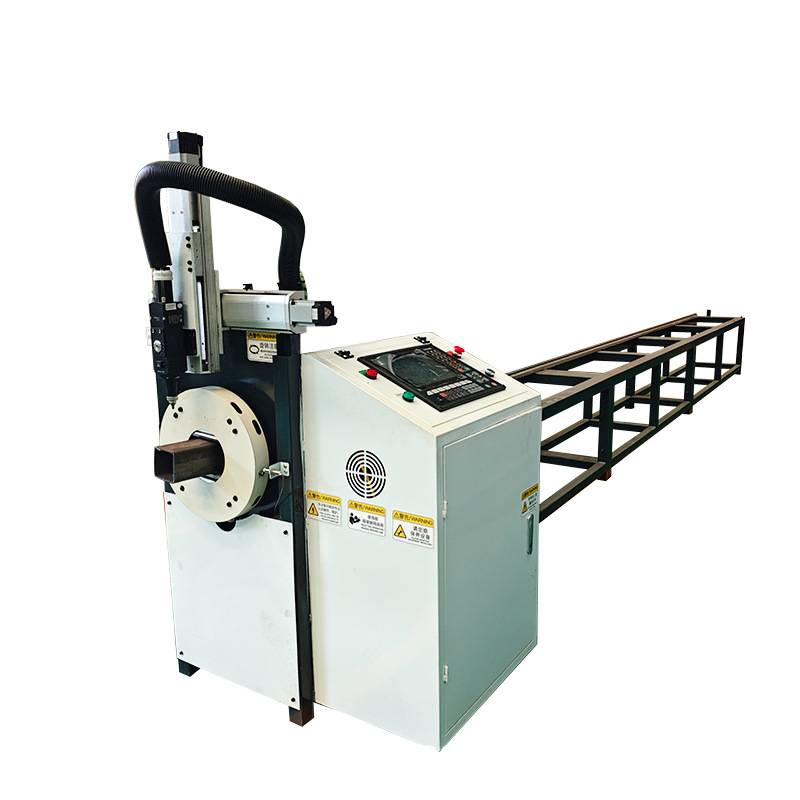
Standard flatbed lasers are designed for sheet metal, but railway infrastructure relies on long-form structural members. The CNC Beam and Channel Cutter uses a sophisticated “chuck and roller” system to feed beams that can be up to 12 meters or longer.
The machine’s CNC controller is programmed to handle the unique “shadowing” challenges of structural steel. For example, when cutting the web of an I-beam, the laser must be positioned so that it does not inadvertently damage the opposite flange. The 3D head’s ability to maneuver within the “inner” space of a C-channel or H-beam allows for the cutting of slots, notches, and complex apertures that were previously only possible with manual labor or expensive milling machines.
Furthermore, the system incorporates automated sensing and compensation. Because structural steel from the mill is rarely perfectly straight—often possessing slight bows or twists—the laser uses capacitive height sensing and touch-probe mapping to “feel” the actual shape of the beam. The CNC then adjusts the cutting path in real-time to ensure that every cut is indexed perfectly to the actual dimensions of the steel.
Applications in Railway Infrastructure: From Tracks to Rolling Stock
The versatility of the 20000W 3D laser makes it indispensable for several key areas of rail development:
* **Bridge Girders and Support Trusses:** The ability to cut massive H-beams with pre-beveled edges allows for faster assembly of bridge segments. The precision ensures that when these components reach the construction site, they fit together with millimeter accuracy, reducing on-site welding time.
* **Rolling Stock Chassis:** The frames of locomotives and railcars are subjected to immense dynamic loads. Laser-cut channels and beams provide a higher level of structural consistency than plasma-cut alternatives, leading to longer service lives for the vehicles.
* **Signaling and Electrification Gantries:** The masts that hold overhead power lines and signaling equipment require numerous mounting points. The 20kW laser can rapidly process these lightweight yet strong C-channels, including all necessary cable management holes and mounting slots in a single automated cycle.
* **Railway Stations and Terminals:** Modern transit hubs in cities like Monterrey feature complex architectural steel designs. The 3D head allows for the creation of aesthetic yet structural “tree” columns and curved beam intersections.
The Economic Impact: Why Monterrey?
For a fabricator in Monterrey, investing in a 20kW 3D laser is a strategic move driven by ROI. The labor market in Northern Mexico is skilled, but the demand for production speed is soaring. This machine replaces several standalone processes: it acts as a saw, a drill, a milling machine, and a beveling station.
By consolidating these processes into a single CNC workstation, fabricators can reduce their footprint and decrease the “work-in-progress” (WIP) time. A beam that used to take four hours to move through various stages of manual layout, sawing, and drilling can now be finished in fifteen minutes. This throughput is essential for meeting the aggressive deadlines of government-led infrastructure projects.
Moreover, the fiber laser is remarkably energy-efficient compared to older CO2 lasers or high-definition plasma systems. The “wall-plug efficiency” of a 20kW fiber source means less electricity is wasted as heat, a significant consideration for Monterrey’s industrial parks where energy management is a key operational metric.
Conclusion: The Future of Fiber Lasers in Mexican Industry
The 20kW CNC Beam and Channel Laser Cutter with an Infinite Rotation 3D Head is more than just a tool; it is a catalyst for industrial maturity. As Monterrey continues to position itself as a premier manufacturing destination, the adoption of such high-end laser technology will be the differentiator between companies that simply “cut steel” and those that engineer the future of transportation.
For the railway sector, where the margin for error is non-existent and the demands for longevity are extreme, the precision of the 3D fiber laser provides a foundation of safety. As we look toward the next decade of infrastructure development in Mexico, the hum of 20,000 watts of light cutting through steel will be the sound of progress—efficient, precise, and infinitely capable.