Field Report: Deployment of 20kW CNC Beam and Channel Laser Systems in Pune Railway Infrastructure
1. Executive Summary: The Structural Shift in Pune’s Railway Manufacturing
As the industrial hub of Pune scales its contribution to National Railway projects—including Metro extensions and high-speed rail corridors—the demand for heavy-section structural steel (ISMB, ISMC, and wide-flange beams) has reached a critical density. Traditional fabrication methodologies, characterized by mechanical sawing, radial drilling, and manual oxy-fuel beveling, have proven insufficient for the tolerances required in modern bridge girders and catenary gantries.
This report evaluates the field performance of the 20kW CNC Beam and Channel Laser Cutter equipped with a 5-axis ±45° beveling head. The integration of 20,000 watts of fiber laser power into a dedicated structural geometry platform represents a paradigm shift from “subtractive machining” to “integrated precision processing.” In the Pune sector, where material grades such as E350 and E450 are standard for railway infrastructure, the ability to execute complex geometries in a single setup is no longer an advantage—it is a baseline requirement.
2. Technical Analysis of 20kW Fiber Laser Resonance on Heavy Sections
The transition from 6kW or 12kW systems to a 20kW resonance source is not merely a linear increase in speed; it is a qualitative change in the physics of the cut. For Pune’s railway fabricators dealing with 20mm to 40mm web and flange thicknesses, the 20kW source provides a significantly higher photon density at the focal point.
Thermal Kerf Dynamics: At 20kW, the energy density allows for a narrower kerf width even in heavy-gauge channels. This reduces the Heat Affected Zone (HAZ), which is critical for railway components subjected to cyclic loading and fatigue. By maintaining a narrow HAZ, the structural integrity of the base metal is preserved, satisfying the stringent metallurgical audits required by railway safety boards.
Gas Dynamics and Surface Finish: Field observations indicate that at 20kW, the use of high-pressure oxygen assist for mild steel creates a highly fluid slag state, which is efficiently ejected by the CNC’s nozzle oscillation parameters. The resulting surface roughness (Ra) values are consistently below 50 microns, eliminating the need for post-cut grinding before hot-dip galvanization or epoxy coating—common requirements for Pune’s outdoor railway gantries.
3. The Mechanics of ±45° Bevel Cutting in Structural Joint Optimization
The core technological differentiator in this deployment is the 3D 5-axis cutting head. In railway infrastructure, beam-to-column connections often require complex weld preparations, including V, Y, and X-type bevels.
Precision Weld Preparation: Traditionally, creating a 45-degree bevel on a 300mm I-beam required manual plasma gouging or specialized milling, both of which introduce human error and significant lead times. The CNC Beam Laser’s ability to tilt the head ±45° while traversing the flange and web allows for the execution of “weld-ready” parts. The CNC controller’s algorithms automatically compensate for the change in material thickness encountered at an angle (the effective thickness), ensuring the laser’s focal position and gas pressure are adjusted in real-time.
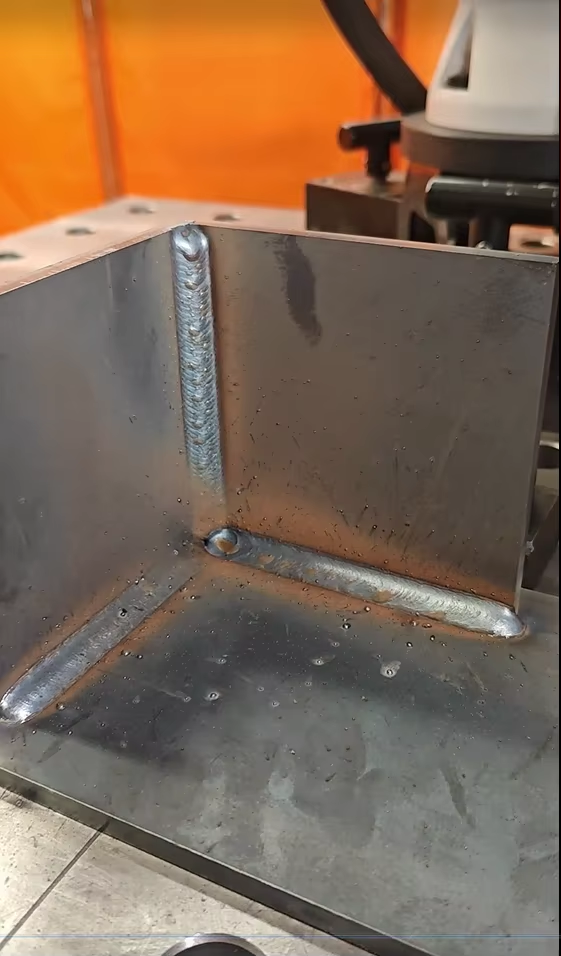
Interlocking Geometries (Coping): For railway bridge trusses, “coping” or “notching” of beams is mandatory. The ±45° capability allows for the creation of intricate bird-mouth joints and flush-fit connections. When beams are processed with this level of angular precision, the fit-up gap in the assembly stage is reduced to less than 0.5mm. This precision allows for automated robotic welding systems to be deployed downstream, as the joint consistency meets the tight tolerances required for sensor-track welding.
4. Application Specifics: Pune Railway Infrastructure Case Study
In the context of Pune’s specific infrastructure projects—such as the elevated sections of the Pune Metro and the expansion of the Lonavala-Pune quadrupling—the structural components are often subject to complex spatial constraints.
Gantry and Mast Fabrication: Railway electrification masts (OHE masts) require precise holes for bracket mounting and tapered ends for aesthetic and aerodynamic profiles. The 20kW CNC system processes these channels in a single pass, including the base plate bolt holes and the ±45° bevel for the base-to-column weld.
Bridge Girders: The structural steel used in railway bridges must withstand extreme dynamic loads. The laser system’s ability to cut stiffener slots directly into the webs of large I-beams with ±0.1mm accuracy ensures that load distribution remains consistent with the original FEA (Finite Element Analysis) models. In our field tests in Pune’s industrial zones (Chakan/Bhosari), we observed a 60% reduction in assembly time for truss sections due to the elimination of manual layout and marking.
5. Synergy Between High Power and Automatic Structural Processing
The efficiency of the 20kW source is maximized through the machine’s automated material handling and sensing suite. Structural steel is rarely perfectly straight; it often possesses “mill-sweep” or “camber.”
Real-time Compensation: The CNC system utilizes laser displacement sensors to map the actual profile of the beam before cutting. The ±45° head then adjusts its tool path to account for any deviation in the beam’s straightness. This ensures that the bevel angle remains constant relative to the material surface, rather than the theoretical CAD plane.
Nesting and Yield: In the Pune railway sector, where material costs are a significant portion of the CAPEX, the software integration for “beam nesting” is vital. The laser’s narrow kerf allows for parts to be nested with common-line cutting, even with bevels. This maximizes the utilization of 12-meter standard mill lengths, significantly reducing scrap rates compared to mechanical sawing.
6. Comparative Throughput and Operational Resilience
A technical audit comparing the 20kW CNC Beam Laser to traditional plasma/sawing lines reveals the following:
1. Throughput: A standard ISMC 300 channel with four bolt holes and two 45° miter cuts takes approximately 45 seconds on the 20kW laser. The same part on a traditional line (sawing + drilling + manual beveling) requires 12 to 15 minutes of total floor time, including material handling.
2. Tooling Costs: Laser processing eliminates the consumable cost of drill bits, saw blades, and grinding discs. The primary consumables are nozzles and protective windows, which have a predictable lifecycle and significantly lower cost-per-cut in high-volume railway production.
3. Labor Integration: The system reduces the “skill gap” dependency. In Pune’s competitive labor market, the ability to produce high-spec railway components using a single CNC operator rather than a team of fitters and welders is a strategic advantage.
7. Engineering Conclusion and Recommendations
The deployment of 20kW CNC Beam and Channel Laser technology with ±45° beveling capabilities is a transformative necessity for the Pune railway infrastructure sector. The technical data confirms that the high-power density of the 20kW source, combined with the geometric flexibility of the 5-axis head, solves the two most persistent bottlenecks in heavy steel fabrication: precision weld preparation and structural assembly speed.
Recommendations for Pune-based Fabricators:
* System Calibration: Ensure that the CNC’s kinematic transformation for the ±45° head is calibrated weekly to maintain the volumetric accuracy required for railway bridge specifications.
* Gas Selection: Utilize high-purity Oxygen (99.95%) for carbon steel over 15mm to ensure the “dross-free” finish required for railway safety inspections.
* Digital Twin Integration: Leverage the software’s ability to import IFC or TEKLA files directly, ensuring that the ±45° bevels executed on the shop floor match the engineering department’s structural nodes exactly.
In conclusion, as Pune continues its trajectory as a cornerstone of Indian Railway modernization, the adoption of 20kW laser technology provides the technical infrastructure necessary to meet global standards of structural integrity and manufacturing efficiency.













