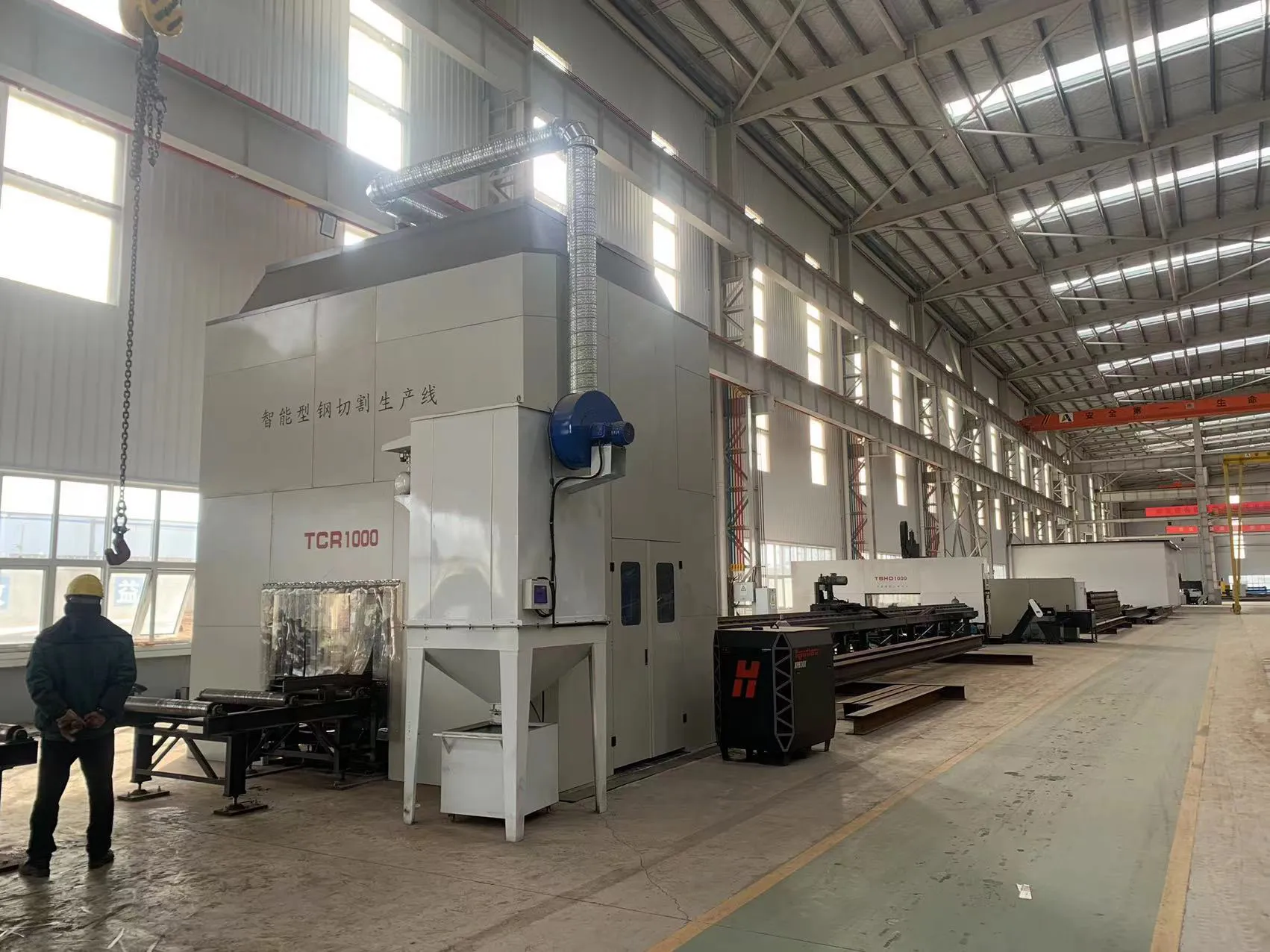
1. Introduction: The Strategic Transition to High-Power 3D Laser Processing
The structural steel industry in Riyadh is currently undergoing a paradigm shift, driven by the aggressive timelines of Saudi Vision 2030 mega-projects and the increasing reliance on modular construction. Traditional fabrication methods—comprising mechanical sawing, CNC drilling, and manual plasma beveling—are no longer sufficient to meet the volumetric demands or the geometric tolerances required for rapid off-site assembly.
The introduction of the 20kW 3D Structural Steel Processing Center represents a critical technological leap. Unlike flatbed fiber lasers or limited-axis tube cutters, this system integrates a high-density 20kW photon source with an Infinite Rotation 3D Head. This field report analyzes the technical performance of this system within the specific context of Riyadh’s modular construction sector, focusing on the mechanical synergy of its components and the resulting impact on structural integrity and throughput.
2. 20kW Fiber Laser Source: Thermal Dynamics and Kinetic Synergy
The 20kW fiber laser source is the primary engine of the processing center. In structural applications, particularly for H-beams, I-beams, and heavy-walled RHS (Rectangular Hollow Sections) exceeding 20mm in thickness, the power density of a 20kW source is transformative.
2.1 Piercing Efficiency and HAZ Reduction
In the modular construction of high-rise frames, thick-gauge steel (S355JR or higher) is standard. A 20kW source allows for “Flash Piercing” techniques that minimize the Heat Affected Zone (HAZ). By concentrating energy into a tighter spot size with higher peak power, the transition from solid to liquid/vapor state is nearly instantaneous. This reduces the thermal energy conducted into the surrounding material, preventing the metallurgical distortion that often plagues thinner-walled sections during prolonged piercing cycles.
2.2 Feed Rates and Gas Dynamics
At 20kW, the cutting speed for 25mm carbon steel is significantly higher than that of the previous 12kW standard. This speed is not merely a metric of productivity but a factor in edge quality. Faster feed rates reduce the dwell time of the oxygen or nitrogen assist gas, leading to a narrower kerf width and a reduction in dross adhesion. For modular components intended for bolt-up assembly, these clean edges eliminate the need for secondary grinding, directly accelerating the production pipeline.
3. The Infinite Rotation 3D Head: Overcoming Geometric Constraints
The defining feature of this processing center is the Infinite Rotation 3D Head. Traditional 3D laser heads are often restricted by internal cabling, requiring a “rewind” motion after a certain degree of rotation (typically ±360°). In structural steel processing, where complex bevels and wraparound cuts on H-beams are required, these pauses introduce significant mechanical latency and potential inaccuracies at the restart points.
3.1 Mechanical Architecture of the Infinite Head
The Infinite Rotation Head utilizes high-torque direct-drive motors and a sophisticated slip-ring/optical fiber management system that allows for continuous C-axis rotation. This is complemented by an A-axis tilt capability of up to ±45 degrees.
In the context of Riyadh’s modular projects—where complex node joints are fabricated to allow for the stacking of volumetric units—the ability to perform continuous, multi-axis beveling is essential. The head can execute V, Y, X, and K-type bevel preparations in a single pass. This ensures that the weld preparation is geometrically perfect, which is a prerequisite for the automated robotic welding systems often utilized in Riyadh’s modern fabrication facilities.
3.2 Precision in Torsional and Longitudinal Compensation
Structural steel, by its nature of manufacture (hot-rolling), often possesses inherent deviations in straightness and “twist.” The 3D head is integrated with high-speed capacitive sensors and laser line scanners. As the beam or channel moves through the processing zone, the system performs real-time mapping of the material’s actual geometry. The Infinite Rotation Head adjusts its focal point and nozzle standoff distance dynamically, compensating for material deviations in microseconds. This maintains a tolerance of ±0.05mm, even on 12-meter structural members.
4. Application in Riyadh’s Modular Construction Sector
Modular construction involves the off-site fabrication of standardized components that are transported and assembled on-site. In Riyadh, the environmental conditions—high ambient temperatures and sand ingress—require that factory-controlled tolerances be exceptionally tight to account for thermal expansion and contraction during site installation.
4.1 High-Tolerance Interlocking Joints
The 20kW 3D system allows for the creation of “jig-less” assembly joints. By laser-cutting interlocking “tab-and-slot” geometries into heavy H-beams and columns, modular units can be self-indexed. This eliminates the need for expensive manual layout and temporary tacking fixtures. The precision of the 20kW beam ensures that the slots are tight enough to maintain structural alignment but allow for the rapid insertion of the mating member.
4.2 Processing Heavy Structural Sections (H, I, and U Profiles)
Riyadh’s mega-structures rely on massive load-bearing columns. Traditional processing of these members involves separate stations for sawing, hole-drilling, and cope-cutting. The 3D Structural Processing Center consolidates these into a single “raw-in, finished-out” workflow. For instance, an H-beam can have its web perforated for MEP (Mechanical, Electrical, Plumbing) pass-throughs, its flanges beveled for full-penetration welding, and its ends mitered for corner joints—all in a single automated cycle.
5. Technical Synergy: Software Integration and Nesting
The hardware is only as effective as the CAD/CAM interface driving it. Senior engineers in the Riyadh sector are increasingly utilizing Tekla or Revit for structural modeling. The 3D processing center utilizes advanced nesting software that directly imports these IFC or DSTV files.
5.1 Material Optimization
The software calculates the optimal nesting of various parts within a standard 12-meter beam length to minimize “drop” or scrap. Given the high cost of structural steel in the GCC region, increasing material utilization by even 5-8% through intelligent nesting provides a significant ROI.
5.2 Toolpath Optimization for 3D Beveling
The software must calculate the “true toolpath” for the 3D head, accounting for the 20kW beam’s kerf at different angles. When cutting a 45-degree bevel, the laser must penetrate significantly more material than a 90-degree cut. The system automatically modulates the power output and gas pressure based on the instantaneous vector and angle of the head, ensuring a uniform cut surface across the entire profile.
6. Reliability and Maintenance in Arid Environments
Operating high-power lasers in Riyadh presents challenges related to heat and airborne particulates. The 3D Structural Processing Center is engineered with a positive-pressure, climate-controlled enclosure for both the laser source and the optical path.
6.1 Cooling Systems
A 20kW source generates substantial waste heat. The system employs a high-capacity dual-circuit chiller. One circuit maintains the laser source at a constant temperature, while the second circuit cools the 3D head optics and the cutting nozzle. This prevents focal shift—a phenomenon where the focus point of the laser drifts due to thermal expansion of the lenses—ensuring consistent cutting quality over long production shifts.
6.2 Filtration and Dust Extraction
The volume of particulate matter generated by a 20kW laser cutting thick steel is immense. The system integrates a high-volume pulse-jet dust collector. Specifically designed for Riyadh’s environment, the filtration system prevents external sand from entering the precision gear racks and linear guides, which would otherwise lead to premature wear and loss of accuracy.
7. Conclusion: The Economic and Engineering Impact
The deployment of 20kW 3D Structural Steel Processing Centers with Infinite Rotation technology is a decisive factor in the success of Riyadh’s modular construction initiatives. By eliminating the bottlenecks of traditional fabrication—namely the manual labor associated with weld preparation and the inaccuracies of mechanical cutting—this technology enables a “just-in-time” delivery model for structural steel.
The technical synergy between high photon density (20kW) and unrestricted mechanical movement (Infinite Rotation) provides an engineering solution that is both highly precise and exceptionally fast. As Riyadh continues to expand, the ability to produce high-integrity, complex structural nodes with sub-millimeter precision will be the benchmark of a competitive fabrication enterprise. This field report confirms that the integration of these systems reduces total processing time by an estimated 60-70% compared to conventional methods, while simultaneously increasing the structural reliability of the modular assemblies.













