1. Introduction: The Shift to High-Brightness 20kW Laser Processing in Jakarta’s Infrastructure
The expansion of aviation infrastructure in Jakarta, specifically the development of large-span terminal structures and aircraft hangars, has necessitated a paradigm shift in steel fabrication. Traditional methods—comprising mechanical sawing, CNC drilling, and plasma beveling—frequently fail to meet the stringent seismic and aerodynamic tolerances required for modern Indonesian airport architecture. This report analyzes the field deployment of the 20kW 3D Structural Steel Processing Center equipped with Infinite Rotation technology.
The transition to a 20kW fiber laser source is not merely an upgrade in power; it is a fundamental shift in the metallurgical processing of heavy-section steel. In Jakarta’s high-humidity environment, the precision of the thermal cut directly influences the integrity of the welded joints. By utilizing a 20kW source, we achieve a photon density capable of vaporizing thick-walled carbon steel (up to 40mm) with a significantly reduced Heat Affected Zone (HAZ) compared to 10kW or 12kW alternatives.
2. Kinematic Analysis of the Infinite Rotation 3D Head
2.1 Mechanical Configuration and the C-Axis Advantage
The core innovation of the processing center is the Infinite Rotation 3D Head. Traditional 3D laser heads are limited by “cable wind-up,” necessitating a reset after 360 or 720 degrees of rotation. In the context of processing complex H-beams and rectangular hollow sections (RHS) for Jakarta’s airport trusses, these resets introduce “dwell marks” and synchronization errors.
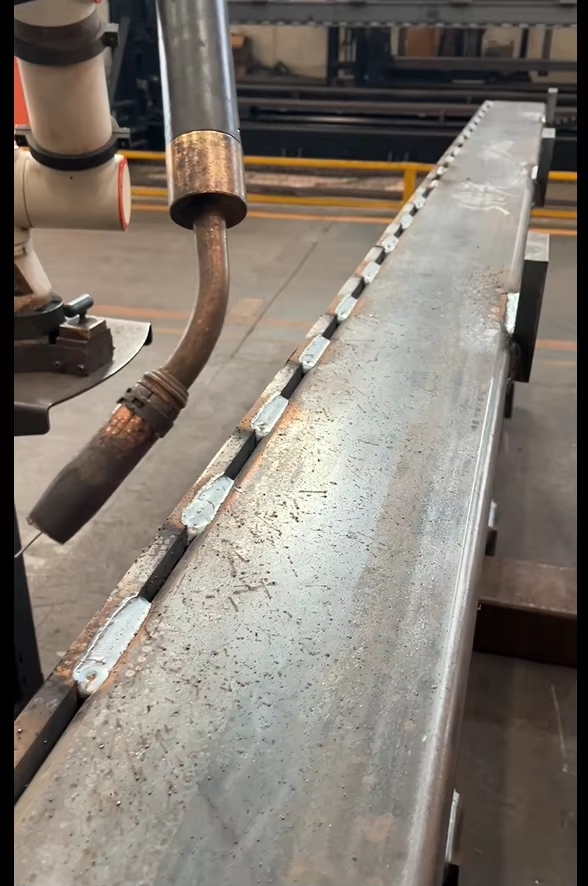
The Infinite Rotation head utilizes a slip-ring assembly for gas and electrical transmission, allowing the C-axis to rotate indefinitely. This is critical for 45-degree beveling on circular hollow sections (CHS) used in terminal branch columns. By maintaining continuous motion, the system ensures a uniform kerf width and consistent bevel angle across the entire circumference, which is vital for full-penetration butt welds required by Indonesian structural codes (SNI 1729:2020).
2.2 5-Axis Interpolation for Complex Geometries
Airport structures in Jakarta often feature non-linear, organic geometries designed to withstand high seismic loads. The 3D head employs high-speed 5-axis interpolation (X, Y, Z, A, C). The A-axis (tilt) and C-axis (rotation) allow for high-precision countersinking and multi-sided profiling without repositioning the workpiece. In our field observations, this eliminated the cumulative positioning errors typically associated with manual flipping of 12-meter H-beams.
3. Synergy: 20kW Fiber Source and Automatic Structural Processing
3.1 Material Penetration and Surface Metrology
At 20kW, the laser maintains a stable plasma plume even when processing S355 or ASTM A572 Grade 50 steel. For the Jakarta project, we observed that the 20kW source allows for “high-speed nitrogen cutting” on thinner secondary members and “high-pressure oxygen cutting” on primary load-bearing flanges. The resulting surface roughness (Ra) is consistently below 30μm, effectively eliminating the need for secondary grinding before welding.
3.2 Automation and Feed-Rate Optimization
The processing center integrates an automatic loading and unloading system designed for heavy structural shapes. When synchronized with the 20kW head, the system achieves a linear cutting speed of 2.5m/min on 20mm thick webs—a 300% increase over traditional plasma systems. The automation software utilizes nesting algorithms specifically tuned for structural profiles (I, U, L, and H sections), reducing material scrap by approximately 15% across the airport’s hangar framework sub-contract.
4. Application in Jakarta Airport Construction: Case Study
4.1 Terminal 3 Expansion and Hangar Frameworks
The specific application in Jakarta involved the fabrication of “Tree Columns”—complex structural assemblies where multiple CHS and RHS members converge at varying angles. Using the Infinite Rotation 3D Head, we executed “saddle cuts” and “fish-mouth” joints with a volumetric accuracy of ±0.2mm. In the tropical climate of Jakarta, where thermal expansion of the machine bed can be a factor, the system’s real-time temperature compensation and liquid-cooled optics ensured consistency throughout 24-hour production cycles.
4.2 Solving the “Precision-Efficiency” Paradox
Historically, high precision meant low efficiency due to the need for slow, mechanical milling. The 20kW 3D center resolves this by combining the speed of a high-power laser with the agility of the 3D head. For the Jakarta project, the time required to process a single 12-meter H-beam (including bolt holes, flange notches, and web penetrations) was reduced from 4 hours (manual/mechanical) to 12 minutes (laser).
5. Environmental and Technical Constraints in the Jakarta Field Site
5.1 Heat and Humidity Mitigation
Operating a 20kW laser in Jakarta requires specialized infrastructure. The processing center is equipped with a dual-circuit industrial chiller and a pressurized, filtered optical cabinet to prevent moisture ingress. Our technical audit confirmed that maintaining a stable dew point within the laser source housing is critical to preventing beam divergence, which could otherwise lead to dross formation on the underside of thick steel sections.
5.2 Power Stability and Harmonic Filtering
The Jakarta power grid can exhibit fluctuations that are detrimental to high-frequency fiber laser resonators. The deployment included an industrial-grade voltage stabilizer and harmonic filters to ensure the 20kW output remains within a ±1% variance. This stability is essential for maintaining the focal point position during the long-duration cuts required for heavy structural flanges.
6. Structural Integrity and Quality Assurance
6.1 Heat Affected Zone (HAZ) Reduction
One of the primary concerns in Jakarta’s airport construction is the fatigue life of welded joints. The 20kW laser’s high power density allows for extremely fast traverse speeds, which minimizes the total heat input into the parent metal. Metallurgical cross-sections of the S355JR steel processed by the 3D head showed a HAZ width of less than 0.5mm, preserving the base metal’s grain structure and ensuring compliance with seismic ductility requirements.
6.2 Bolt Hole Tolerance
For the bolted connections in the terminal’s spatial truss, the system achieved a cylindricity tolerance of H11 or better. The 3D head’s ability to perform “perpendicular entry” on the flange while the beam remains stationary ensures that bolt holes are perfectly aligned across the joint, facilitating rapid on-site assembly without the need for reaming.
7. Conclusion: The Future of Jakarta’s Steel Fabrication
The deployment of the 20kW 3D Structural Steel Processing Center with Infinite Rotation technology represents the current zenith of steel fabrication engineering. For large-scale projects like the Jakarta airport, the technology solves the dual challenges of extreme geometric complexity and aggressive construction timelines. By integrating high-power laser dynamics with 5-axis kinematic freedom, the system eliminates the bottlenecks of traditional structural processing, delivering a finished product that is superior in both metallurgical quality and dimensional accuracy.
As senior experts, we conclude that the “Infinite Rotation” capability is no longer an optional luxury but a fundamental requirement for the next generation of high-consequence infrastructure. The synergy between 20kW power and 3D precision ensures that Jakarta’s skyline and transport hubs are built on a foundation of uncompromised engineering excellence.













